Proving the 2:1 Ratio of a Triangle's Medians at the Centroid Using Vectors

Click For Summary
The discussion focuses on proving the 2:1 ratio of a triangle's medians at the centroid using vectors. The user seeks clarification on whether the established proof that the sum of vectors from the centroid to the vertices equals zero (GA + GB + GC = 0) directly demonstrates this ratio. They express uncertainty about the missing elements in the proof process. A response suggests that understanding the relationship between the centroid and the midpoints can help clarify the ratio. The conversation highlights the need for a deeper exploration of vector relationships in the context of triangle geometry.
pjallen58
Messages
12
Reaction score
0
I am trying to figure out how to prove the 2:1 ratio of a triangle's medians at the centroid using vectors. Example if I had a triangle ABC with midpoints D of BC, E of AC and F of AB. I know G is where the medians intersect. I have seen many proofs and understand the process that proves the addition of the vectors from the centroid to the vertices are zero i.e. GA+GB+GC=0.
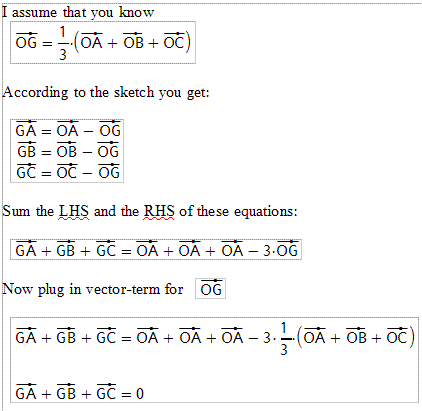
vectorsum_dreieck.GIF

Does this prove the 2:1 ratio? I cannot find anything explaining how to prove the actual 2:1 ratio. I am not sure if I am missing something or what. Any help or suggestions would be appreciated. Thanks.
 
Mathematics news on Phys.org
pjallen58 said:
I am trying to figure out how to prove the 2:1 ratio of a triangle's medians at the centroid using vectors. Example if I had a triangle ABC with midpoints D of BC, E of AC and F of AB. I know G is where the medians intersect. I have seen many proofs and understand the process that proves the addition of the vectors from the centroid to the vertices are zero i.e. GA+GB+GC=0.
View attachment 14402
Does this prove the 2:1 ratio? I cannot find anything explaining how to prove the actual 2:1 ratio. I am not sure if I am missing something or what. Any help or suggestions would be appreciated. Thanks.

Hi pjallen58! :smile:

Yes, because, for example, a + 2(d) is 1/3 of the way,

and that's a + 2(1/2(b + c)), = a + b + c! :smile:
 
Here is a little puzzle from the book 100 Geometric Games by Pierre Berloquin. The side of a small square is one meter long and the side of a larger square one and a half meters long. One vertex of the large square is at the center of the small square. The side of the large square cuts two sides of the small square into one- third parts and two-thirds parts. What is the area where the squares overlap?

Similar threads

  • · Replies 13 ·
Replies
13
Views
2K
  • · Replies 1 ·
Replies
1
Views
1K
  • · Replies 3 ·
Replies
3
Views
2K
  • · Replies 3 ·
Replies
3
Views
2K
  • · Replies 1 ·
Replies
1
Views
2K
Replies
5
Views
3K
Replies
3
Views
2K
  • · Replies 1 ·
Replies
1
Views
2K
Replies
2
Views
2K
  • · Replies 2 ·
Replies
2
Views
5K