SUMMARY
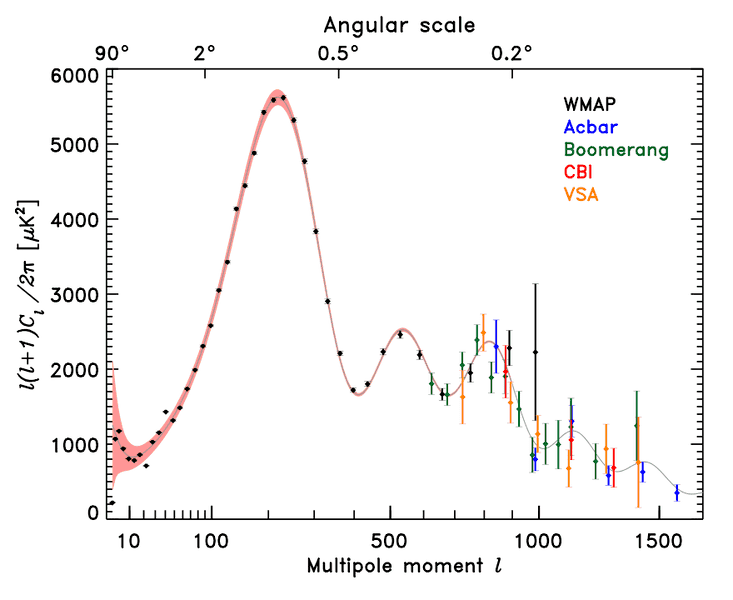
The vertical axis of the Cosmic Microwave Background (CMB) power spectrum is typically represented as ##l(l+1)C_l/2\pi## rather than simply ##C_l## to account for the non-flat nature of spherical harmonics. This representation helps in normalizing the power spectrum, making it easier to interpret the data, especially in the context of cosmic variance and instrumental noise. Key references include "Modern Cosmology" by Scott Dodelson and the article "COSMIC BACKGROUND RADIATION MINI-REVIEW" by Scott and Smoot, which provide foundational insights into this choice.
PREREQUISITES
- Understanding of CMB power spectrum analysis
- Familiarity with spherical harmonics
- Knowledge of Gaussian random fields in cosmology
- Basic grasp of cosmic variance and instrumental noise
NEXT STEPS
- Study the mathematical derivation of the CMB power spectrum using spherical harmonics
- Explore the implications of cosmic variance on CMB measurements
- Read "Modern Cosmology" by Scott Dodelson for in-depth theoretical context
- Investigate the role of instrumental noise in astrophysical data analysis
USEFUL FOR
Astronomers, cosmologists, and researchers involved in analyzing CMB data and interpreting power spectrum results.