mancity
- 26
- 2
- Homework Statement
- A soccer ball is kicked up a hill with a flat top, as shown. The ball bounces twice on the hill, at the points shown, then lands on the top and begins rolling horizontally. Which of the following shows the vertical component of its velocity as a function of time?
Attached is the picture, along with the answer choices.
- Relevant Equations
- KE+PE=ME
I understand that through process of elimination the only plausible solution is (E), but a question that rises up:
When the ball bounces, does the velocity change from negative to positive instantly (as shown by the dotted lines) or gradually (a very small time period, but still solid line)?
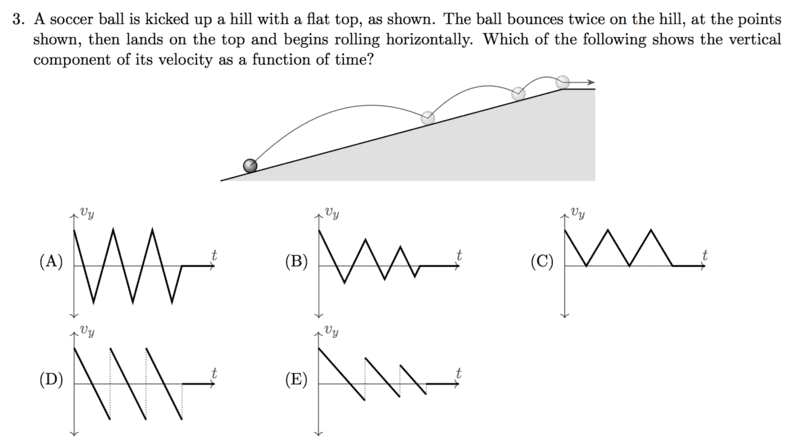
When the ball bounces, does the velocity change from negative to positive instantly (as shown by the dotted lines) or gradually (a very small time period, but still solid line)?