Vibration in "cantilever" rotating bar

Click For Summary
The discussion focuses on designing an automatic bar feeder for a CNC lathe, specifically addressing the vibration issues of a rotating steel bar. The user seeks to calculate the force needed to stabilize the free end of the bar while minimizing eccentricity without excessive pressure. Suggestions include using roller or bearing supports instead of simple v-blocks to reduce friction and noise at high RPMs. The importance of ensuring the bar is straight and the supports are aligned with the lathe chuck is emphasized. Overall, the conversation highlights the need for effective vibration management in high-speed machining applications.
sempiternum
Messages
3
Reaction score
0
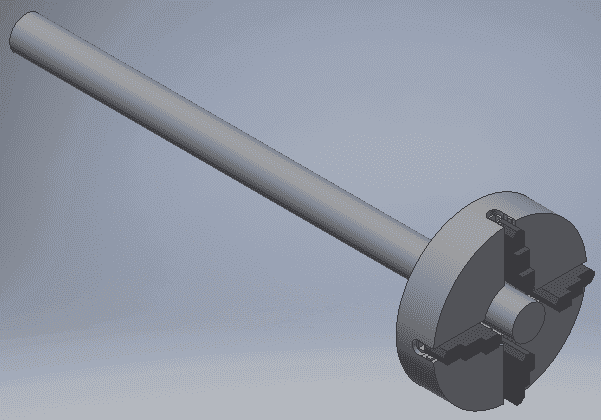
Hi. I'm working in the design of an auotomatic bar feeder for a CNC lathe. I've established that the bars will not be longer than 1.2 m and will not have a diameter of more than 75 mm. Suppose they are steel bars, which would make them have a mass of about 80 kg

So, bars are tightly held in one end by the lathe chuck, as shown in this image
YRsxAcP.png


Now, on the other end there'll be the automatic feeder. When the chuck starts to rotate to, let's say 1000 RPM, the free end will not naturally stay centered, so, I need to calculate the magnitude of the force created by the vibration on the free end as to design the components that will hold it steady.

How can I approach this calculation?

Thanks.
 
Engineering news on Phys.org
Vibration analysis is a somewhat complex topic, for a start you might take a look at some of MIT's Open Course information available on the topic: MIT OpenCourseWare - Mechanical Vibrations.

Generally speaking, I think you'll need to minimize the cantilever load to minimize the amount of vibration induced by both 1) asymmetries in the bar, and 2) tilt due to run-out in the lathe chuck and mechanical interface. How much of the bar is being processed, and how straight will they typically be?
 
Mech_Engineer said:
Vibration analysis is a somewhat complex topic, for a start you might take a look at some of MIT's Open Course information available on the topic: MIT OpenCourseWare - Mechanical Vibrations.

Generally speaking, I think you'll need to minimize the cantilever load to minimize the amount of vibration induced by both 1) asymmetries in the bar, and 2) tilt due to run-out in the lathe chuck and mechanical interface. How much of the bar is being processed, and how straight will they typically be?

Yes, actually, the bar won't be in cantilever, it would be held in place through all of its length (Outside of the lathe) with 3 or four devices like shown in this picture

IzgoqsG.png


What I want to calculate is a magnitude of force "F", which should be big enough so that there's minimum eccentrity, without applying excesive pressure.

I presented it as a cantilever because I thought it would simplify analysis since it would be the most critical situation.
 
The supports you've outlined will need to be almost perfectly coincident with the lathe chuck to work, and will only work if the bar is very straight. Also, I'm not sure a simple v-block like you've outlined will be a good choice for support of a rod rotating at thousands of rpm, friction may be a problem (and will be loud). You will probably want rollers/bearings instead.

This is a problem that has been solved many times, do a search for "long part on a short lathe" for some ideas. Take this thread for example: http://www.practicalmachinist.com/vb/general/long-parts-short-lathe-234926/
 
Mech_Engineer said:
The supports you've outlined will need to be almost perfectly coincident with the lathe chuck to work, and will only work if the bar is very straight. Also, I'm not sure a simple v-block like you've outlined will be a good choice for support of a rod rotating at thousands of rpm, friction may be a problem (and will be loud). You will probably want rollers/bearings instead.

I've based my design on what I've seen in most bar feeders (see notes). Also, "V" channels will probably be constantly lightly lubricated, and the force from the plastic roller applied through a spring. Most machines actually use 2 "V" channels, but I'd still need some sort of notion of the force to be applied by the top "V" channel.

Notes from: http://www.productionmachining.com/...derations-for-high-speed-lights-out-machining

Guide Channel Sets
Most magazine bar feeders use some form of guide channel sets made of polyurethane that are sized to handle a specific range of material. Guide channel sets form the long channel inside a bar feeder that opens and closes to capture the pusher and barstock and help create a hydrostatic bearing when flooded with oil in automatic operation. A few years ago, polyurethane use emerged in items such as spindle liners, bearing blocks, rollers and guide channel sets because of its inherent lubricity, durability and ability to absorb vibration and noise.

Roller Steady Rests
Another development that occurred during the last few years and was embraced by some bar feeder manufacturers has been the use of roller steady rest systems featuring adjustable polyurethane rollers. Some bar feeders place this mechanism internal to the bar feeder; others place it between the bar feeder end plate and the lathe or provide both internal and external roller systems. The bottom line is that these devices help support the rotating bar and promote higher spindle speeds.​
 
My idea is that I want to use immerse Whitetail Antlers in a fishtank to measure their volumetric displacement (the Boone and Crockett system is the current record measurement standard to place in a juxtaposition with) I would use some sight glass plumbed into the side of the tank to get the change in height so that I can multiply by the tank cross-section. Simple Idea. But... Is there a simple mechanical way to amplify the height in the sight glass to increase measurement precision...

Similar threads

  • · Replies 7 ·
Replies
7
Views
3K
  • · Replies 1 ·
Replies
1
Views
2K
Replies
4
Views
20K
  • · Replies 4 ·
Replies
4
Views
8K
  • · Replies 2 ·
Replies
2
Views
3K
Replies
2
Views
6K
  • · Replies 4 ·
Replies
4
Views
3K