Graduate Visualizing Arbitrary Coordinate System - Example Needed

Click For Summary
The discussion centers on understanding the distinction between the accelerations of components and the overall acceleration in a plane polar coordinate system. The user seeks clarification on how the components' accelerations can differ from the total acceleration, specifically questioning the values of r-double-dot and zero. The provided equations illustrate that while the radial component has an acceleration of r-double-dot, the angular component's acceleration is influenced by both the velocity and angular acceleration. This confusion stems from a long gap in the user's study of classical mechanics. A clear example is requested to enhance understanding of these concepts.
BLevine1985
Messages
7
Reaction score
2
Hi I'm wondering if someone can illustrate with an example what I bracketed in blue? I'm having a hard time visualizing how it is that the accelerations of the components are NOT necessarily equal to the components of the acceleration...Much appreciated!
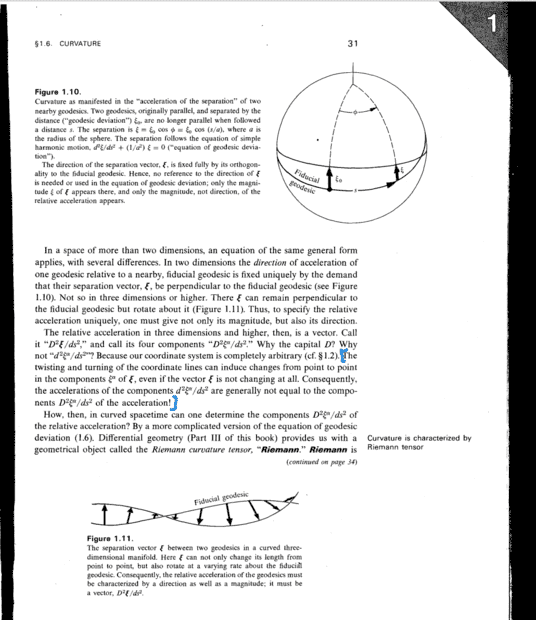
relative acceleration of geodesic in 3+ dimensions.png
 
Physics news on Phys.org
In plane polars, the position vector is r\mathbf{e}_r(\theta) = r(\cos \theta, \sin \theta). The accelerations of the components are therefore \ddot r and zero. However, the acceleration is <br /> \ddot{\mathbf{r}} = \ddot r\mathbf{e}_r + 2\dot r \dot \theta \mathbf{e}_\theta + r(-\dot \theta^2 \mathbf{e}_r + \ddot \theta \mathbf{e}_\theta) = (\ddot r - r\dot \theta^2)\mathbf{e}_r + (2\dot r \dot \theta + r\ddot \theta)\mathbf{e}_\theta.
 
How did you get the acceleration of the components as r-double-dot and zero?

I understand how you got the general acceleration of r-double dot but not the first part. Sorry it's been like 10 years since I took classical mechanics...
 
MOVING CLOCKS In this section, we show that clocks moving at high speeds run slowly. We construct a clock, called a light clock, using a stick of proper lenght ##L_0##, and two mirrors. The two mirrors face each other, and a pulse of light bounces back and forth betweem them. Each time the light pulse strikes one of the mirrors, say the lower mirror, the clock is said to tick. Between successive ticks the light pulse travels a distance ##2L_0## in the proper reference of frame of the clock...

Similar threads

  • · Replies 12 ·
Replies
12
Views
2K
  • · Replies 8 ·
Replies
8
Views
2K
  • · Replies 40 ·
2
Replies
40
Views
5K
  • · Replies 26 ·
Replies
26
Views
2K
  • · Replies 5 ·
Replies
5
Views
2K
  • · Replies 5 ·
Replies
5
Views
2K
  • · Replies 17 ·
Replies
17
Views
3K
  • · Replies 51 ·
2
Replies
51
Views
5K
  • · Replies 18 ·
Replies
18
Views
2K
  • · Replies 11 ·
Replies
11
Views
2K