Volume change when cooling a saturated volume of air

Click For Summary

Discussion Overview

The discussion revolves around the volume change of a bag filled with 100% water-saturated air when cooled from 85 degrees Celsius to 50 degrees Celsius, while maintaining a constant pressure of 738 torr. Participants explore the implications of condensation on volume change and the calculations involved in determining the final volume of air in the bag.

Discussion Character

  • Technical explanation
  • Mathematical reasoning
  • Debate/contested

Main Points Raised

  • Some participants note that cooling the air will cause some water to condense into liquid, which may affect the volume calculations.
  • One participant presents calculations based on Charles' Law, suggesting that if no condensation occurs, the volume would decrease to approximately 90% of the original volume.
  • Another participant provides a detailed calculation using the ideal gas law, arriving at a final volume and volume ratio, while also noting the need to account for the mass of liquid water that condenses.
  • There is a discussion about the accuracy of the calculations, with one participant expressing skepticism about a previously stated volume solution.
  • Participants engage in correcting each other's calculations, with one pointing out a typo in the mole fraction calculations and another providing an updated calculation that slightly adjusts the final volume ratio.

Areas of Agreement / Disagreement

Participants generally agree that condensation will occur and that it affects the volume calculations, but there is no consensus on the exact volume change or the methods used to calculate it. Multiple competing views and approaches remain present in the discussion.

Contextual Notes

Some calculations rely on assumptions about the ideal gas behavior and the treatment of water vapor and liquid phases, which may not fully capture the complexities of the system. The discussion also highlights the importance of precision in calculations and the potential for errors in mathematical expressions.

Who May Find This Useful

This discussion may be useful for individuals interested in thermodynamics, fluid mechanics, or those working with systems involving humid air and condensation, such as in engineering or environmental science contexts.

Gstoettenmayr
Messages
7
Reaction score
4
TL;DR Summary: How much does a bag with 100 % water saturated air shrink in volume when it is cooled?

A bag filled with 100% water saturated air at 85 degrees C (inside and outside) at a pressure of 738 torr inside and outside is cooled to 50 degrees C (inside and outside bag) and the pressure (inside and outside of bag) remains at 738 torr. How much will the bag shrink?

Mentor note: Moved from a technical forum.
 
Last edited by a moderator:
Physics news on Phys.org
Welcome to PF.

Are you aware that some water will condense, to liquid in the bag, when the bag is cooled?
 
Thank you for your reply. Yes, I am aware of this. What shrinkage did you calculate for the question I posted?
 
Gstoettenmayr said:
Thank you for your reply. Yes, I am aware of this. What shrinkage did you calculate for the question I posted?
You first. Let's see your analysis.
 
@Gstoettenmayr
Why do you ask such a specific question?
What accuracy does the answer require?
What is your application?
 
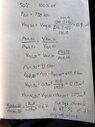
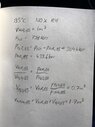
Here are my calculations, what are your thoughts?
 

Attachments

  • 02988FAA-496E-4C38-9C10-DA0E5ED7C865.jpeg
    02988FAA-496E-4C38-9C10-DA0E5ED7C865.jpeg
    45.4 KB · Views: 107
  • CCF6AFD9-5D21-4D90-8919-A72F06F08279.jpeg
    CCF6AFD9-5D21-4D90-8919-A72F06F08279.jpeg
    49.8 KB · Views: 105
Baluncore said:
@Gstoettenmayr
Why do you ask such a specific question?
What accuracy does the answer require?
What is your application?
It is just a thought experiment and ideal gas laws will suffice for the accuracy required.
 
I do not have confidence in your 61% volume solution.

A first approximation.
Charles' Law. https://en.wikipedia.org/wiki/Charles's_law
T1 = 273 K + 85°C = 358 K.
T2 = 273 K + 50°C = 323 K.
If we wrongly assume there is no condensation,
T2 / T1 = 323 / 358 = 0.90 = 90%

A second approximation.
CalcTool https://www.calctool.org/atmospheric-thermodynamics/air-density
Air Density Calculator. 738 Torr. RH = 100%.
The density of saturated air at 85°C = 0.82513 kg/m³
The density of saturated air at 50°C = 1.01042 kg/m³
The mass in the bag remains constant, so the density ratio is also the volume ratio.
0.82513 / 1.01042 = 0.817 = 81.7%
That ignores the volume of liquid condensate that remains in the bag.

A third approximation.
Requires an absolute humidity calculator to work out the mass of liquid water that will condense during the cooling process. Assume water density is 1g/cc, and use that to correct the previous 50°C density.

An accurate computation.
You must correct for the density of the liquid water at 50°C.
 
Thank you for very much for your detailed answer. Regarding the second approximation, the mass in the bag does remain constant. However, the mass in the gas phase does decrease due to the water condensing. Therefore, I would think that in this case the density ratios cannot be used to calculate the volume ratios. How far off the mark would I be with my reasoning?
(Or perhaps that is what you already pointed out by saying that this ignores the volume of condensate in the bag?)
 
  • #10
I can't really follow what you did, but here is my approach:

$$P_{w,85}=433.6\ torr$$$$P_{w,50}=92.5\ torr$$Assume an initial number of moles of gas = 1 mole.

Initial moles water vapor = 433.6/738=0.5875
Initial moles air in gas = 1 - 0.5875 = 0.4125

At 50 C, mole fraction water in vapor = 92.5/738= 0.1253
mole fraction air in gas phase = 1 - 0.1253 = 0.8747

Since none of the air condenses, the number of moles of air in the final gas is the same as in the initial gas. Therefore, final moles of gas phase = 0.4125 / 0.8747 = 0.4716
From this it follows that the number of moles of water that condenses to liquid = 1-0.4716 = 0.5284 moles = 9.5 grams. The volume of this liquid water condensate is about 9.5 cc = 0.0095 liters.

The pressure in the initial and final states is 738/760 = 0.9711 atm.

From the ideal gas law, initial volume in the bag is $$V_{85}=\frac{(1)(0.082)(273+85)}{0.9711}=31.2 \ liters$$

From the ideal gs law, the final volume in the bag is $$V_(50)=\frac{(0.4716)0.082)(273+50)}{0.9711}+0.009=12.9\ liters$$

The volume ratio is 12.9/31.2 =0.414
 
Last edited:
  • #11
Chestermiller said:
1 - 0.5975 = 0.4125
I think your calculator needs servicing.
 
  • Like
Likes   Reactions: Nik_2213
  • #12
Tom.G said:
I think your calculator needs servicing.
That 0.5975 was a typo. It should have been 0.5875. I've corrected it.
 
  • Like
Likes   Reactions: Nik_2213
  • #13
Chestermiller said:
I can't really follow what you did, but here is my approach:

$$P_{w,85}=433.6\ torr$$$$P_{w,50}=92.5\ torr$$Assume an initial number of moles of gas = 1 mole.

Initial moles water vapor = 433.6/738=0.5875
Initial moles air in gas = 1 - 0.5875 = 0.4125

At 50 C, mole fraction water in vapor = 92.5/738= 0.1253
mole fraction air in gas phase = 1 - 0.1253 = 0.8747

Since none of the air condenses, the number of moles of air in the final gas is the same as in the initial gas. Therefore, final moles of gas phase = 0.4125 / 0.8747 = 0.4716
From this it follows that the number of moles of water that condenses to liquid = 1-0.4716 = 0.5284 moles = 9.5 grams. The volume of this liquid water condensate is about 9.5 cc = 0.0095 liters.

The pressure in the initial and final states is 738/760 = 0.9711 atm.

From the ideal gas law, initial volume in the bag is $$V_{85}=\frac{(1)(0.082)(273+85)}{0.9711}=31.2 \ liters$$

From the ideal gs law, the final volume in the bag is $$V_(50)=\frac{(0.4716)0.082)(273+50)}{0.9711}+0.009=12.9\ liters$$

The volume ratio is 12.9/31.2 =0.414
Hello,

Thank you very much for your detailed calculation.

$$V_{85}=\frac{(1)(0.082)(273+85)}{0.9711}=31.2 \ liters$$ seems to contain a small error or typo
$$V_{85}=\frac{(1)(0.082)(273+85)}{0.9711}=30.2 \ liters$$ is the correct number.
So the the volume ratio is 12.9/30.2 =0.43 instead of 0.414

In the attachment, please find my updated calculations which give the same result as yours. I chose to also calculate the moist air densities (like Baluncore's approach) and compared them with the literature to check my calculations. I prefer your approach via the moles which is more elegant than my calculations.

In addition, I attached a graph that shows the partial and final volumes of 100 % RH air as temperature changes.

Thank you everyone for your help. This will allow me to calculate the mass flow changes in a dryer scrubber system at work with confidence:) !

graph.jpg

Densities_calulated.jpg

1708312519174.png

1708312547099.png
 
  • Like
Likes   Reactions: Chestermiller
  • #14
Thank you for catching my typo. My eyes are not working as well as they used to because of Parkinson's.
 
  • Like
Likes   Reactions: Nik_2213 and Tom.G
  • #15
Sorry to hear about that, either way, your explanations are most helpful! :)
 
  • Like
Likes   Reactions: Nik_2213

Similar threads

  • · Replies 29 ·
Replies
29
Views
4K
  • · Replies 2 ·
Replies
2
Views
1K
Replies
1
Views
6K
  • · Replies 3 ·
Replies
3
Views
3K
  • · Replies 16 ·
Replies
16
Views
32K
  • · Replies 3 ·
Replies
3
Views
2K
Replies
1
Views
2K
  • · Replies 3 ·
Replies
3
Views
11K
  • · Replies 2 ·
Replies
2
Views
2K
Replies
1
Views
4K