Volume of a Cube: Definition & Explanation

Click For Summary

Discussion Overview

The discussion revolves around the concept of volume, particularly in relation to a cube. Participants explore various definitions and interpretations of volume, including mathematical formulations and intuitive visualizations. The scope includes conceptual understanding and mathematical reasoning.

Discussion Character

  • Conceptual clarification
  • Exploratory
  • Mathematical reasoning

Main Points Raised

  • One participant describes volume as the product of length, width, and height, and questions whether their visualization of stacking layers to form a cube is incorrect.
  • Another participant asserts that volume is the amount of space enclosed by a closed surface and suggests a mathematical definition using triple integrals.
  • A later reply affirms that the stacking visualization is a good way to understand the integration process, noting that it can be applied to various shapes beyond cubes.
  • One participant expresses concern that their interpretation of stacking layers may not apply to more complex 3D shapes.
  • Another participant suggests that volume can be conceptualized in multiple ways, including dividing a solid into tiny cubes and summing them up.
  • One participant provides a dimensional perspective, stating that length, area, and volume correspond to one-dimensional, two-dimensional, and three-dimensional spaces, respectively.
  • Another introduces a dynamic interpretation of volume, describing it as the result of moving a surface along a direction, referencing a Newtonian viewpoint.

Areas of Agreement / Disagreement

Participants express various interpretations and visualizations of volume, with no clear consensus on a singular definition. Some agree that stacking layers is a valid approach, while others introduce different perspectives without resolving the differences.

Contextual Notes

Participants highlight the flexibility in understanding volume, but there are unresolved questions about the applicability of certain interpretations to complex shapes. The discussion reflects a range of assumptions and definitions that may not be universally accepted.

McFluffy
Messages
37
Reaction score
1
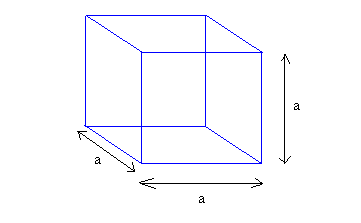
Suppose if we have a cube:
xcubevolume.gif.pagespeed.ic.MJ_UzbP459.png

The volume of the cube is the product of the length, width and the height. All this time, I've been looking at it as: To get the volume, multiply the area of the cross section of the cube by how many "layers" it has. To elaborate with the diagram given, one can see that the above image is a cube. But how I see it is that, if you have a square of length ##a## and stack ##a## amount of "layers" above/beside/behind/whatever direction such that it is perpendicular the square, you'll form a cube. My question is that, is this a wrong way to look at volumes in general? If it is, why is it wrong and what is the correct definition? I searched the internet but I can't find any satisfying answer. I see definitions that state that volume is defined as how much space can a closed surface contain but that's just a bit vague for me.
 
Mathematics news on Phys.org
McFluffy said:
Then is the way I looked at volume the wrong way?
No, it is basically a good visualization of the integration process. You can see the volume arising from summing a stack of surfaces. (you have to make each surface infinitely thin and sum and infinite number of them).

And you don't necessarily need to stack identical squares: you could start from one corner of the cube and add progressively bigger surfaces then progressively smaller surfaces as you move to the opposite corner.
 
  • Like
Likes   Reactions: McFluffy
Thank you for the answer. I was having doubts about how I defined volume and feared that this interpretation of stacking layers upon layers of the surfaces would break down once you start introducing 3d shapes that doesn't work well with it.
 
You can think of volume all those ways. You can stack them upward, sideways, forward, backward, in a circle, any way you want. You can divide a weird-shaped solid into tiny cubes, stack up each tiny cube, then add them up. All those ways should give you the same answer. Just make sure that you are dividing the entire shape into disjoint parts that are added up.
 
  • Like
Likes   Reactions: McFluffy
You might imagine this in this way:
Length is the total space occupied one dimensionally.
Area is the total space occupied two dimensionally.
Volume is the total space occupied three dimensionally.

Is this comprehensible? If not, feel free to ask further questions.
 
Hi, there are a lot of definitions and intuitive way to think it, for example you can think the volume in a "dynamic'' way as the result of a movement of a surface (2D dimensional) along a direction (1D dimensional). This is the Newton point of view, moving a point you have a line, moving a line a surface, and so on ...
Ssnow
 
  • Like
Likes   Reactions: Leo Authersh and McFluffy

Similar threads

  • · Replies 5 ·
Replies
5
Views
2K
  • · Replies 35 ·
2
Replies
35
Views
5K
  • · Replies 45 ·
2
Replies
45
Views
5K
Replies
2
Views
2K
  • · Replies 3 ·
Replies
3
Views
2K
  • · Replies 2 ·
Replies
2
Views
1K
  • · Replies 1 ·
Replies
1
Views
2K
  • · Replies 9 ·
Replies
9
Views
1K
  • · Replies 9 ·
Replies
9
Views
7K
Replies
1
Views
2K