Volume of a tetrahedron regular

Click For Summary
SUMMARY

The discussion focuses on deriving the volume and surface area of a tetrahedron, specifically how to express these metrics in terms of different sets of edges and areas. The volume V of a tetrahedron defined by edges x, y, and z is given by V(x,y,z) = (1/6)xyz. The surface area S can be expressed as S(A,B,C) = √(A² + B² + C²) and S(u,v,w) = √((+u+v+w)(-u+v+w)(+u-v+w)(+u+v-w)). The user successfully derived V in terms of edges u, v, and w as V(u,v,w) = √(1/288 (+u²+v²-w²)(+u²-v²+w²)(-u²+v²+w²)) and V(A,B,C) = √(2/9 ABC).

PREREQUISITES
  • Understanding of tetrahedron geometry
  • Familiarity with Heron's formula for area calculation
  • Knowledge of algebraic manipulation of geometric formulas
  • Basic calculus concepts related to volume and surface area
NEXT STEPS
  • Study the derivation of Heron-type formulas for tetrahedron volume
  • Explore the relationship between edge lengths and surface areas in tetrahedrons
  • Research advanced geometric properties of irregular tetrahedrons
  • Learn about computational geometry techniques for volume calculations
USEFUL FOR

Mathematicians, geometry enthusiasts, students studying advanced geometry, and professionals involved in computational geometry or architectural design.

Bruno Tolentino
Messages
96
Reaction score
0
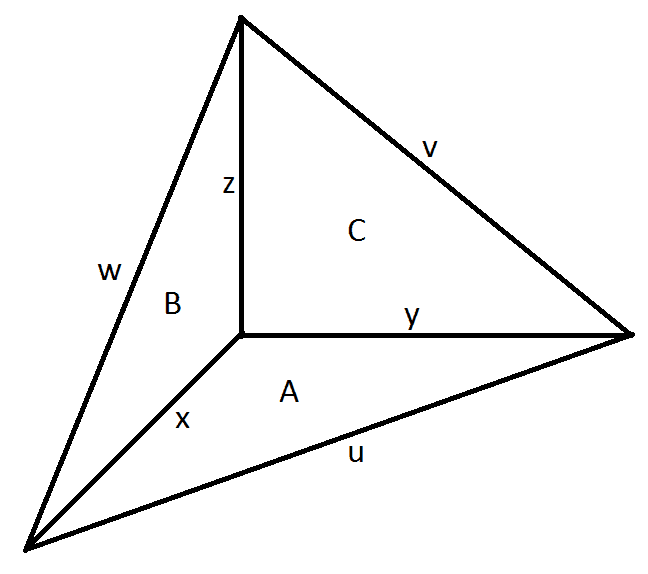
See the image that I uploaded...

2222.png


I want to write the surface S (bounded by edges u, v and w) in terms of x, y and z, u, v and w and A, B and C. And I got it!

See:
S(A,B,C) = \sqrt{A^2+B^2+C^2}
S(x,y,z) = \sqrt{\frac{1}{4}( (yz)^2 + (zx)^2 + (xy)^2 )}
S(u,v,w) = \sqrt{(+u+v+w)(-u+v+w)(+u-v+w)(+u+v-w)}

And the Volume V:
V(x,y,z) = \frac{1}{6} xyz
But, I don't know how to write V in terms of A, B, C neither u, v, w. Can you help me with this, please?
 
Mathematics news on Phys.org
Bruno Tolentino said:
See the image that I uploaded...

View attachment 84788

I want to write the surface S (bounded by edges u, v and w) in terms of x, y and z, u, v and w and A, B and C. And I got it!

See:
S(A,B,C) = \sqrt{A^2+B^2+C^2}
S(x,y,z) = \sqrt{\frac{1}{4}( (yz)^2 + (zx)^2 + (xy)^2 )}
S(u,v,w) = \sqrt{(+u+v+w)(-u+v+w)(+u-v+w)(+u+v-w)}

And the Volume V:
V(x,y,z) = \frac{1}{6} xyz
But, I don't know how to write V in terms of A, B, C neither u, v, w. Can you help me with this, please?
There are some complicated Heron-type formulas for computing the volume of a tetrahedron which are similar to those for computing the area of a triangle. However, these formulas are much more complex.

The paper at the following link shows the derivation of these formulas ad gives references for further study:

http://www.cs.berkeley.edu/~wkahan/VtetLang.pdf

Tetrahedrons are discussed starting at p. 11, but the previous material provides a good refresher.
 
I thank you for this answer. Actually, this no answer my question, but I'll intend to ask this in another thread. I'll intend to ask this and more one thing, that's the following:

Given a tetrahedron irregular (any tetrahedron), how to write the volume V in terms of the areas A, B, C and S?

OBS: my first question in this thread still no be answered.
 
Bruno Tolentino said:
I thank you for this answer. Actually, this no answer my question, but I'll intend to ask this in another thread. I'll intend to ask this and more one thing, that's the following:

Given a tetrahedron irregular (any tetrahedron), how to write the volume V in terms of the areas A, B, C and S?

OBS: my first question in this thread still no be answered.

If the edges x, y, and z are mutually perpendicular, you can write expressions for the areas A, B, and C using those lengths.
 
SteamKing said:
If the edges x, y, and z are mutually perpendicular, you can write expressions for the areas A, B, and C using those lengths.

I don't understand you explanation...

I discovered how to write V in terms of u, v and w:

V(u,v,w) = \sqrt{\frac{1}{288} (+u^2+v^2-w^2) (+u^2-v^2+w^2) (-u^2+v^2+w^2) }
 
I discovered too: V(A,B,C) = \sqrt{\frac{2}{9} A B C}
 

Similar threads

  • · Replies 1 ·
Replies
1
Views
1K
  • · Replies 0 ·
Replies
0
Views
505
  • · Replies 7 ·
Replies
7
Views
2K
  • · Replies 3 ·
Replies
3
Views
2K
  • · Replies 2 ·
Replies
2
Views
2K
Replies
4
Views
1K
  • · Replies 3 ·
Replies
3
Views
3K
  • · Replies 32 ·
2
Replies
32
Views
2K
Replies
1
Views
4K
  • · Replies 7 ·
Replies
7
Views
2K