Wave-function solution in time-reversal transformation

  • Thread starter Thread starter Happiness
  • Start date Start date
  • Tags Tags
    Transformation
Click For Summary
The discussion centers on the derivation of a wave-function solution in the context of time-reversal transformation, specifically addressing the commutation of the operator Uτ with the time derivative and Hamiltonian. It is assumed that Uτ is time-independent due to the time-independence of the Hamiltonian, which leads to the conclusion that Uτ commutes with the time derivative operator. However, this assumption raises concerns about contradictions arising from the relationship between Uτ and the Hamiltonian, particularly regarding the nature of H being non-real. The validity of the assumption is questioned, with a request for proof that UΨ remains a solution to Schrödinger's equation if Ψ is. The discussion highlights the complexities and potential pitfalls in the assumptions made during the derivation process.
Happiness
Messages
686
Reaction score
30
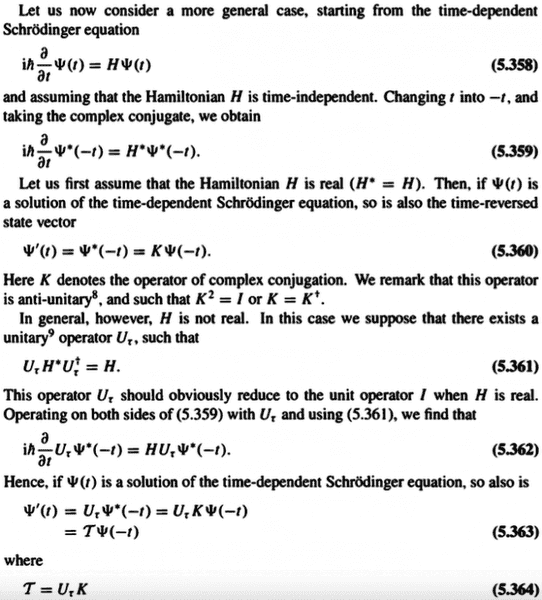
In obtaining (5.362) from (5.359), we first get

##U_{\tau}i\hbar\frac{\partial}{\partial t}\Psi(t) = U_{\tau}H^*\Psi^*(-t)##

In order to obtain the LHS of (5.362), ##U_{\tau}## must commute with ##\frac{\partial}{\partial t}##. But how do we know that they commute?
Screen Shot 2016-01-04 at 6.26.09 am.png
 
Physics news on Phys.org
The Hamiltonian is assumed to be time-independent, so its reasonable to expect U to be time-independent too. So we just assume it and continue. If it was a bad assumption, it would give us non-sense. Then we could go back and relax this assumption. But if it works(as it did here), good for us!
 
Shyan said:
The Hamiltonian is assumed to be time-independent, so its reasonable to expect U to be time-independent too. So we just assume it and continue. If it was a bad assumption, it would give us non-sense. Then we could go back and relax this assumption. But if it works(as it did here), good for us!

But it appears I could get non-sense out of this assumption:

Since ##U_{\tau}## commutes with ##i\hbar\frac{\partial}{\partial t}##, it also commutes with ##H## by the time-dependent Schrondinger equation. From (5.361), ##H^*=U_{\tau}^{\dagger}HU_{\tau}##. Since ##U_{\tau}## commutes with ##H##, ##H^*=U_{\tau}^{\dagger}U_{\tau}H=H##, which contradicts the assumption that ##H## is not real.
 
Happiness said:
Since UτU_{\tau} commutes with iℏ∂∂tiℏ∂∂ti\hbar\frac{\partial}{\partial t}, it also commutes with HHH by the time-dependent Schrondinger equation.
I don't see how that follows!
 
Shyan said:
I don't see how that follows!

##UH\Psi=Ui\hbar\frac{\partial}{\partial t}\Psi=i\hbar\frac{\partial}{\partial t}U\Psi=HU\Psi##

Since this is true for any ##\Psi##, ##UH=HU##.
 
Happiness said:
##UH\Psi=Ui\hbar\frac{\partial}{\partial t}\Psi=i\hbar\frac{\partial}{\partial t}U\Psi=HU\Psi##

Since this is true for any ##\Psi##, ##UH=HU##.

Here you're assuming that ## U\Psi ## is a solution to Schrodinger's equation only because ## \Psi ## is! Can you prove this?
 
  • Like
Likes Happiness
Time reversal invariant Hamiltonians must satisfy ##[H,\Theta]=0## where ##\Theta## is time reversal operator. However, in some texts (for example see Many-body Quantum Theory in Condensed Matter Physics an introduction, HENRIK BRUUS and KARSTEN FLENSBERG, Corrected version: 14 January 2016, section 7.1.4) the time reversal invariant condition is introduced as ##H=H^*##. How these two conditions are identical?

Similar threads

  • · Replies 8 ·
Replies
8
Views
1K
  • · Replies 15 ·
Replies
15
Views
2K
  • · Replies 5 ·
Replies
5
Views
2K
  • · Replies 12 ·
Replies
12
Views
823
  • · Replies 9 ·
Replies
9
Views
3K
  • · Replies 17 ·
Replies
17
Views
3K
  • · Replies 3 ·
Replies
3
Views
2K
  • · Replies 1 ·
Replies
1
Views
1K
  • · Replies 14 ·
Replies
14
Views
3K
  • · Replies 29 ·
Replies
29
Views
5K