Wave-function solution in time-reversal transformation

  • Context: Graduate 
  • Thread starter Thread starter Happiness
  • Start date Start date
  • Tags Tags
    Transformation
Click For Summary

Discussion Overview

The discussion revolves around the time-reversal transformation in quantum mechanics, specifically focusing on the wave-function solution and the implications of commuting operators in the context of the time-dependent Schrödinger equation. Participants explore the assumptions regarding the time-independence of the Hamiltonian and the operator involved in the transformation.

Discussion Character

  • Technical explanation
  • Debate/contested
  • Mathematical reasoning

Main Points Raised

  • One participant questions how to establish that the operator ##U_{\tau}## commutes with the time derivative operator ##\frac{\partial}{\partial t}##.
  • Another participant suggests that assuming ##U_{\tau}## is time-independent is reasonable given that the Hamiltonian is also time-independent, but acknowledges that this assumption could lead to contradictions if proven incorrect.
  • A participant points out a potential contradiction arising from the assumption that ##H^* = H##, which implies that the Hamiltonian is real, conflicting with the earlier assumption that it is not real.
  • Some participants argue about the implications of the commutation relation between ##U_{\tau}## and ##H##, with one participant expressing skepticism about the validity of the conclusion drawn from this relationship.
  • There is a challenge regarding the assumption that ##U\Psi## remains a solution to the Schrödinger equation solely based on the fact that ##\Psi## is a solution, prompting a request for proof of this claim.

Areas of Agreement / Disagreement

Participants express differing views on the validity of assumptions regarding the time-independence of operators and the implications of their commutation. The discussion remains unresolved, with multiple competing perspectives on the correctness of the reasoning presented.

Contextual Notes

Participants highlight limitations in their assumptions, particularly regarding the nature of the Hamiltonian and the conditions under which the operators commute. There is an acknowledgment of potential contradictions that arise from these assumptions.

Happiness
Messages
686
Reaction score
30
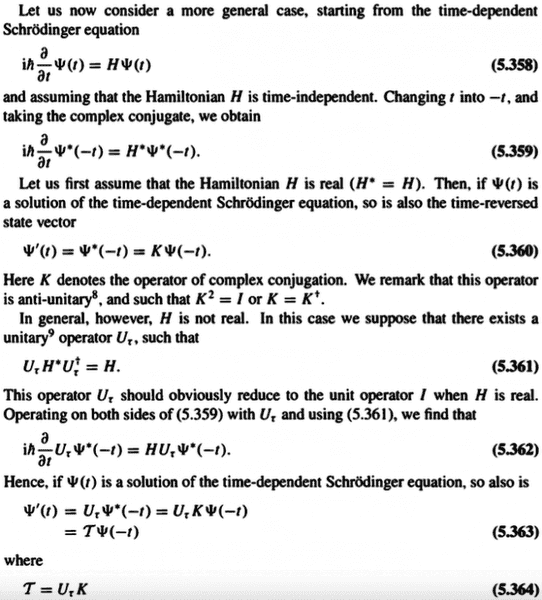
In obtaining (5.362) from (5.359), we first get

##U_{\tau}i\hbar\frac{\partial}{\partial t}\Psi(t) = U_{\tau}H^*\Psi^*(-t)##

In order to obtain the LHS of (5.362), ##U_{\tau}## must commute with ##\frac{\partial}{\partial t}##. But how do we know that they commute?
Screen Shot 2016-01-04 at 6.26.09 am.png
 
Physics news on Phys.org
The Hamiltonian is assumed to be time-independent, so its reasonable to expect U to be time-independent too. So we just assume it and continue. If it was a bad assumption, it would give us non-sense. Then we could go back and relax this assumption. But if it works(as it did here), good for us!
 
Shyan said:
The Hamiltonian is assumed to be time-independent, so its reasonable to expect U to be time-independent too. So we just assume it and continue. If it was a bad assumption, it would give us non-sense. Then we could go back and relax this assumption. But if it works(as it did here), good for us!

But it appears I could get non-sense out of this assumption:

Since ##U_{\tau}## commutes with ##i\hbar\frac{\partial}{\partial t}##, it also commutes with ##H## by the time-dependent Schrondinger equation. From (5.361), ##H^*=U_{\tau}^{\dagger}HU_{\tau}##. Since ##U_{\tau}## commutes with ##H##, ##H^*=U_{\tau}^{\dagger}U_{\tau}H=H##, which contradicts the assumption that ##H## is not real.
 
Happiness said:
Since UτU_{\tau} commutes with iℏ∂∂tiℏ∂∂ti\hbar\frac{\partial}{\partial t}, it also commutes with HHH by the time-dependent Schrondinger equation.
I don't see how that follows!
 
Shyan said:
I don't see how that follows!

##UH\Psi=Ui\hbar\frac{\partial}{\partial t}\Psi=i\hbar\frac{\partial}{\partial t}U\Psi=HU\Psi##

Since this is true for any ##\Psi##, ##UH=HU##.
 
Happiness said:
##UH\Psi=Ui\hbar\frac{\partial}{\partial t}\Psi=i\hbar\frac{\partial}{\partial t}U\Psi=HU\Psi##

Since this is true for any ##\Psi##, ##UH=HU##.

Here you're assuming that ## U\Psi ## is a solution to Schrödinger's equation only because ## \Psi ## is! Can you prove this?
 
  • Like
Likes   Reactions: Happiness

Similar threads

  • · Replies 8 ·
Replies
8
Views
1K
  • · Replies 15 ·
Replies
15
Views
2K
  • · Replies 5 ·
Replies
5
Views
3K
  • · Replies 12 ·
Replies
12
Views
1K
  • · Replies 9 ·
Replies
9
Views
4K
  • · Replies 17 ·
Replies
17
Views
3K
  • · Replies 3 ·
Replies
3
Views
2K
  • · Replies 14 ·
Replies
14
Views
4K
  • · Replies 1 ·
Replies
1
Views
2K
  • · Replies 29 ·
Replies
29
Views
6K