Weinberg gives relations of SO(3)

Click For Summary

Discussion Overview

The discussion revolves around the relations of SO(3) as presented in Weinberg's Quantum Field Theory, specifically regarding their derivation and notation. Participants express their challenges in understanding these relations and compare them to other resources, particularly in the context of angular momentum in quantum mechanics.

Discussion Character

  • Technical explanation
  • Conceptual clarification
  • Debate/contested
  • Homework-related

Main Points Raised

  • One participant questions the difficulty of deriving the relations presented by Weinberg, noting that they have not encountered them elsewhere.
  • Another participant suggests that the relations are standard in the context of SO(3) but criticizes Weinberg's notation as unnecessarily complex for beginners.
  • A participant explains the notation used in three dimensions, clarifying the relationship between the indices of the angular momentum tensor and the pseudovector representation.
  • There is a suggestion to refer to Ballentine's Chapter 7 for a clearer understanding of angular momentum, with a specific mention of the quantum spectrum derivation.
  • One participant inquires whether the derivation in Ballentine is similar to that in an external document, expressing difficulty in accessing Ballentine's book.
  • Another participant agrees with the sentiment about Ballentine's approach being more direct compared to the external document mentioned.

Areas of Agreement / Disagreement

Participants express differing views on the clarity of Weinberg's presentation, with some finding it complex and others suggesting it is standard. There is no consensus on the ease of understanding the relations or the best resources for learning them.

Contextual Notes

Participants note that the notation and derivation methods can vary significantly between different texts, which may contribute to confusion. The discussion highlights the importance of familiarity with angular momentum concepts in quantum mechanics for understanding the material.

Who May Find This Useful

This discussion may be useful for students and researchers interested in quantum field theory, angular momentum in quantum mechanics, and those seeking alternative resources for understanding SO(3) relations.

kent davidge
Messages
931
Reaction score
56
(Weinberg QFT, Vol 1, page 68)

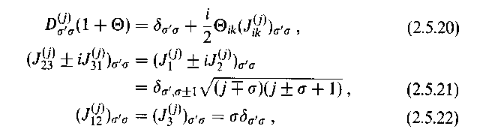
He considers Mass-Positive-Definite, in which case the Little Group is SO(3). He then gives the relations
3NR6PdK.png


Is it difficult to derive these relations? I'm asking this mainly because I haven't seen them anywhere other than in Weinberg's book.

Also, I'm finding them difficult to follow, as on one side of the equations the ##J## have two indices whereas on the other side they have only one index.
 

Attachments

  • 3NR6PdK.png
    3NR6PdK.png
    4.4 KB · Views: 833
Last edited:
Physics news on Phys.org
These are just some standard relations used when dealing with SO(3), but (as usual) Weinberg's treatment/notation makes it seem more difficult that it really is. Generally, Weinberg is able to deepen an existing understanding, but is not good for learning things the first time.

If you haven't already studied angular momentum aspects of ordinary QM, then try Ballentine ch7. In particular, in sect 7.1 Ballentine derives the quantum spectrum applicable to angular momentum (corresponding to the little ##j##'s and ##\sigma##'s). Where Weinberg uses ##\sigma##'s, Ballentine uses the (more common?) symbol ##m##.

After you've studied the material in Ballentine, you should be able to relate it back to Weinberg's formulas more easily.
 
  • Like
Likes   Reactions: kent davidge
kent davidge said:
Also, I'm finding them difficult to follow, as on one side of the equations the JJJ have two indices whereas on the other side they have only one index.

This is the standard notation in three dimensions. In D spatial dimensions, there are D(D-1)/2 independent rotations, and they are usually arranged in an antisymmetric tensor J_{ij} = -J_{ji} where i and j run from 1 to D. In three dimensions, it is conventional to define an angular momentum pseudovector J_i \equiv \epsilon_{ijk} J_{jk}, which extracts the three independent components of this tensor. The latter is the angular momentum vector you've encountered throughout physics, but it's important to keep in mind that angular momentum cannot be expressed as a vector in other dimensionalities.
 
  • Like
Likes   Reactions: kent davidge
strangerep said:
try Ballentine ch7. In particular, in sect 7.1 Ballentine derives the quantum spectrum applicable to angular momentum
Hey, is what Ballentine does the same or similar as what's in http://www.cmth.ph.ic.ac.uk/people/d.vvedensky/groups/Chapter8.pdf ?

I'm asking this because if it's the same derivation, I'll be done with that one, because it's quite difficult for me to get Ballentine's book in my hands.
 
kent davidge said:
Hey, is what Ballentine does the same or similar as what's in http://www.cmth.ph.ic.ac.uk/people/d.vvedensky/groups/Chapter8.pdf ?
That's excruciatingly tedious compared to Ballentine's more direct physicist-oriented treatment.

[...] it's quite difficult for me to get Ballentine's book in my hands.
See your private conversations page.
 
  • Like
Likes   Reactions: kent davidge

Similar threads

  • · Replies 4 ·
Replies
4
Views
1K
  • · Replies 5 ·
Replies
5
Views
2K
  • · Replies 53 ·
2
Replies
53
Views
5K
  • · Replies 3 ·
Replies
3
Views
2K
Replies
2
Views
3K
  • · Replies 5 ·
Replies
5
Views
2K
  • · Replies 76 ·
3
Replies
76
Views
9K
Replies
5
Views
4K
  • · Replies 1 ·
Replies
1
Views
2K
  • · Replies 18 ·
Replies
18
Views
5K