Weird (or not) issues in thin-walled cylindrical shell buckling modes

Click For Summary
SUMMARY

The discussion focuses on analyzing buckling modes in a thin-walled cylindrical shell using the Karamba3D parametric engineering plugin for Grasshopper/Rhino. Key observations include an unexpected increase in the lowest buckling factor (BF) as mesh size decreases, with significant changes in mode shape occurring at finer mesh sizes below 0.35 m. The analysis also reveals discrepancies between two triangular meshing patterns, Mesh-UV and Alternate, affecting the expected symmetry of buckling ripples. Ultimately, the consensus is to utilize finer mesh sizes for accurate calculations while disregarding artifacts from coarser meshes.

PREREQUISITES
  • Understanding of finite element analysis (FEA) principles
  • Familiarity with Karamba3D for parametric modeling
  • Knowledge of buckling behavior in thin-walled structures
  • Experience with mesh sensitivity analysis in computational modeling
NEXT STEPS
  • Investigate the effects of mesh size on buckling behavior in thin-walled structures
  • Learn about advanced meshing techniques in Karamba3D
  • Explore the implications of different triangular meshing patterns on structural analysis
  • Study the convergence criteria for finite element models in FEA
USEFUL FOR

Structural engineers, FEA analysts, and researchers focusing on buckling analysis and optimization of thin-walled cylindrical structures.

Vigardo
Messages
87
Reaction score
7
TL;DR
Would you explain why I observe weird issues in the buckling modes of a thin-walled cylindrical shell? Are they physically sound?
Dear FEA experts,

I’m trying to analyse* some finite elements model of a thin walled cylinder with variable cross-section, but I’m observing four weird issues in the buckling modes. The structure is vertically (along z-axis) and horizontally (along y-axis) loaded on top. Would you help me to understand why? Thanks!
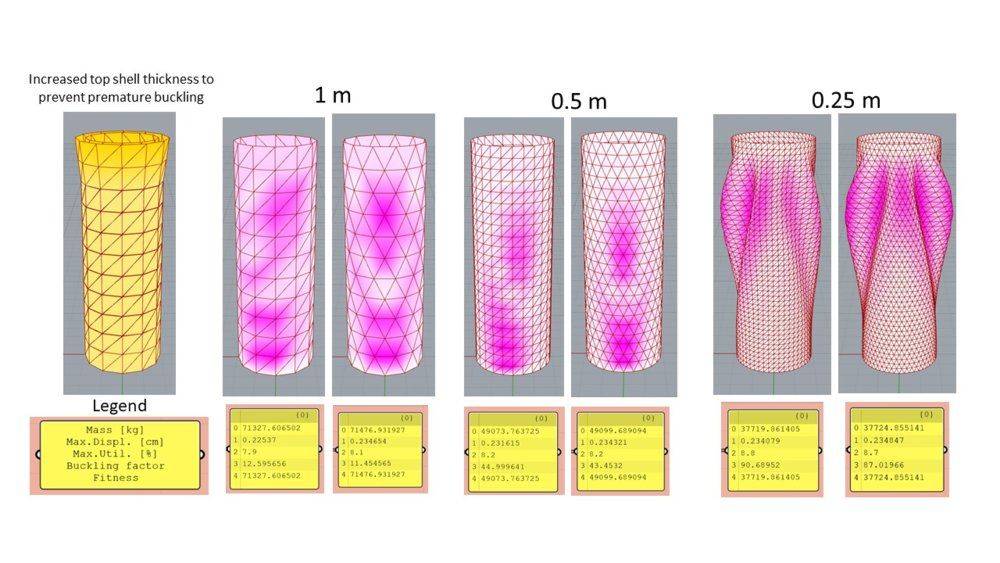
1st buckling mode of a thin walled cylindrical shell

  1. The lowest buckling factor (BF) increases as the mesh size decreases from 1 to 0.25 m (row number "3" in the yellow panels). Shouldn't it happen exactly the opposite? Shouldn't the structure be less stiff as element size is reduced?
  2. In addition, it happens an abrupt change in the lowest buckling mode shape for mesh sizes finer that 0.35 m. This is accompanied by an steady increase in BF until about 0.25 or 0.1 m element size, where it converges to around 85-90 values. Note that the observed increase in BF (issue 1.) also occurs without mode shape change.
  3. I tried two different triangular meshing patterns: Mesh-UV (left) and Alternate (right). It is apparent that the ripples of the first buckling mode are a bit twisted from the y-axis (green line, the direction of the horizontal load) for Mesh-UV meshing pattern. Only the Alternate meshing produces the expected horizontal ripples (because of loads symmetry). Would this be caused by the different triangular meshing?
  4. As expected, the maximum displacements and utilisation (row "1" and "2" in yellow panels) are the same in all of them. However, the BFs are slightly different (around 5%) between Alternate and UV meshes, even at the finer mesh size. Shouldn't they converge?
*Using Karamba3D parametric engineering plugin (FEA) for Grasshopper/Rhino. Top ring elements are much thicker (50 cm) to prevent premature local buckling.
 
Engineering news on Phys.org
If the mesh is too coarse when compared with the radius of curvature you will be seeing the effect of the mesh size rather than the modeled object in the real world.

The fact that the numerical model changes behaviour is an indication that the model is failing at some mesh size. It is important to test the model sensitivity to mesh size. That is exactly what you have done and observed.

We know that too coarse a mesh will fail, and that too fine a mesh will work, but then computation will take too long. Trying to explain why a coarse mesh fails, in the particular way it does, is probably not a sensible use of your time.
 
  • Like
Likes   Reactions: Vigardo
You're right, perhaps I'm overthinking here. I will use the finer mesh for my calculations and not worry about the coarser mesh artefacts anymore. In fact, the finer mesh buckling factors are not so different (90 and 87) for both mesh types. Thank you very much for your kind explanation!
 

Similar threads

  • · Replies 2 ·
Replies
2
Views
10K