What Am I Missing in My Third Year QM Assignment Solution?

  • Thread starter Thread starter karlhoffman_76
  • Start date Start date
  • Tags Tags
    Assignment Qm Year
Click For Summary

Homework Help Overview

The discussion revolves around a third-year quantum mechanics assignment, specifically focusing on the analysis of a wavefunction and its relation to spherical harmonics and angular momentum operators.

Discussion Character

  • Exploratory, Conceptual clarification, Mathematical reasoning, Assumption checking

Approaches and Questions Raised

  • Participants explore the relationship between the wavefunction and spherical harmonics, questioning how the powers of coordinates x, y, and z relate to the indices l and m. There is discussion on the superposition of eigenfunctions and the implications for the wavefunction's representation.

Discussion Status

Participants are actively engaging with the problem, offering insights into the characteristics of spherical harmonics and their dependencies. Some have begun to formulate new interpretations based on the feedback received, indicating a productive exploration of the topic.

Contextual Notes

There is an emphasis on understanding the dependencies of spherical harmonics on the coordinates and how this relates to the original wavefunction. The discussion includes references to specific eigenfunctions and their expected contributions to the wavefunction expansion.

karlhoffman_76
Messages
4
Reaction score
1
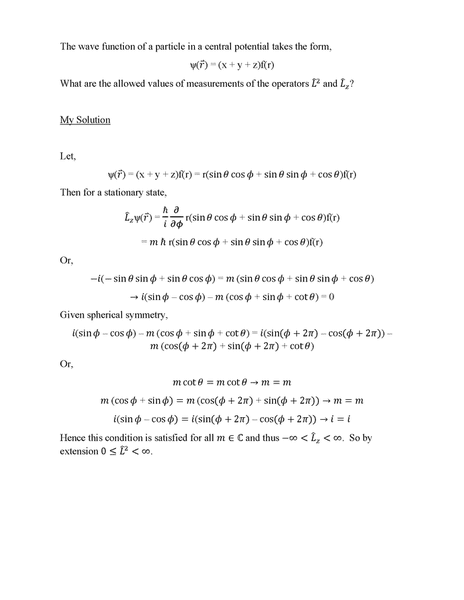
See the picture below for details. I have included my solution thus far, but it doesn't feel right and I'm just wondering what I am missing. Any assistance would be greatly appreciated, cheers.

f8lyXRl.png
 
Physics news on Phys.org
What about analyzing which powers of x,y, and z appear in the wavefunction and compare it with the spherical harmonics?
Comment to your second equation in your solution: ##\psi(\mathbf{r})## is supposed to be superposition of several eigenfunctions of ##L_z##, means you can't write the equation such that where you can associate the wavefunction with one value of m.
 
blue_leaf77 said:
What about analyzing which powers of x,y, and z appear in the wavefunction and compare it with the spherical harmonics?
Comment to your second equation in your solution: ##\psi(\mathbf{r})## is supposed to be superposition of several eigenfunctions of ##L_z##, means you can't write the equation such that where you can associate the wavefunction with one value of m.

Hey blue_leaf77, thanks for your reply. What do you mean by analyzing powers of x, y and z that appear in the wave function?
 
The purpose of the question is to check which eigenfunctions of ##L^2## and ##L_z## may appear when the original wavefunction is expanded as a sum of those eigenfunctions, which are the spherical harmonics ##Y_{lm}##. Now if you remember the characteristic dependency of ##Y_{lm}## w.r.t to the three coordinates x,y, and z is governed by the indices ##l## and ##m##. Using this fact you can get the first rough idea of which ##l## and ##m## are allowed to appear because they conform with the dependency of the original wavefunction to three coordinates. First of all, do you know how the spherical harmonics looks like and its dependency on x,y,z?

For example, ##Y_{2,-2} \propto (x-iy)^2##, by comparing this with the manner x,y, and z appear in the original wavefunction, do you think ##Y_{2,-2}## will appear in the expansion?
 
Last edited:
blue_leaf77 said:
The purpose of the question is to check which eigenfunctions of ##L^2## and ##L_z## may appear when the original wavefunction is expanded as a sum of those eigenfunctions, which are the spherical harmonics ##Y_{lm}##. Now if you remember the characteristic dependency of ##Y_{lm}## w.r.t to the three coordinates x,y, and z is governed by the indices ##l## and ##m##. Using this fact you can get the first rough idea of which ##l## and ##m## are allowed to appear because they conform with the dependency of the original wavefunction to three coordinates. First of all, do you know how the spherical harmonics looks like and its dependency on x,y,z?

For example, ##Y_{2,-2} \propto (x-iy)^2##, by comparing this with the manner x,y, and z appear in the original wavefunction, do you think ##Y_{2,-2}## will appear in the expansion?

I think I see where this is going now. Given that the final form of the expansion of ##(x-iy)^2## does not match the spherical harmonic (in terms of its Cartesian representation) of the wave function in question I would NOT expect to see ##Y_{2,-2}## in this particular wave function. So after reading your comments and looking into it a bit further I have a new solution. First of all, looking up a table of spherical harmonics I was able to ascertain that,

##x = \sqrt{\frac{2\pi}{3}}r(Y_{1,-1}-Y_{1,1})##

##y = \sqrt{\frac{2\pi}{3}}ir(Y_{1,1}+Y_{1,-1})##

##z = \sqrt{\frac{4\pi}{3}}rY_{1,0}##

and hence,

##\psi(\vec{r}) = (x+y+z)f(r) = \sqrt{\frac{2\pi}{3}}r[(Y_{1,-1}-Y_{1,1})+i(Y_{1,1}+Y_{1,-1})+\sqrt{2}Y_{1,0}]f(r)##

and so the allowed values of ##l## are ##l = 1## only and the allowed values of ##m## are ##m = -1,0,1##. Thus the allowed values of ##\hat{L}_{z}## are ##\hat{L}_{z} = -\hbar,0,\hbar## and the allowed values of ##\hat{L}^2## are ##\hat{L}^2 = 2\hbar^2## only.
 
yes, that's what I think the correct one.
 
blue_leaf77 said:
yes, that's what I think the correct one.

Thanks so much blue_leaf77!
 
  • Like
Likes   Reactions: blue_leaf77

Similar threads

  • · Replies 16 ·
Replies
16
Views
2K
  • · Replies 6 ·
Replies
6
Views
2K
Replies
13
Views
3K
  • · Replies 11 ·
Replies
11
Views
2K
  • · Replies 9 ·
Replies
9
Views
2K
  • · Replies 1 ·
Replies
1
Views
2K
  • · Replies 10 ·
Replies
10
Views
2K
  • · Replies 4 ·
Replies
4
Views
2K
  • · Replies 8 ·
Replies
8
Views
3K
  • · Replies 5 ·
Replies
5
Views
3K