What are Some Momentum Questions and How Can I Solve Them?

  • Thread starter Thread starter musicfairy
  • Start date Start date
  • Tags Tags
    Momentum
Click For Summary
SUMMARY

The discussion focuses on solving momentum and energy questions related to physics problems involving collisions and motion. Participants analyze a scenario where a ball is thrown between two students in a boat, exploring the implications of momentum conservation and kinetic energy calculations. Key answers identified include the impulse exerted on a ball during a collision, the total kinetic energy of a two-puck system calculated as 5.0 J, and the momentum of the system before and after the collision. The consensus is that the boat moves forward immediately after the throw and does not move after the ball is caught, confirming the principle of momentum conservation.

PREREQUISITES
  • Understanding of momentum conservation principles
  • Familiarity with kinetic energy equations
  • Basic knowledge of vector addition in physics
  • Concept of internal and external forces in a closed system
NEXT STEPS
  • Study the principles of momentum conservation in closed systems
  • Learn how to apply kinetic energy equations in collision scenarios
  • Explore vector addition techniques in physics problems
  • Investigate real-world applications of momentum and energy conservation
USEFUL FOR

Students studying physics, educators teaching mechanics, and anyone interested in understanding the principles of momentum and energy in collision scenarios.

musicfairy
Messages
101
Reaction score
0
Here's a couple of mcs I'm trying to use to study, but they got me stuck and I don't have the answers, much less the explanations. A little help here would be greatly appreciated.


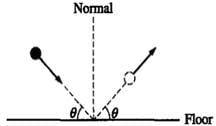
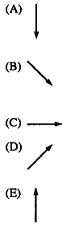
1. A 2kg ball collides with the floor at an angle  and rebounds at the same angle and speed as shown above. Which of the following vectors represents the impulse exerted on the ball by the floor?
200403.jpg


200403a.jpg


The left and right cancels, leaving only up, so I'm guessing E is the answer?


2-3
20042223.jpg


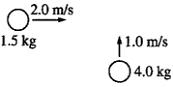
22. What is the total kinetic energy of the two-puck system before the collision?
(A) √13 J
(B) 5.0 J
(C) 7.0 J
(D) 10 J
(E) 11 J

For this one I used the kinetic energy equation on the 2 particles and added them, getting 5.0 J so B is the answer.

3. What is the magnitude of the total momentum of the two-puck system after the collision?
(A) 1.0 kg.m/s
(B) 3.5 kg.m/s
(C) 5.0 kg.m/s
(D) 7.0 kg.m/s
(E) 5.5 √5 kg.m/s


I solved for momentum of both, then used pythagorean theorem and got C as the answer


200425.jpg


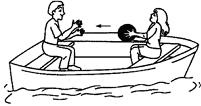
4. As shown above, two students sit at opposite ends of a boat that is initially at rest. The student in the front throws a heavy ball to the student in the back. What is the motion of the boat at the time immediately after the ball is thrown and, later, after the ball is caught? (Assume that air and water friction are negligible.)

Immediately
After the Throw After the Catch

(A) Boat moves forward Boat moves forward
(B) Boat moves forward Boat moves backward
(C) Boat moves forward Boat does not move
(D) Boat moves backward Boat does not move
(E) Boat moves backward Boat moves forward


This one I'm really clueless. What difference does it make if the ball is moving or caught?

I knoew (or think I know) that the boat would move right when the ball is caught, but what happens immeidately after the ball is thrown? I'd try this if I had a heavy ball, a buddy and a boat but I don't live close to any of those.


Please help me understand all this stuff.
 
Physics news on Phys.org
1) is correct, but maybe the wrong reason. The x component of velocity is unchanged, so only the y component would be affected. Since it was reversed by the bounce ...

2) bad math mv2/2

3) total m*v before = ...

4) for every action, there is a reaction.
 
Huh, for #2 I used mv2/2 on the 2 objects, added them but keep on getting 5 as the answer? What went wrong?

Ok, so the p after the collision would be the sum of p before the collision, and the answer is 7 (D)?

For 4 I'm guessing that the boat does not move when it's immediately thrown because it's an internal force and moves forward after it's caught because center of mass does not move.
 
I think your answer for #2 is fine:
I found the kinetic energy of the first particle to be 0.5*1.5 kg*(2.0 m/s)^2 = 3.0 J
and the kinetic energy of the second to be: 0.5*4.0 kg*(1.0 m/s)^2 = 2.0 J
So I think you've applied the kinetic energy equations correctly (finding the energies separately and then adding to result in 5.0 J, because energy is not a vector).

For #3, are you using momentum as a vector? I think you've found the magnitudes of their momentum correctly, but when you find the net momentum you will have to add these as vectors!

For #4, think of the instants when the ball and the boat are separated, and then when they join (examine the momentum): You could even try to do this yourself on a skateboard (or an office chair), tossing a heavy object from one hand to the other.
 
#3 asked for total momentum, so I guess it would be the same as before collision.

I unfortunately don't have any toys to test #4. My second guess is that the boat moves forward and then stop when it's caught?
 
musicfairy said:
Huh, for #2 I used mv2/2 on the 2 objects, added them but keep on getting 5 as the answer? What went wrong?

Sorry I thought you checked A. I didn't read your answer below that.
 
After much thought into #4...

I'm guessing that the boat would move in the opposite direction that the ball moves. I'm thing of recoil. After the student in the back catches the ball, the boat would move opposite (recoil again?)

So the answer would be B, boat moves forward immediately after throw and boat moves backward after the catch. Is this correct?
 
musicfairy said:
After much thought into #4...

I'm guessing that the boat would move in the opposite direction that the ball moves. I'm thing of recoil. After the student in the back catches the ball, the boat would move opposite (recoil again?)

So the answer would be B, boat moves forward immediately after throw and boat moves backward after the catch. Is this correct?

Before the throw, how much momentum is there in the system?

During the throw then how much momentum in the system? The boat forward plus the ball backward is what?

After the catch how much momentum?
 
Momentum is conserved. When the ball is thrown, the ball moves backward, which I'll refer to as left from now on. The boat moves right.

When the person catches the ball, the ball stops and the person (plus boat) moves left.

I think that's how it goes, unless I have major conceptual errors.
 
  • #10
musicfairy said:
Momentum is conserved. When the ball is thrown, the ball moves backward, which I'll refer to as left from now on. The boat moves right.

When the person catches the ball, the ball stops and the person (plus boat) moves left.

I think that's how it goes, unless I have major conceptual errors.

When the person catches the ball what is the forward momentum of the boat just before he catches it? Isn't it equal to the backward momentum of the ball in motion?

And when it is caught and the ball has no momentum, hasn't its momentum gone to exactly cancel the momentum of the boat moving forward? If the boat has no momentum what is the velocity again?
 
  • #11
Oh, so the boat doesn't move after it's caught?

Does it then mean that the answer is C, the boat moves forward after thrown and does not move after it's caught?
 
  • #12
musicfairy said:
Oh, so the boat doesn't move after it's caught?

Does it then mean that the answer is C, the boat moves forward after thrown and does not move after it's caught?

That's the way I see it.
 
  • #13
Thanks for the help. This is one of those problems that I have to spend hours to figure out how it works.
 

Similar threads

  • · Replies 13 ·
Replies
13
Views
1K
  • · Replies 16 ·
Replies
16
Views
6K
  • · Replies 11 ·
Replies
11
Views
4K
Replies
14
Views
3K
  • · Replies 4 ·
Replies
4
Views
1K
  • · Replies 24 ·
Replies
24
Views
4K
  • · Replies 6 ·
Replies
6
Views
3K
  • · Replies 10 ·
Replies
10
Views
9K
  • · Replies 9 ·
Replies
9
Views
2K
  • · Replies 4 ·
Replies
4
Views
1K