What are the implied domain and range of cos(arctan(x))?

Click For Summary
SUMMARY

The discussion centers on determining the implied domain and range of the composite function cos(arctan(x)). The domain is established as [0, ∞) because arctan(x) outputs values in the interval (-π/2, π/2), while the range of cos(arctan(x)) excludes 0 due to the restriction of the arctan function. The peak of the function occurs at x=0, where y=1, and approaches zero as x approaches ±∞. The participants confirm that the domain of the composite function is not [0, π] due to the behavior of the arctan function.

PREREQUISITES
  • Understanding of composite functions
  • Familiarity with trigonometric functions, specifically cosine
  • Knowledge of inverse functions, particularly arctangent
  • Basic graphing skills for analyzing function behavior
NEXT STEPS
  • Study the properties of composite functions in calculus
  • Learn about the behavior of the arctan function and its range
  • Explore the implications of function restrictions on domain and range
  • Investigate the graphical representation of trigonometric functions and their inverses
USEFUL FOR

Mathematicians, students studying calculus, educators teaching composite functions, and anyone interested in the properties of trigonometric and inverse functions.

Darkmisc
Messages
222
Reaction score
31
Homework Statement
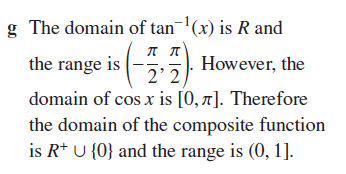
The domain of cos is restricted to [0, pi]. What is the implied domain and range of cos(tan^-1(x))?
Relevant Equations
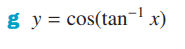
y=cos(tan^-1(x))?
Hi everyone

I have the solution to this question, but I'm not sure I understand it.

1674111199416.png


image_2023-01-19_174256922.png


1674110596820.png

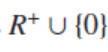
Why is the domain of the composite function
image_2023-01-19_174415215.png
and not [0, pi]?

Is it because tan^-1 (0 and R+) will always give a value between (-pi/2, pi/2)? I.e. the domain of the composite function refers to x.

Is 0 excluded from the range of the composite function because pi/2 is excluded from the domain of tan^-1?

Thanks
 
Physics news on Phys.org
I observe graph of
y=\cos(\arctan x)
shows peak y=1 at x=0 and going down to zero for both plus and minus x. x=##\pm \infty## correspond with arctan x=##\pm \pi/2##. It should be adjusted if we apply [0,##\pi##) for x. Isn't it enough ?
 
Last edited:
  • Like
Likes   Reactions: Darkmisc
To find the implied domain of a composite function we need to consider the inverse image of the outer function. So we If we want 0<arctan(x)<pi we must have 0<=x as the domain. Next we consider values of cos(arctan(x)) that are possible. That will be the range. 0 excluded from the range of the composite function because pi/2 is excluded from the range of tan^-1. Yes, tan^-1 ({0} U R+) will always give a value in (-pi/2, pi/2) in fact in [0, pi/2) require that arctan be in [0, pi] due to the restriction of cos.
 
  • Like
Likes   Reactions: Darkmisc
Darkmisc said:
I have the solution to this question, but I'm not sure I understand it.
I think you do :smile:

Darkmisc said:
Why is the domain of the composite functionView attachment 320662 and not [0, pi]?
Please don't use images, write ## \mathbb R^+ \cup \{0\} ##, or the less clunky ## [0, \infty) ##.

Darkmisc said:
Is it because tan^-1 (0 and R+) will always give a value between (-pi/2, pi/2)?
Yes.

Darkmisc said:
Is 0 excluded from the range of the composite function because pi/2 is excluded from the domain of tan^-1?
Yes.
 
  • Like
Likes   Reactions: Darkmisc

Similar threads

  • · Replies 3 ·
Replies
3
Views
2K
  • · Replies 11 ·
Replies
11
Views
3K
  • · Replies 2 ·
Replies
2
Views
1K
  • · Replies 23 ·
Replies
23
Views
2K
  • · Replies 15 ·
Replies
15
Views
2K
  • · Replies 7 ·
Replies
7
Views
2K
  • · Replies 22 ·
Replies
22
Views
2K
  • · Replies 14 ·
Replies
14
Views
4K
  • · Replies 10 ·
Replies
10
Views
2K
  • · Replies 4 ·
Replies
4
Views
1K