What Are the Key Differences Between Fixed and Movable Pulleys in Physics?

  • Context:
  • Thread starter Thread starter mathmari
  • Start date Start date
  • Tags Tags
    Physics Pulleys
Join the discussion
Ask a follow-up here, or get your own question answered by working scientists, mathematicians and engineers — people, not an autocomplete.
Real named experts · corrections over time · the nuance an AI answer skips
1 reply · 2K views
mathmari
Gold Member
MHB
Messages
4,984
Reaction score
7
Hey! :o

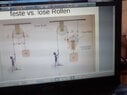
View attachment 4338

Fixed pulley:

$$F_G \cdot r=F_z \cdot r \Rightarrow F_G=F_z$$

Only force transfer, no changement of force

Movable pulley:

Like one-sided lever, current center of rotation is at the circumference of the pulley:

$$F_G \cdot r=F_z \cdot 2r \Rightarrow F_z=\frac{F_G}{2}$$

Could you explain me why these formulas stand?? (Wondering)
 

Attachments

  • TPhoto_00126.jpg
    TPhoto_00126.jpg
    25.6 KB · Views: 122
Mathematics news on Phys.org
You assume the systems are in equilibrium. Therefore, the sum of the total torques of each system must be zero.

In the fixed pulley you measure torques with respect to the center of the pulley. In this situation, the torque due to the man is $\tau_m = F_z \cdot r$ in the counterclockwise orientation. The torque due to the box is $\tau_b = F_G \cdot r$, in the clockwise orientation. The sum of these torques is $$\tau_m - \tau_b = F_z \cdot r - F_G \cdot r = 0.$$The negative sign is due to the convention that clockwise orientation gets a negative sign, just as in trigonometry. You obtain the desired result.

There is another way to view this. The thread is massless, and this means the force is fully transmitted to the mass. Therefore, the box has two forces acting on it: the weight and the pulling force. Both forces act vertically, with the weight pointing down and the pulling force pointing up. Since it is in equilibrium we have $F_z - F_G = 0$.

The same idea is applied in the second case, but the point of reference is not the center of the second pulley. Instead you take the point of reference on the right side of the pulley. The distance to the pulling force $F_z$ is $2r$, now acting in a clockwise orientation, and the distance to the weight $F_G$ is $r$, acting in a counterclockwise orientation. Again we assume equilibrium and therefore $$-F_z \cdot 2r + F_G \cdot r = 0.$$