Undergrad What are the Relativistic versions of Jefimenko's equations?

  • Thread starter Thread starter tade
  • Start date Start date
  • Tags Tags
    Relativistic
Click For Summary
The discussion centers on the Special Relativistic versions of Jefimenko's equations, particularly regarding the B-field generated by a magnetostatic circular current loop. It highlights that the relativistic B-field magnitude at the loop's center is derived from Jefimenko's equation and is adjusted by the Lorentz factor, which depends on the speed of the moving charges. An increase in the speed of these charges, while maintaining constant current, results in a higher B-field magnitude. Participants seek references to confirm the relativistic formulations of Jefimenko's equations. The thread remains open for further contributions pending the provision of a reference.
tade
Messages
720
Reaction score
26
I would like to know what the Special Relativistic versions of Jefimenko's equations are.An example of a noticeable difference between non-relativistic and relativistic cases is considering Jefimenko's equation for the B-field, for a magnetostatic circular current loop.

Jefimenko's B-field equation yields the magnitude of the B-field at the center of the loop similar to that of the Biot-Savart Law. (http://hyperphysics.phy-astr.gsu.edu/hbase/magnetic/curloo.html#c2)
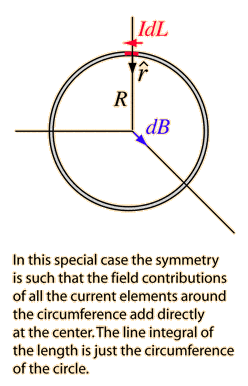
loopc.gif


With the effects of special relativity in consideration, the magnitude of the B-field at the center of the loop is the Jefimenko/Biot-Savart magnitude multiplied by the Lorentz factor.

The Lorentz factor is based on the speed(s) of the moving electric charges whizzing about the circular loop.

So if you increase the speed of the charges, while keeping the magnitude of the current constant, the magnitude of the B-field will increase.
 
Last edited:
Physics news on Phys.org
tade said:
I would like to know what the Special Relativistic versions of Jefimenko's equations are.

AFAIK they already are, assuming you're referring to the equations in terms of retarded potentials. But we need a reference to be sure; see below.

tade said:
Jefimenko's B-field equation

Please give a reference for where you are getting Jefimenko's equations from.
 
We will leave this closed until a reference is provided.
 
Last edited:
MOVING CLOCKS In this section, we show that clocks moving at high speeds run slowly. We construct a clock, called a light clock, using a stick of proper lenght ##L_0##, and two mirrors. The two mirrors face each other, and a pulse of light bounces back and forth betweem them. Each time the light pulse strikes one of the mirrors, say the lower mirror, the clock is said to tick. Between successive ticks the light pulse travels a distance ##2L_0## in the proper reference of frame of the clock...

Similar threads

  • · Replies 26 ·
Replies
26
Views
3K
  • · Replies 18 ·
Replies
18
Views
2K
  • · Replies 10 ·
Replies
10
Views
750
  • · Replies 30 ·
2
Replies
30
Views
3K
  • · Replies 5 ·
Replies
5
Views
2K
  • · Replies 2 ·
Replies
2
Views
1K
  • · Replies 3 ·
Replies
3
Views
3K
  • · Replies 45 ·
2
Replies
45
Views
4K
  • · Replies 6 ·
Replies
6
Views
5K
  • · Replies 16 ·
Replies
16
Views
2K