What Are the Sign Rules for Second Degree Functions?

  • Context: High School 
  • Thread starter Thread starter help
  • Start date Start date
  • Tags Tags
    Degree Functions
Click For Summary

Discussion Overview

The discussion revolves around determining the sign (larger than, smaller than, or equal to zero) of several algebraic expressions involving variables with known inequalities. The scope includes mathematical reasoning and analysis of expressions based on given conditions.

Discussion Character

  • Mathematical reasoning
  • Debate/contested

Main Points Raised

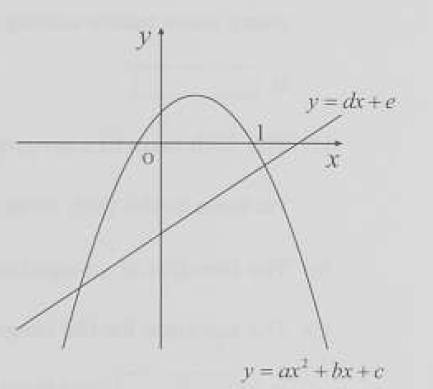
  • Participants are asked to evaluate the signs of expressions: i) a+b+c, ii) a-b+c, iii) 4a+2b+c, iv) c-e, given conditions on variables a, b, c, d, and e.
  • Some participants express uncertainty about how to proceed with the evaluations based on the provided inequalities.
  • One participant notes that the information about the signs of the variables does not provide enough clarity to determine the sign of the expression a+b+c, as it involves a negative value compared to two positive values.
  • Another participant suggests that the graph referenced by the original poster (O.P.) contains additional information that could help answer the questions posed.
  • There is a mention of the equation y(x)=0 having two solutions, raising questions about the implications of having two real solutions.

Areas of Agreement / Disagreement

Participants express differing views on the conclusiveness of the evaluations, with some stating that the expressions are inconclusive while others argue that the graph can provide sufficient information to determine the signs.

Contextual Notes

Participants highlight that the known inequalities only indicate whether the variables are positive or negative, but do not clarify their relationships, leading to uncertainty in evaluating the expressions.

help
Messages
14
Reaction score
0
TL;DR
judge whether the following expressions are larger than, smaller than or equal to zero
i) a+b+c
ii)a-b+c
iii)4a+2b+c
iv)c-e

I know that <0, b> 0, c> 0, d> 0 and e <0 but I don't know what to do
1.jpg
 
Mathematics news on Phys.org
help said:
Summary:: judge whether the following expressions are larger than, smaller than or equal to zero

I know that <0, b> 0, c> 0, d> 0 and e <0 but I don't know what to do
inconclusive on most of those.
 
help said:
Summary:: judge whether the following expressions are larger than, smaller than or equal to zero

judge whether the following expressions are larger than, smaller than or equal to zero
i) a+b+c
ii)a-b+c
iii)4a+2b+c
iv)c-e

I know that <0, b> 0, c> 0, d> 0 and e <0 but I don't know what to doView attachment 263235
Note that e.g. ##a+b+c=y(1)## or ##c=y(0)##. Then the equation ##y(x)=0## has two solutions. Which are the solutions in general, and what does it mean that there are two real solutions?
 
  • Like
Likes   Reactions: help
thanks a lot!
 
symbolipoint said:
inconclusive on most of those.
Which one is inconclusive? All of them can be taken from the graph.
 
I was only going by this:
help said:
Summary:: judge whether the following expressions are larger than, smaller than or equal to zero

whether the following expressions are larger than, smaller than or equal to zero
i) a+b+c
ii)a-b+c
iii)4a+2b+c
iv)c-e

I know that a<0, b> 0, c> 0, d> 0 and e <0
The "know" part only tells if a number is POSITIVE or NEGATIVE.

Looking at (i),
a+b+c
neg + pos + pos
we do not know how the neg compares to the two pos values.

I see no reason why the graph was shown. It appears to be separate from the given description of O.P. I did not make use of it, so this is my possible misunderstanding.
 
The graph is where OP got the sign information from, but you can get more information from the graph - enough to answer the questions.
 

Similar threads

  • · Replies 19 ·
Replies
19
Views
4K
  • · Replies 6 ·
Replies
6
Views
2K
  • · Replies 4 ·
Replies
4
Views
2K
  • · Replies 2 ·
Replies
2
Views
2K
  • · Replies 7 ·
Replies
7
Views
2K
  • · Replies 51 ·
2
Replies
51
Views
4K
  • · Replies 8 ·
Replies
8
Views
3K
  • · Replies 12 ·
Replies
12
Views
3K
  • · Replies 13 ·
Replies
13
Views
3K
  • · Replies 7 ·
Replies
7
Views
2K