What Conditions Must Be Met for a Transformation to Be Canonical?

  • Context: Graduate 
  • Thread starter Thread starter MisterX
  • Start date Start date
  • Tags Tags
    Transformations
Click For Summary

Discussion Overview

The discussion centers on the conditions required for a transformation between phase space variables to be canonical in the context of Hamiltonian mechanics. Participants explore the implications of these conditions on the Hamiltonian and the associated action principle, with references to classical mechanics literature.

Discussion Character

  • Technical explanation
  • Conceptual clarification
  • Debate/contested

Main Points Raised

  • One participant questions why the coefficients of the velocities \(\dot{q}_i\) or \(\dot{Q}_i\) cannot be non-zero and absorbed into the function \(\mathcal{K}\), suggesting a need for further explanation.
  • Another participant asserts that \(\mathcal{K}\) should not depend on the derivatives of \(Q\) and \(q\), implying a restriction on the form of \(\mathcal{K}\).
  • A different perspective is presented, where the Hamiltonian action is defined, and the relationship between the old and new phase-space coordinates is described through the variational principle, leading to expressions for \(p_k\), \(P_k\), and \(K\) in terms of a function \(f\).
  • A participant reiterates the question about the dependence of \(K\) on \(P\) and \(Q\) without their derivatives, seeking clarification on the canonical equations.

Areas of Agreement / Disagreement

Participants express differing views on the nature of \(\mathcal{K}\) and its dependence on phase space variables. There is no consensus on the implications of these conditions or the specific formulation of the canonical transformations.

Contextual Notes

Some discussions involve assumptions about the nature of the transformations and the definitions of the variables involved, which may not be explicitly stated. The mathematical steps leading to the relationships between the variables are not fully resolved.

MisterX
Messages
758
Reaction score
71
Background

For which of the invertible transformations [itex](\mathbf{q}, \mathbf{p}) \leftrightarrow(\mathbf{Q}, \mathbf{P})[/itex]
[itex]\mathbf{Q}(\mathbf {q}, \mathbf {p}, t)[/itex]
[itex]\mathbf{P}(\mathbf{q}, \mathbf {p}, t)[/itex]
is it so that for every Hamiltonian [itex]\mathcal{H}(\mathbf {q}, \mathbf {p}, t)[/itex] there is a [itex]\mathcal{K}[/itex] such that
[tex]\dot{Q}_i = \frac{\partial\mathcal{K}}{\partial P_i} \;\;\;\;\;\;\;\; \dot{P}_i = -\frac{\partial\mathcal{K}}{\partial Q_i}\; ?[/tex]
Stationary action should correspond, and that condition is met if

[itex]\sum p_i\dot{q}_i - \mathcal{H} = \sum P_i\dot{Q}_i - \mathcal{K} + \frac{dF}{dt}[/itex],

since integrating [itex]\frac{dF}{dt}[/itex] results in something only dependent of the endpoints.

Question
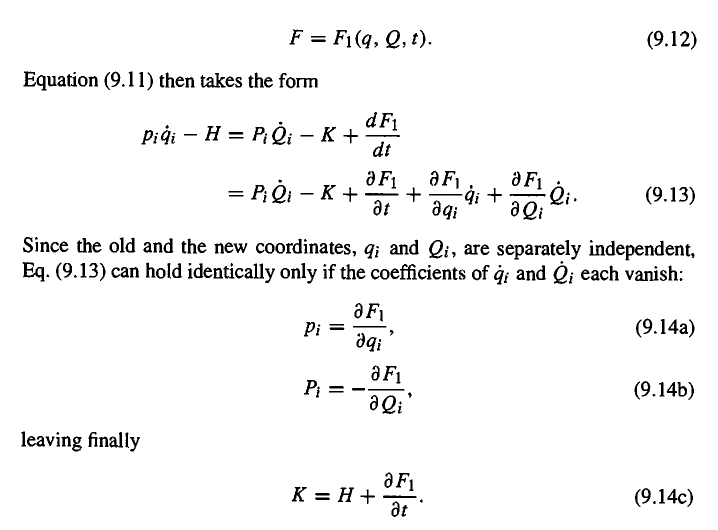
Consider this part of Goldstein's Classical Mechanics.
m3icfYL.png


rearranging 9.13 to make this clear:

[tex]\mathcal{K} = \mathcal{H} + \frac{\partial F_1}{\partial t} + \sum_i \dot{Q}_i\left(P_i - \frac{\partial F_1}{\partial Q_i} \right) + \sum_i \dot{q}_i\left(\frac{\partial F_1}{\partial q_i} - p_i\right)[/tex]
I guess I might like this explained a more. Why aren't we able to to have the coefficients of [itex]\dot{q}_i[/itex] or [itex]\dot{Q}_i[/itex] be non-zero, and have the difference absorbed into [itex]\mathcal{K}[/itex] ?
 
Physics news on Phys.org
it's because K should not depend on the derivates of Q and q
 
  • Like
Likes   Reactions: 1 person
I would argue as follows. The Hamiltonian version of the action is
[tex]S[x,p]=\int_{t_1}^{t_2} \mathrm{d} t [\dot{q}^k p_k - H(t,q,p)].[/tex]
The trajectory in phase space is determined as the stationary point of this functional with the boundary values [itex]q(t_1)[/itex] and [itex]q(t_2)[/itex] fixed.

Now if you want to determine new phase-space coordinates [itex](Q,P)[/itex] that describe the same system in the new coordinates by the variational principle, i.e., such that the phase-space trajectories are described by the Hamilton canonical equations, you must have
[tex]\mathrm{d} q^k p_k - \mathrm{d} Q^k P_k - \mathrm{d} t (H-K)=\mathrm{d} f.[/tex]
From this it is clear that the "natural" independent variables for [itex]f[/itex] are [itex]q[/itex], [itex]Q[/itex], and [itex]t[/itex]. Then comparing the differential on each side leads to
[tex]p_k=\frac{\partial f}{\partial q^k}, \quad P_k=-\frac{\partial f}{\partial Q^k}, \quad K=H+\frac{\partial f}{\partial t}.[/tex]
Then you can go over to other pairs of old and new independent phase-space variables in the "generator" using appropriate Legendre transformations.
 
  • Like
Likes   Reactions: 1 person
Jul 7, 2013 #1
MisterX
avatar_m.png

Messages:
585
Background

For which of the invertible transformations (q,p)↔(Q,P)
Q(q,p,t)
P(q,p,t)
is it so that for every Hamiltonian H(q,p,t) there is a K such that
Q˙i=∂K∂PiP˙i=−∂K∂Qi?Is It show that K is dependent upon (P, Q) not in Derivative of (P, Q)? please.

also show that
Q˙i=∂K∂PiP˙i=−∂K∂Qi?
 

Similar threads

  • · Replies 2 ·
Replies
2
Views
1K
  • · Replies 7 ·
Replies
7
Views
2K
  • · Replies 4 ·
Replies
4
Views
2K
  • · Replies 4 ·
Replies
4
Views
4K
  • · Replies 2 ·
Replies
2
Views
2K
  • · Replies 7 ·
Replies
7
Views
1K
  • · Replies 2 ·
Replies
2
Views
5K
  • · Replies 3 ·
Replies
3
Views
2K
  • · Replies 1 ·
Replies
1
Views
2K
  • · Replies 6 ·
Replies
6
Views
2K