What could you tell me about this planet?

  • Thread starter Thread starter cbrons
  • Start date Start date
  • Tags Tags
    Planet
Click For Summary

Discussion Overview

The discussion revolves around the feasibility of human exploration of a planet with specific characteristics, including its size, distance from its star, and potential environmental conditions. Participants explore the implications of these factors on the planet's habitability and the challenges that might arise during exploration.

Discussion Character

  • Exploratory
  • Debate/contested
  • Technical explanation
  • Conceptual clarification

Main Points Raised

  • One participant questions the feasibility of exploring the planet, suggesting that high radiation from its star class could pose significant dangers.
  • Another participant points out that a radius of 0.82 km would classify the object as an asteroid rather than a planet, indicating a possible typo in the original post.
  • Concerns are raised about the planet's temperature based on its orbital radius of 3 AU and its luminosity of 3.5, with some participants suggesting that it should be cold unless greenhouse gases significantly increase the temperature.
  • A participant speculates that if the object is very small, it could be a black hole or neutron star, which complicates the discussion of its parameters.
  • Clarifications are made regarding the use of prefixes, with a participant correcting the meaning of "T" to "tera" rather than "terra."
  • Some participants argue that the planet resembles Earth closely, with increased gravity being a potential issue for exploration teams, but not a major obstacle.
  • There is a discussion about the planet's position within the habitable zone and the implications of its star's reduced lifespan on the development of life and oxygen production.
  • One participant notes that the relationship between luminosity and distance does not seem consistent for a hot planet, raising questions about the assumptions made in the discussion.

Areas of Agreement / Disagreement

Participants express a mix of agreement and disagreement regarding the planet's classification, its environmental conditions, and the implications for exploration. There is no clear consensus on the feasibility of exploration or the planet's characteristics.

Contextual Notes

There are unresolved assumptions regarding the definitions of terms used, the implications of the planet's size, and the effects of greenhouse gases on temperature. The discussion also reflects uncertainty about the relationship between luminosity and distance in the context of habitability.
cbrons
Messages
44
Reaction score
0
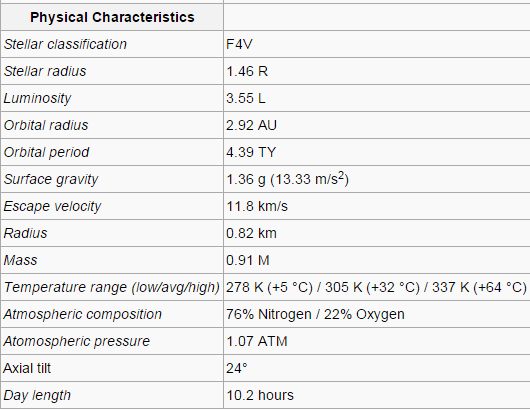
What could you tell me about humans exploring this planet? Would it be feasible? Or would it be far too dangerous? What would be the biggest problem here? I am assuming the star class means it gives off a fairly high amount of radiation.
upload_2015-6-25_15-23-23.png


Btw TY is "Earth years", "R" is x Earth radius, etc.
 
Physics news on Phys.org
With a radius of .82Km, this would not be a planet, it would be an asteroid, so I assume that's a typo
 
I'm not sure whether I get those numbers correctly...

Orbital radius is 3 AU, so according to inverse square law this planet should receive 1/9 of the light that planet at 1 AU would receive...

...however Luminosity is 3.5, so roughly counting 3.5/9 of the light that Earth receive should go there...

Shouldn't such planet be rather cold? Or you boost temperature with huge amount of greenhouse gasses? Or I miss something?
 
I think that if the object was that small it would be some kind of a black hole, (neutron star possibly), in which case a lot of the other parameters make little sense.
 
phinds said:
With a radius of .82Km, this would not be a planet, it would be an asteroid, so I assume that's a typo
Sorry that was a typo. Should be 0.82 the size of Earth
 
Corrected:

upload_2015-6-25_20-22-27.png
 
Um, the prefex T is for "tera" meaning a trillion, not "terra" meaning earth.
 
The planet seems to be chosen to closely resemble Earth, so I don't see any problems. Increased gravity might be the most obvious issue affecting exploration teams, but more of a nuisance than an obstacle.
A reduced lifespan of the star puts a limit on the time the planet had to develop, though. It only had ~3.5 Gy tops to calm down geologically, develop life and produce all that free oxygen.

Following on Vanadium's comment: use the symbol ⊕ to denote Earth, just like you use ☉ for the Sun, to avoid confusion.

Czcibor said:
Shouldn't such planet be rather cold? Or you boost temperature with huge amount of greenhouse gasses? Or I miss something?
That seems to be within the habitable zone with high greenhouse effects. See here:
http://depts.washington.edu/naivpl/sites/default/files/index.shtml
 
Last edited:
  • Like
Likes   Reactions: cbrons
Bandersnatch said:
The planet seems to be chosen to closely resemble Earth, so I don't see any problem. Increased gravity might be the most obvious issue affecting exploration teams, but more of a nuisance than an obstacle.
A reduced lifespan of the star puts a limit on the time the planet had to develop, though. It only had ~3.5 Gy tops to calm down geologically, develop life and produce all that free oxygen.

[...]

That seems to be within the habitable zone with high greenhouse effects. See here:
http://depts.washington.edu/naivpl/sites/default/files/index.shtml

You want to point me that planet is within outer edge HZ? Yes, it is. Just Cbrnos requested a tropical planet with average temperature of +32C.

If he wants a tropical planet around a hot star - sounds legit. The HZ shifted. Big part of oxygen comes from UV splitting water, what speed up oxygen catastrophe. Just such relation of luminosity and distance did not seem for me right for a hot planet.
 

Similar threads

  • · Replies 8 ·
Replies
8
Views
964
  • · Replies 13 ·
Replies
13
Views
4K
  • · Replies 28 ·
Replies
28
Views
5K
  • · Replies 87 ·
3
Replies
87
Views
10K
  • · Replies 22 ·
Replies
22
Views
3K
  • · Replies 28 ·
Replies
28
Views
6K
  • · Replies 21 ·
Replies
21
Views
5K
  • · Replies 13 ·
Replies
13
Views
3K
  • · Replies 7 ·
Replies
7
Views
2K
  • · Replies 24 ·
Replies
24
Views
4K