Kolika28
- 146
- 28
- Homework Statement
- What does it mean that an rigid body is in equilibrium?
- Relevant Equations
- ##\sum F_x=0##
##\sum F_y=0##
## \sum \tau=0##
So I have always been thinking that equilibrium means that an object is not moving or having constant acceleration. On a webside they said: " A rigid body is in equilibrium when it is not undergoing a change in rotational or translational motion. " To me it sounds like the object then must not be moving or rotating. But in several problems I come across for example this one:
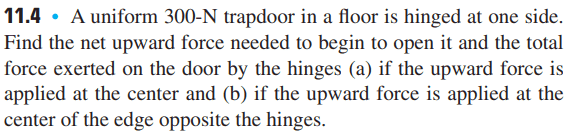
The object is moving and is undergoing a rotational motion . I then thought I could not use the equations above. So it makes me a bit confussed and I find it hard to identify when I'm dealing with a rigid-body equlibrium problem.
The object is moving and is undergoing a rotational motion . I then thought I could not use the equations above. So it makes me a bit confussed and I find it hard to identify when I'm dealing with a rigid-body equlibrium problem.
