What Does Rotating a Circular Arc Create?

2 replies · 4K views · last reply
murrdpirate0
Messages
29
Reaction score
0
A 180 degree circular arc (i.e. a half sphere) is obvious:
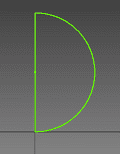
Green-outlined 2D cross-section of a solid of revolution: a vertical straight edge on the left joined to a semicircular arc bulging to the right, drawn in a 3D modelling viewport.


When you rotate this about its two end points, you get a sphere.

What about for something less than 180 degrees (e.g. 90)?:
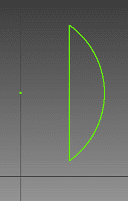
Green curved arc drawn in a CAD-style viewer, bulging to the right between two endpoints connected by a straight vertical line, against a grey background.
3D rendering of a solid of revolution formed by rotating a circular arc of less than 180 degrees about the axis joining its endpoints, shown as a lens-like shape with a green highlighted arc edge.


I believe this forms an ellipsoid, with coefficients a and b being equal, with respect to wikipedia's entry on ellipsoid: http://en.wikipedia.org/wiki/Ellipsoid. Can anyone confirm that is correct?

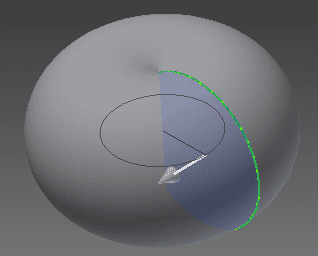
I have no idea what it would be for something greater than 180 degrees:

Green arc of a circle with its center marked by a dot, the arc spanning more than a semicircle and closed by a straight vertical segment on the left side, drawn on a dark gray background with crosshair axes.
Shaded 3D rendering of a torus-like solid of revolution with a green-highlighted circular arc sweeping around it, a translucent blue sector showing the swept region, a thin ellipse outline with a radius line, and a white arrow indicating rotation.


Its cross section would look like a butterfly. I have no idea what the 3D shape would be called. Anyone have any idea? I'm especially interested in obtaining an equation that would describe its surface.
 
Last edited:


murrdpirate0 said:
A 180 degree circular arc (i.e. a half sphere) is obvious:

Green-outlined shape on a dark background: a vertical straight edge on the left joined to a semicircular arc bulging to the right, with the arc meeting the straight edge at its top and bottom ends.


When you rotate this about its two end points, you get a sphere.

What about for something less than 180 degrees (e.g. 90)?:
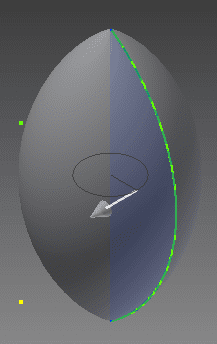
Green curve on a grey background: a vertical straight segment on the left joined at its ends to a circular arc bulging to the right, forming a lens-like closed shape.
Rendered 3D surface shaped like a lens or spindle, with pointed tips at top and bottom, shaded grey and blue, with a green curved arc along one edge and a small circle and arrow near the middle.


I believe this forms an ellipsoid, with coefficients a and b being equal, with respect to wikipedia's entry on ellipsoid: http://en.wikipedia.org/wiki/Ellipsoid. Can anyone confirm that is correct?

It cannot be an ellipsoid. The reason is that an ellipsoid is smooth everywhere, while your surface has "cusps" on the bottom and on the top.

I have no idea what it would be for something greater than 180 degrees:
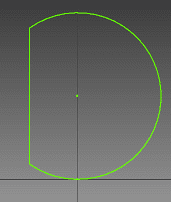
Green curve on a dark background: a circular arc of roughly three-quarters of a circle, closed by a vertical straight line on its left, with a small green dot at the centre and black axis lines crossing it.
Grey 3D surface of revolution with a black circle and a white arrow inside it, and a blue-shaded cross-section outlined in green on one side.


Its cross section would look like a butterfly. I have no idea what the 3D shape would be called. Anyone have any idea? I'm especially interested in obtaining an equation that would describe its surface.

It looks like a spindle torus: http://en.wikipedia.org/wiki/Spindle_torus
 
I was just looking at the spindle torus and I agree, that appears right. It would be preferable if I could have the math only describe the outer shell, but maybe that's not practical.

Good point about the other shape not being an ellipsoid. I don't think I would have noticed that. I guess it's actually the inner surface of the spindle torus. Being able to make an equation for that might solve both problems...

Thanks for the help. Any other ideas are warmly welcomed :)

Edit: Just found this http://mathworld.wolfram.com/Lemon.html and this http://mathworld.wolfram.com/Apple.html I need to find the intersection of these two shapes. Looks pretty promising.
 
Last edited: