What Does the Graph of This Vector Equation Look Like?

  • Context: MHB 
  • Thread starter Thread starter ineedhelpnow
  • Start date Start date
  • Tags Tags
    Vector
Click For Summary
SUMMARY

The discussion centers on the vector equation $r(t)=e^{2t}i + e^{t}j$ and its graphical representation. Participants confirm that the correct y-component is $e^{t}$, leading to the relationship $x=y^2$. This relationship indicates that the graph is a parabola, specifically the standard form of a quadratic equation. The conversation also touches on the use of MATLAB for visualizing the graph, confirming its accuracy in representing the equation.

PREREQUISITES
  • Understanding of vector equations and parametric equations
  • Familiarity with exponential functions
  • Basic knowledge of graphing parabolas
  • Experience with MATLAB for graphing
NEXT STEPS
  • Explore the properties of parabolas and their equations
  • Learn how to graph parametric equations in MATLAB
  • Study the implications of exponential growth in mathematical modeling
  • Investigate the relationship between x and y in parametric equations
USEFUL FOR

Mathematics students, educators, and anyone interested in vector equations and their graphical representations, particularly those using MATLAB for visualization.

ineedhelpnow
Messages
649
Reaction score
0
sketch the plane curve with the given vector equation

$r(t)=e^{2t}$i $+e^{r}$j

what does the graph of this look like. is there any way to get a simple equation out of the two?
 
Physics news on Phys.org
ineedhelpnow said:
sketch the plane curve with the given vector equation

$r(t)=e^{2t}$i $+e^{r}$j

what does the graph of this look like. is there any way to get a simple equation out of the two?

Can it be that the y-component should be $e^t$? :confused:

If so, suppose you define $x=e^{2t}$ and $y=e^t$.
What kind of relationship can you deduce from that? (Wondering)
 
oops. yeah the y component is e^t not e^r

- - - Updated - - -

$x=y^2$?
 
ineedhelpnow said:
oops. yeah the y component is e^t not e^r

- - - Updated - - -

$x=y^2$?

Yep! :D

What would the graph look like? (Wondering)
 

Attachments

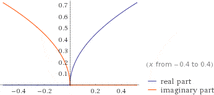
  • MSP982220ib93c4571g25e00000eca3402f9317713.gif
    MSP982220ib93c4571g25e00000eca3402f9317713.gif
    3.6 KB · Views: 78
ineedhelpnow said:
https://www.physicsforums.com/attachments/3102

Hmm... what would be the meaning of that red line?
What kind of standard graph would it be anyway? (Wondering)
 
red line is imaginary. ignore that part. the blue part represents x=y^2
 
ineedhelpnow said:
red line is imaginary. ignore that part. the blue part represents x=y^2

Yeah right!

be-rational-get-real.png
 
dude come on... grow up (Giggle)

- - - Updated - - -

or should i say get real...
 
  • #10
ineedhelpnow said:
https://www.physicsforums.com/attachments/3102

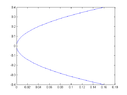
That's what I got,using matlab:

View attachment 3104

(Blush)
 

Attachments

  • matt.png
    matt.png
    1.8 KB · Views: 102
  • #11
evinda said:
That's what I got,using matlab:

View attachment 3104

(Blush)

But... but... how can $y=e^t$ be negative?? :confused:

It does look like some standard graph, doesn't it? (Wondering)
 
  • #12
I like Serena said:
But... but... how can $y=e^t$ be negative?? :confused:

It does look like some standard graph, doesn't it? (Wondering)

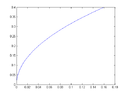
I tried it again.. (Wasntme)

View attachment 3105

Is it better now? (Blush)
 

Attachments

  • matt.png
    matt.png
    1.6 KB · Views: 92
  • #13
evinda said:
I tried it again.. (Wasntme)

https://www.physicsforums.com/attachments/3105

Is it better now? (Blush)

It's perfect! (Nod)
 

Similar threads

  • · Replies 3 ·
Replies
3
Views
1K
  • · Replies 3 ·
Replies
3
Views
2K
  • · Replies 4 ·
Replies
4
Views
2K
Replies
2
Views
2K
  • · Replies 3 ·
Replies
3
Views
3K
  • · Replies 14 ·
Replies
14
Views
5K
  • · Replies 3 ·
Replies
3
Views
2K
  • · Replies 3 ·
Replies
3
Views
2K
  • · Replies 13 ·
Replies
13
Views
2K