What Does the Mysterious Symbol in a Formal Proof Represent?

  • Context: Undergrad 
  • Thread starter Thread starter sa1988
  • Start date Start date
  • Tags Tags
    Mean Symbol
Click For Summary
SUMMARY

The mysterious symbol in the formal proof of the inertia tensor is identified as the identity matrix, denoted as \mathbb{I}. This conclusion was reached after analyzing its context within the proof and comparing it to the Kronecker delta. The symbol's appearance aligns with the LaTeX (AMS) description of "binary negative entail," but its primary function is confirmed to represent the identity matrix in the context of oscillations and eigenvalues. The discussion highlights the importance of precise symbol rendering in mathematical proofs.

PREREQUISITES
  • Understanding of formal proofs in mathematics
  • Familiarity with LaTeX typesetting for mathematical symbols
  • Knowledge of the Kronecker delta and its applications
  • Basic concepts of linear algebra, particularly identity matrices
NEXT STEPS
  • Research LaTeX rendering techniques for mathematical symbols
  • Explore the properties and applications of the identity matrix in linear algebra
  • Study the Kronecker delta and its role in tensor calculus
  • Investigate the use of Lagrangian formulations in physics, particularly in oscillation problems
USEFUL FOR

Mathematicians, physicists, students studying linear algebra and formal proofs, and anyone interested in the nuances of mathematical notation and its implications in theoretical contexts.
sa1988
Messages
221
Reaction score
23
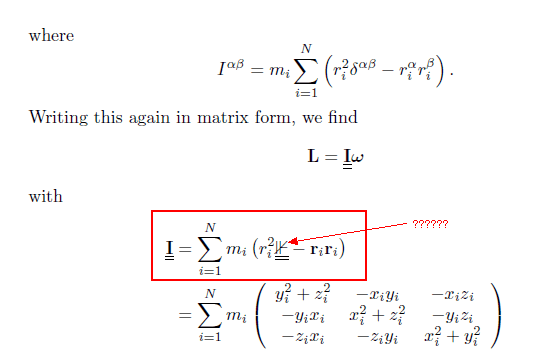
The below image shows the end part of a formal proof of the inertia tensor. There's a weird symbol in there that I've never seen before, and google isn't bringing much in the way of explanation.

Anybody know what it is? At a guess I'd say it has quite a strong connection to the Kronecker delta in the step above, but a definitive answer would be great. Thanks

3356uxw.png
 
Physics news on Phys.org
http://anorien.csc.warwick.ac.uk/mirrors/CTAN/info/symbols/comprehensive/symbols-letter.pdf

Page 52 gives the LaTex (AMS) description "binary negative entail", naively I'd say that does sound like it'd fit with being a more formal definition of whatever category contains the Kronecker delta. Further attempts at squeezing meaningful links out this symbol lead to vague hints about it being to do with model theory. Which immediately filled me with existential dread. Sorry I can't be of any more help to you, I'd like to know the answer to this as well.
 
  • Like
Likes   Reactions: sa1988
That PDF is gigantic! How did you manage to find it specifically in there?!

Either way, yeah it's an odd one. I can fathom out what it means, based on the step above, but it would be interested to see it properly defined.
 
You could compare the latex mnemonic for that symbol with the kronecker delta you expect to see if a simple typo caused it.
 
There are over 300 with the string "dash" in them, haha
 
It almost looks like the rendering of \mathbb{1} (for the identity matrix) went horribly wrong.
Edit: \mathbb{1} doesn't render properly (irony!), but \mathbb{I} gets pretty close: ##\mathbb{I}##
2nd edit: Better yet, with the double underline: ##\underline{\underline{\mathbb{I}}}##
 
  • Like
Likes   Reactions: sa1988
TeethWhitener said:
It almost looks like the rendering of \mathbb{1} (for the identity matrix) went horribly wrong.
Edit: \mathbb{1} doesn't render properly (irony!), but \mathbb{I} gets pretty close: ##\mathbb{I}##
2nd edit: Better yet, with the double underline: ##\underline{\underline{\mathbb{I}}}##

Sorry for the late reply. I don't come on here much.

I just came back to this thread to say that I've figured it out, but it looks like I was beaten to it!

It certainly must be the identity matrix.

I came across it again in the same lecture notes, at a part covering oscillations using a Lagrangian formulation and finding normal modes using eigenvalues of the resulting matrix construction.

After a bit of careful checking, it now seems obvious that the weird symbol is supposed to be the identity matrix. The image below demonstrates it pretty well (from the original tensor matrix notes I was dealing with before).

j67uq8.png


That would obviously only work if the symbol there is actually the identity matrix.
 

Similar threads

  • · Replies 2 ·
Replies
2
Views
634
  • · Replies 2 ·
Replies
2
Views
2K
  • · Replies 2 ·
Replies
2
Views
5K
  • · Replies 5 ·
Replies
5
Views
2K
  • · Replies 2 ·
Replies
2
Views
3K
  • · Replies 2 ·
Replies
2
Views
2K
  • · Replies 8 ·
Replies
8
Views
919
  • · Replies 26 ·
Replies
26
Views
7K
Replies
9
Views
6K
Replies
4
Views
3K