What factors affect stopping and directional control in basketball shoes?

  • Thread starter Thread starter potatonecromancer
  • Start date Start date
  • Tags Tags
    Potential Topic
Join the discussion
Registration is free. Ask a follow-up in this thread, or start your own.
5 replies · 2K views
potatonecromancer
Messages
3
Reaction score
0
Homework Statement
"How does the angle of a drawing board affect the friction coefficients of a basketball shoe?"

Would my question still work even if I can't direcrly measure the coefficient? Or should I change the DV variable to velocity, for example--for graphical/raw data + easier to measure, then anaylze the graph/convert/calculate for the coefficients?

I got curious of my basketball shoe's friction coefficient and tried replicating it on the closesr thing i had to a wooden floor.
Relevant Equations
Fr = uN
- Change DV to velocity and measure it with motion sensor
- create separate table/graph of friction coefficient using velocities and other information
 
Physics news on Phys.org
Welcome to PF.

I'm having trouble understanding what you have posted. What is a "drawing board" in the context of your post? And measuring the ## \mu_S ## of a baskeball shoe on wood should be pretty straightforward, no?

1644594728636.png

https://leenaphysicsbasketball.weebly.com/friction.html
 
Last edited:
berkeman said:
Welcome to PF.

I'm having trouble understanding what you have posted. What is a "drawing board" in the context of your post? And measuring the ## \mu_S ## of a baskeball shoe on wood should be pretty straightforward, no?

View attachment 296952
https://leenaphysicsbasketball.weebly.com/friction.html
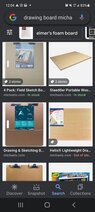
A drawing board is a wooden board, typically with clips at the top and a rubber band near the end, used to hold the paper you are drawing on down.

I'm also not sure on how to measure the coefficient itself to create a raw data table and graph for the ia...
I can "easily" measure the angle in which it start to fall, but i can't rlly direct measure the coefficient, just when it starts to and how far it might for the DV part of my raw data graph
 
Attachments
  • Screenshot_20220211-120456_Google.jpg
    Screenshot_20220211-120456_Google.jpg
    29.1 KB · Views: 143
I think that as long as you add weight to the shoe (I'm not sure how best to do that -- maybe with small rocks?), you should get a good number with the angle measurement where the shoe starts to slip.
 
  • Like
Likes   Reactions: potatonecromancer
BTW, in the link I posted there are some tips about how to maximize the friction/traction from BB shoes. Be sure to incorporate those variables into your tests.

Also, an important part of BB is being able to stop quickly and change direction. Does that involve ##F_s## or ##F_d## ?