What Factors Affect the Record for Fastest Pitch Ever Thrown?

  • Thread starter Thread starter mugaliens
  • Start date Start date
  • Tags Tags
    Pitch
Click For Summary

Discussion Overview

The discussion revolves around the factors affecting the record for the fastest pitch ever thrown, including measurement techniques, historical context, and comparisons between different pitching styles. Participants explore the implications of these factors on the perceived speed of pitches in baseball and softball.

Discussion Character

  • Debate/contested
  • Technical explanation
  • Historical

Main Points Raised

  • Some participants express skepticism about the 120 mph pitch recorded in men's underhanded fast-pitch softball, questioning its validity compared to overhand pitches.
  • Others note that the fastest recorded pitch in baseball is 105 mph, suggesting that the progression of pitch speeds has been minimal despite players historically throwing over 100 mph.
  • A participant discusses the variability in pitch speed measurements, highlighting that different measurement techniques and standards have been used over time, which complicates comparisons between past and present pitchers.
  • It is mentioned that the speed of a baseball decreases as it travels, with specific estimates provided for how much speed is lost over distance, indicating that measurement points affect reported speeds.
  • Some participants argue that the lack of standardization in measuring pitch speeds historically may lead to misconceptions about the actual progression of pitching speeds.

Areas of Agreement / Disagreement

Participants generally disagree on the validity of certain pitch speed records and the implications of measurement techniques, with no consensus reached on the accuracy of historical comparisons or the future of pitch speed records.

Contextual Notes

Limitations include the dependence on measurement techniques, historical context of pitch speed recording, and the variability in conditions under which pitches were measured. The discussion reflects a range of assumptions about the evolution of pitching speeds and the reliability of historical data.

mugaliens
Messages
197
Reaction score
1
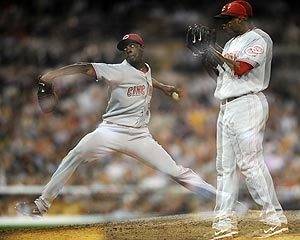
Yes, ladies and gents, it's in the record books: http://sports.yahoo.com/mlb/news?slug=sh-redspadres092410".

1285401683.jpg


But what a conflagration! I still can't discern who actually won the game!
 
Last edited by a moderator:
Physics news on Phys.org
Too bad it wasn't a strike.
 
This guys going to top that number in the next couple of years. The fact that he is only a rookie is astounding!
 
What I find rather incredible (meaning I don't believe it) is the 120 mph velocity credited to men's underhanded fast-pitch softball by the Guiness Book of World Records for many years. Phooey! According to my sources, it's Eddie Feigner, at 104 mph.

I used to pitch in Little League, and years later (after radar guns were invented) my best pitch was a measly 63 mph.

I was a good hitter, though. Just no power. Even today I can go to the batting cage and connect with more than half the 95 mph balls. It hurts like heck, though, and amounts to little more than bunting, so I stick with the 60 mph setting. :)
 
mugaliens said:
What I find rather incredible (meaning I don't believe it) is the 120 mph velocity credited to men's underhanded fast-pitch softball by the Guiness Book of World Records for many years.

My BS-meter hits a 10 on this one. Underhand pitches go slower than overhand. The MLB is a collection of the greatest ball players on the planet. And I am supposed to believe that some guy was able to go 15 mph faster than the fastest pitch of ALL TIME while he was throwing UNDERHAND! No way
 
105 is the fastest ever? I thought it would have been a little higher. Players have thrown over 100 mph for a long time. Why has the speed in pitches progressed so little?
 
leroyjenkens said:
105 is the fastest ever? I thought it would have been a little higher. Players have thrown over 100 mph for a long time. Why has the speed in pitches progressed so little?

There's two ways to measure faster pitch speeds: wait for the world to develop faster pitchers or move the measurement point.

The radars in most stadiums have reached some semblance of a standard where most measure pitch speed 50 feet from home plate. In the past, most people didn't see much point in measuring the speed of each pitch and flashing the speed on the scoreboard. Measuring a pitcher's speed with a radar was a special gimmick usually done to measure the speed of a pitcher everyone already knew was fast. In other words, the speed of past pitchers wasn't measured as often as the speed of today's pitchers are. There was little standardization to the measurements in any event.

Nolan Ryan's famous 100.9 mph pitch was measured 10 feet from home plate (not the 50 feet from home plate that has become somewhat of a standard).

Bob Feller was measured at 98.6 mph at home plate by a device normally used to test the speed of field artillery.

The speed of a baseball slows by almost 2 mph every 10 feet (depends on the rotation of the ball, how high the ball was released above the ground, etc, so you can only estimate how pitches measured at different points compare).

So, the speed of major league pitchers has probably progressed even less than you might think. Or maybe quite a bit. It was rare for pitchers' speed to be measured in the early days of baseball, but occasionally a few were measured at various ballistics testing facilities (Remington's lab for testing bullets, West Point's ballistic lab, etc). They used various systems that were different than the system used in today's ballparks and different from the Doppler radar guns used in the 70's to near present day. Walter Johnson, considered one of the hardest throwers ever topped out at 83.1 mph measured 75 feet away from where he threw the ball (about 15 feet behind home plate, had there been a home plate, which would be somewhere around 95 mph using today's 50 foot standard). Topping 90 was always very rare, but the tests were always in an environment far different (no pitching mound, etc) and the pitcher actually had to get the ball in the measuring device in order for the speed to be measured. There's really no way to compare the early day measurements to modern day measurements.

Today, I think every major league park uses MLB's Enhanced Gameday measuring system. Speeds are measured by video instead of by Doppler, so the speed displayed could be maximum speed (the 50 feet away from home plate standard), speed of the ball across home plate (which would be minimum speed) or the average speed. Just about all stadiums display maximum speed, which is obviously the more impressive number.

For Doppler measurements, the radar gun is aimed at a spot between home plate and the pitcher's mound, and the speed is measured when the ball passes through the radar gun's beam. You can pick any spot between the mound and home plate, so unless the spot the gun was aimed at was documented and the angle between the gun and pitch were determined (as Nolan Ryan's was), then the speed is hard to compare to measurements of other pitchers taken at other times at other locations.
 
Last edited:

Similar threads

  • · Replies 16 ·
Replies
16
Views
5K
  • · Replies 1 ·
Replies
1
Views
9K
Replies
3
Views
6K
  • · Replies 4 ·
Replies
4
Views
3K
  • · Replies 4 ·
Replies
4
Views
5K
  • · Replies 65 ·
3
Replies
65
Views
12K
  • · Replies 15 ·
Replies
15
Views
6K
  • Sticky
  • · Replies 48 ·
2
Replies
48
Views
69K
  • · Replies 5 ·
Replies
5
Views
4K
  • · Replies 6 ·
Replies
6
Views
6K