High School What Function Produces a Smooth Curve with Specific Symmetry and Decay?

  • Thread starter Thread starter DaveC426913
  • Start date Start date
  • Tags Tags
    Curve First order
Click For Summary
A function that produces a smooth curve starting at (0,0), peaking at n, and approaching zero at infinity can be modeled using the lognormal probability density function (pdf) or other right-skewed distributions like Pareto and Weibull. The lognormal curve has two adjustable parameters, μ and σ, which can be set to ensure the peak occurs at n by using the constraint n = μ - σ². An alternative function, y = x^m e^(-cx), can also achieve the desired characteristics, with the peak determined by the ratio n/c. For visualization, GeoGebra is recommended for plotting these functions, allowing users to manipulate parameters and see the effects on the curve. The discussion also touches on the distinction between the proposed functions and the Poisson distribution.
DaveC426913
Gold Member
Messages
24,088
Reaction score
8,222
TL;DR
Is there a simple function that would produce a curve in this family?
Helping someone with some fictional physics.

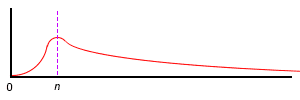
He's looking for a function that will produce a curve similar to this (poor geometry is my doing, assume smooth curvature):
1630359239267.png

Starts at 0,0.
Maximum at n.
Reaches zero at infinity.
The cusp is not sharp, it's a curve (which, I think suggests at least two variables?).

Presumably, the curve is symmetrical about n logarithmically, but not a given.
 
Physics news on Phys.org
The lognormal pdf curve matches the four criteria listed, as do a number of other right-skewed, long-tailed probability distributions (could try pareto, weibull).

It has two parameters ##\mu,\sigma## that can be adjusted to modify the shape.

To make the maximum (mode of the distribution) happen at ##x=n## we set a constraint:

$$n=\mu-\sigma^2$$
 
  • Like
Likes FactChecker
andrewkirk said:
The lognormal pdf curve matches the four criteria listed, as do a number of other right-skewed, long-tailed probability distributions (could try pareto, weibull).

It has two parameters that can be adjusted to modify the shape.
Heh. I literally just stumbled upon this before tabbing back here.
 
##x^n e^{-cx}##
It starts at 0,0, it has a maximum at x=n/c, it goes to zero for x to infinity.

If the logarithmic property is required, ##e^{-\log(x/n)^2}## will do the job (it's just a normal distribution adjusted using log(x)), but it's a bit more complicated.
 
  • Like
Likes FactChecker
mfb said:
##x^n e^{-cx}##
It starts at 0,0, it has a maximum at x=n/c, it goes to zero for x to infinity.

If the logarithmic property is required, ##e^{-\log(x/n)^2}## will do the job (it's just a normal distribution adjusted using log(x)), but it's a bit more complicated.
Thanks. What is c?

Also,where can I plug this into see it?
 
DaveC426913 said:
Thanks. What is c?
You should start with the fact that you want the peak to be at n. THIS IS NOT NECESSARILY THE n IN NBF'S POST. Using ##y= x^m e^{-cx}##, the peak is at ##m/c=n## (your ##n##). So you have a new function, ##y= x^{nc} e^{-cx}## with only the parameter, ##c##.
DaveC426913 said:
Also,where can I plug this into see it?
I like the free download of GeoGebra. It is easy to type in an equation and get a plot. In this case, you would want to first set up a parameter, c, and set the integer, n, to a value. Then define the function ##y= x^{nc} e^{-cx}##.
Here is an example.
1630391481588.png
 
Last edited:
DaveC426913 said:
Thanks. What is c?
An adjustable parameter. The ratio n/c is the position of the peak.

Example plots, both with their peak at x=1. I multiplied the second example by 3 for better comparison.
 
Here is a GeoGebra example of the lognormal method. Suppose you want the maximum value to be at n=2. That is the ##mean## of the lognormal distribution. So ##mean=2##. The lognormal has two parameters: ##NormMean## and ##NormVariance##. You can set the ##NormVariance \gt 0## parameter as you wish. The smaller you make it, the higher the maximum at n=2. The value of ##NormMean## is calculated as ##NormMean = ln(mode)+NormVariance^2##. With these parameters set, the lognormal PDF is determined. Here is the GeoGebra example.
1630425031073.png
 
andrewkirk said:
To make the maximum (mode of the distribution) happen at ##x=n## we set a constraint:

$$n=\mu-\sigma^2$$
I think that should be ##n=e^{\mu-\sigma^2}##
 
  • #10
Thanks all.
 
  • #11
What you have drawn looks like a Poisson distribution to me ...
 
  • #12
Svein said:
What you have drawn looks like a Poisson distribution to me ...
No.

This, sir, is a Poisson Distribution:
1630532463267.png


*for clarity that's a moustache, beret and ascot on a cod.
 
Last edited:

Similar threads

Replies
3
Views
2K
  • · Replies 2 ·
Replies
2
Views
3K
  • Poll Poll
  • · Replies 27 ·
Replies
27
Views
10K
  • · Replies 13 ·
Replies
13
Views
3K
  • Poll Poll
  • · Replies 2 ·
Replies
2
Views
7K
  • · Replies 5 ·
Replies
5
Views
3K
  • · Replies 6 ·
Replies
6
Views
5K
  • · Replies 1 ·
Replies
1
Views
3K
  • · Replies 35 ·
2
Replies
35
Views
29K
  • · Replies 5 ·
Replies
5
Views
4K