What is a function that is continuous at all points except the rationals?

  • Context: MHB 
  • Thread starter Thread starter Dustinsfl
  • Start date Start date
  • Tags Tags
    Function
Click For Summary

Discussion Overview

The discussion revolves around the construction of a function that is continuous at all points except the rational numbers within the interval (0,1). Participants explore various mathematical formulations and properties of such functions, including continuity, monotonicity, and the implications of rational and irrational points on the function's behavior.

Discussion Character

  • Exploratory, Technical explanation, Debate/contested

Main Points Raised

  • One participant proposes a function using a series involving the Heaviside function and rational numbers, questioning its correctness.
  • Another participant suggests an alternative function defined as a sum over the rationals in the interval, indicating a general agreement on the idea but expressing confusion over the original formula.
  • A participant raises a contradiction regarding the continuity of a proposed function at rational points, arguing that the presence of infinitely many rationals in any interval leads to a contradiction in continuity.
  • Another participant critiques the reasoning presented in the previous post, emphasizing the importance of the order of choice in proving continuity and suggesting that it is possible to construct a function that is discontinuous at every rational point while remaining continuous at every irrational point.
  • Further clarification is sought regarding the continuity conditions and the implications of choosing rational points in the context of continuity proofs.
  • A participant expresses their non-expert status in mathematics and attempts to clarify the concept of continuity for irrational points while highlighting potential misunderstandings in the arguments presented.

Areas of Agreement / Disagreement

There is no consensus on the correctness of the proposed functions or the arguments regarding continuity. Multiple competing views and interpretations of continuity and the behavior of functions at rational and irrational points remain unresolved.

Contextual Notes

Participants express uncertainty regarding the definitions and implications of continuity in the context of rational and irrational numbers, indicating a need for further clarification and reflection on the topic.
Dustinsfl
Messages
2,217
Reaction score
5
Construct a function on $(0,1)$ that is continuous at all points except the rationals, is monotone increasing, is right continuous at all points on $(0,1)$, and such that $f(0) = 0$ and $f(1) = 1$.

$$
f(x) = \sum_{n=1}^{\infty}\frac{a_{n+1} - a_n}{a_na_{n+1}}H_n(x-\mathbb{Q})
$$
where $H_n$ is the Heaviside function and the rationals are of the form $\frac{1}{a_n}$.
Is this correct?
 
Physics news on Phys.org
dwsmith said:
Construct a function on $(0,1)$ that is continuous at all points except the rationals, is monotone increasing, is right continuous at all points on $(0,1)$, and such that $f(0) = 0$ and $f(1) = 1$.

$$
f(x) = \sum_{n=1}^{\infty}\frac{a_{n+1} - a_n}{a_na_{n+1}}H_n(x-\mathbb{Q})
$$
where $H_n$ is the Heaviside function and the rationals are of the form $\frac{1}{a_n}$.
Is this correct?
I think that you have the right general idea, though I don't understand the actual formula that you are proposing (and to be blunt, I don't think it makes any sense at all). The key thing must be that there are countably many rationals in the unit interval. Let $\{r_1,r_2,r_3,\ldots\}$ be an enumeration of the rationals in $(0,1)$, and define $$f(x) = \sum_{n=1}^{\infty}2^{-n}H(x-r_n),$$ where $H$ is the Heaviside function.
 
dwsmith said:
Construct a function on $(0,1)$ that is continuous at all points except the rationals...

I think that this concept would be a little better specified. Calling $\varphi(x)$ this function if $x_{0}$ is irrational, under Your hypothesis, for an $\varepsilon>0$ it exists a $\delta>0$ for which for all x for which $|x-x_{0}| < \delta$ is $|\varphi(x) - \varphi(x_{0})|< \varepsilon$. Now in any interval $(x,x_{0})$ there are infinite rational values of x so that, swapping the roles of $x_{0}$ and $x$ we conclude that $\varphi(x)$ is continuos also per rational values of x... contradiction!...

Kind regards

$\chi$ $\sigma$
 
chisigma said:
I think that this concept would be a little better specified. Calling $\varphi(x)$ this function if $x_{0}$ is irrational, under Your hypothesis, for an $\varepsilon>0$ it exists a $\delta>0$ for which for all x for which $|x-x_{0}| < \delta$ is $|\varphi(x) - \varphi(x_{0})|< \varepsilon$. Now in any interval $(x,x_{0})$ there are infinite rational values of x so that, swapping the roles of $x_{0}$ and $x$ we conclude that $\varphi(x)$ is continuos also per rational values of x... contradiction!...
That argument is false, and it neatly illustrates the importance of order of choice in analysis proofs.

When you use the fact that $\varphi$ is continuous at $x_0$, you start with two given elements: the point $x_0$ and the number $\varepsilon>0$. You then obtain a number $\delta>0$ (which depends on $x_0$ and $\varepsilon$) and you choose a rational point $x$ such that $|x-x_0|<\delta$. Thus $x$ depends on $x_0$, $\varepsilon$ and $\delta$.

You then claim that "swapping the roles of $x_{0}$ and $x$ we conclude that $\varphi(x)$ is continuous" at $x$. But that is not allowed. The roles of $x_0$ and $x$ are not symmetrical, because $x$ depends on $x_0$. To prove that $\varphi(x)$ is continuous at $x$, you would need to start with $x$ and $\varepsilon$, and find a $\delta>0$ such that $|\varphi(x') - \varphi(x)|<\varepsilon$ whenever $|x'-x|<\delta.$ But you cannot use the $\delta$ from the previous paragraph, because that was chosen before $x$. To prove continuity at $x$, you have to start with $x$ before knowing $\delta$. The order of choice is wrong, and the "proof" fails.

In fact, it is quite possible to have a function that is discontinuous at every rational point and continuous at every irrational point. See the function that Wikipedia calls Thomae's function.
 
Opalg said:
... when you use the fact that $\varphi$ is continuous at $x_0$, you start with two given elements: the point $x_0$ and the number $\varepsilon>0$. You then obtain a number $\delta>0$ (which depends on $x_0$ and $\varepsilon$) and you choose a rational point $x$ such that $|x-x_0|<\delta$. Thus $x$ depends on $x_0$, $\varepsilon$ and $\delta$...

That is not what I said... the condition $|x-x_{0}|<\delta$ must be true for any x, rational and irrational...

Anyway the question is complex and requires to me adequate 'reflection time'...

Kind regards

$\chi$ $\sigma$
 
Before to proceed in this discussion an important detail: I'm not a Mathematician and all what is about 'abstact logic',' patological functions', 'indeterminate forms' and 'removable singularties' is very far from how my brain works...

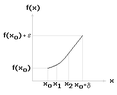
Now I'try to clarify a little, and with benefit for anyone, the question about the function that is contonous for irrationals and discontinuos for rationals. Let br f(x) such a functions and for clarity sake we will use the following [pure explicative...] pitcure... View attachment 462

Let be $x_{0}$ an irrational and 'by definition' f(x) is continuos in $x=x_{0}$. That means that, given an $\varepsilon>0$ it exists a $\delta>0$ for which for any $|x-x_{0}|<\delta$ is $|f(x)-f(x_{0}| < \varepsilon$. Now we choose two rational values of x in $(x_{0},x_{0}+\delta)$ with $x_{2}-x_{1}= \sigma>0$. According with what we have said is $|f(x_{1})-f(x_{0}| < \varepsilon$ and $|f(x_{2})-f(x_{0}| < \varepsilon$ and that means that $|f(x_{2})-f(x_{1})|< 2\ \varepsilon$ for $|x_{2}-x_{1}| < \sigma$...

... in other words f(x) seems to be continuous both in $x_{2}$ and $x_{1}$...

For the reasons I explained before this is my last post on this thread... Kind regards $\chi$ $\sigma$
 

Attachments

  • MHB72.PNG
    MHB72.PNG
    749 bytes · Views: 98

Similar threads

  • · Replies 11 ·
Replies
11
Views
3K
  • · Replies 4 ·
Replies
4
Views
3K
  • · Replies 38 ·
2
Replies
38
Views
5K
  • · Replies 2 ·
Replies
2
Views
3K
  • · Replies 21 ·
Replies
21
Views
3K
  • · Replies 1 ·
Replies
1
Views
2K
  • · Replies 2 ·
Replies
2
Views
2K
  • · Replies 12 ·
Replies
12
Views
3K
  • · Replies 2 ·
Replies
2
Views
3K
  • · Replies 1 ·
Replies
1
Views
2K