norak
- 2
- 0
Hi, everyone, I'm new here and don't know how to type mathematics, but I have a scanner.
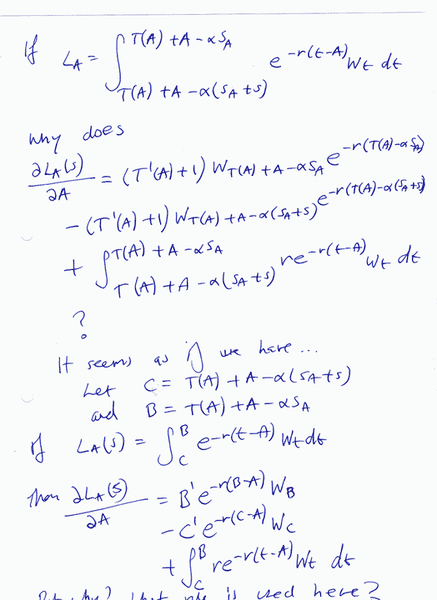
I have a function L_A and it is an integral. I want to differentiate this function with respect to A. I already have the answer written but what I don't know is how it was obtained.
Just by looking at the answer I can sort of see some sort of pattern, and I have written what I think is some sort of rule on the second half of this page, but I still don't really know what kind of differentiation rule is used here, so if any smart people here know it would greatly help me thanks!
I have a function L_A and it is an integral. I want to differentiate this function with respect to A. I already have the answer written but what I don't know is how it was obtained.
Just by looking at the answer I can sort of see some sort of pattern, and I have written what I think is some sort of rule on the second half of this page, but I still don't really know what kind of differentiation rule is used here, so if any smart people here know it would greatly help me thanks!