What is meant by decay constant?

Click For Summary
SUMMARY

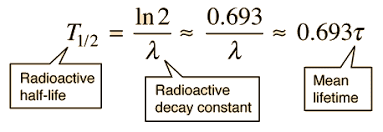
The decay constant (λ) is a fundamental parameter in exponential decay processes, representing the probability of decay per unit time. For example, if λ=1, the expected half-life is approximately 0.693 seconds, indicating that after this time, half of the original atoms will remain undecayed. The confusion arises when interpreting λ as a direct probability of decay over finite intervals; it is only accurate for infinitesimal time intervals. The relationship between the decay constant and half-life is mathematically defined as T1/2 = 0.693/λ.

PREREQUISITES
  • Understanding of exponential decay principles
  • Familiarity with basic probability concepts
  • Knowledge of differential equations
  • Basic calculus skills for interpreting decay equations
NEXT STEPS
  • Study the mathematical derivation of the exponential decay formula N(t) = N0e-λt
  • Learn about the relationship between decay constant and half-life in various contexts
  • Explore applications of decay constants in fields like radioactivity and population dynamics
  • Investigate the use of probability distributions in decay processes, particularly the exponential distribution
USEFUL FOR

Students of physics, researchers in nuclear science, and anyone interested in understanding the principles of exponential decay and its applications in various scientific fields.

erazork
Messages
1
Reaction score
0
TL;DR
What is meant by decay constant?
Hello everyone.

First my english is not good, sorry for that. So i am not a physician, i am just somebody who wants to learn things by myself, and therefore i don't have many people to ask from, if i am stuck. So here it goes.
There are many threads about this question already, and i am still failing to understand what decay constant actually means, because the answers dosent make sense to me. Here is a forum, with this question-https://www.physicsforums.com/threads/what-is-meant-by-decay-constant.590778/

Copy paste from it-
Eg if λ= 0.1 and we start with 1000 atoms then after 1 second 100 will have decayed and 900 will be left undecayed.
the decay constant is also a probability of decay...

And similar answers like this appear later on. Here is my problem.

Let λ =1, that would mean that a particle has 100 % chance to decay after 1 second, so it has to decay. So according to the equation
1609502369190.png

half life has to be ln2, which is 0,693 s. But after two half lifes, approxymately 1,4s, we would still have one quarter of our original atoms undecayed. That dosent correspond with the assumption that the decay constant is 1, because after passing 1 sec, 100% decay chance would mean we don't have any undecay atoms.
Somewhere there is a flaw in my thinking, i just can't find it alone.
 

Attachments

  • 1609502157272.png
    1609502157272.png
    89 bytes · Views: 213
  • 1609502164912.png
    1609502164912.png
    89 bytes · Views: 229
  • 1609502362993.png
    1609502362993.png
    5.4 KB · Views: 286
Physics news on Phys.org
erazork said:
Summary:: What is meant by decay constant?

Let λ =1, that would mean that a particle has 100 % chance to decay after 1 second, so it has to decay
That is not correct. This is exponential decay
 
  • Like
Likes   Reactions: etotheipi and Lord Jestocost
Ah no, I think this is a common confusion. It's only really right to say that the probability a nucleus decays in an infinitesimal time ##dt## is ##\lambda dt##. For any finite time ##\delta t##, the probability it decays in this interval will not be ##\lambda \delta t##.

You can think of it like this; let's say we have a single nucleus with decay parameter ##\lambda##, and we want to figure out the probability distribution of the time ##T## at which it decays. Let us suppose, that the probability it "survives" at least a time ##t## is ##S(t)##. What is the probability that it decays in the interval ##[t, t+ dt]##? It will be ##\lambda dt##. In that case, the probability that it "survives" at least a time ##t + dt## is simply the probability that it survives at least a time ##t##, i.e. ##S(t)##, multiplied by the probability that it survives in the next interval ##dt##, i.e. ##1-\lambda dt##, which gives ##S(t+dt) = S(t)[1-\lambda dt]##.

This is now just a differential equation that you can solve,$$\frac{dS(t)}{dt} = - \lambda S(t) \implies S(t) = e^{-\lambda t}$$where the pre-exponential factor from the integration constant is ##1##. Now, let ##T## be the random variable denoting the time at which the particle decayed. It's cumulative distribution function satisfies$$F_{T}(t) = P(T \leq t) = 1 - P(T > t) = 1- S(t) = 1- e^{-\lambda t}$$The density function is$$f_{T}(t) = \frac{dF_{T}(t)}{dt} = \lambda e^{-\lambda t}$$This is the well known exponential distribution
 
Last edited by a moderator:
  • Like
Likes   Reactions: phyzguy and vanhees71
@etotheipi you did notice that this is a B-level thread, I hope? :smile:

@erazork if you haven't had enough calculus to work through that differential equation, don't worry about it; just note that this problem is a lot easier with mathematical tools that you will eventually learn.
erazork said:
Let λ =1, that would mean that a particle has 100 % chance to decay after 1 second,
That's not right because ##\lambda## doesn't mean quite what you're thinking. You are thinking that the probability of a particle decaying in time ##t## is ##\lambda t##, but that's just an approximation that works reasonably well as long as ##t## is small compared to the half-life - in your example with ##\lambda=1## and a half-life of .693 the approximation won't even come close and that's what you're seeing.

Etotheipi's post is about how to make that approximation exact.
 
  • Like
Likes   Reactions: Vanadium 50, Astronuc, Doc Al and 1 other person
The decay constant is the constant of proportionality that relates the rate of decay (disintegrations per second) to the number of nuclei that are available for decay

i.e. The change in the number of undecayed nuclei in a small interval of time at any time = - λ times the number of undecayed nuclei present at the given time.

This rate is an instantaneous value, that is, the value at a specific time only. As time progresses the rate according to the relation above decreases because N decreases at every instant so the decay process necessarily slows down. The decay decelerates. If you use up p percentage of the nuclei the resulting decay rate is p% less. For such a situation for a specific time interval during the decay, there is a specific fractional or percentage decrease in the remaining nuclei and a corresponding decrease in the decay rate. This behavior is characteristic of exponential decay.

Stated mathematically, if Y = aX for the constant a, for every specific change in X there will be a specific fractional (percentage) change in Y.

To make this clear mathematically using only algebra.

The decay law is N(t) = N0e -λt

If we multiply both sides by a number c <1 so that cN(t) = cN0e -λt we show how a fraction of N is related to time. c is a constant and we can express this in any form we wish. For this we choose

c= e-λt' where t' is a constant and has dimensions of time (why?).

so that cN = e-λt' N0e -λt

= N0e-(λt+λt')

=N0e-λ(t+t')

If you increase the time by a specific increment t' in this case, you will decrease the undecayed nuclei by a certain fraction c.

Typically the decay law is be expressed for a decay of 50% of nuclei in terms of a time increment called the half-life.

N=N0(1/2)-0.693t/t½

Can you show what this would be in terms of the tenth life, the time for the decay to leave only 10% of the nuclei?
 
Last edited:
  • Like
Likes   Reactions: vanhees71 and Astronuc
OK, I don't like that name for the constant, instead I prefer the half-lifetime or something that is really related to time and something that can be physically understood. The constant on itself, with the same characteristics, is found in many other fields or applications where exponential relationships (decays or explosions) occur e.g. Covid infections in some format, or the population of animals/cells (more will bear more) and there it changes names. That is because the parameter \lambda is nothing else than the proportionality constant between a rate of change that depends on the "current" state (e.g. cells will give 2, 4, 8, 16 ,... cells as they split, and so at each splitting the change depends on the current population).
Nevertheless, in radioactivity (as the number of radioactive nuclei decreases) this is written by the following equation:
\frac{dN}{dt} = -\lambda N.
1609918889255.png

if you don't want to read a lot of maths, you can think of the decay constant as a parameter that tells you how fast your populations starting at the same point changes... I attach some plots of how the number of remaining nuclei will look after some time for different values of λ, where the starting point is taken at 1000. You can see that at 0.693~\text{sec} the population of λ=1 has dropped to 500 (halfened), while the halfening for the λ=0.5 (slow) happens at 2\times 0.693=1.386~\text{sec}. At that time the λ=1 has also halfened compared to how it was in its previous stamp (500->250), and so it has been dropped to 1/4 of its original (1000->250).

So overall:
A small decay constant (λ<1) means that the half-lifetime of the population is large, so they will decay slower.
A large decay constant (λ>1) means that the half-lifetime of the populations is small, so they will decay faster.
"faster"/"slower" is somewhat arbitrary, and I meant with respect to λ=1 where they decay to their half at each step of 0.693seconds.
 
You can get the constant exactly noting that
$$N(t)=N_0 (1/2)^{t/T_{1/2}}=N_0 \exp(-\lambda t).$$
Taking the natural logarithm leads to
$$\ln N(t)=\ln N_0+\frac{t}{T_{1/2}} \ln(1/2)=\ln N_0-\lambda t.$$
Solving for ##T_{1/2}## finally gives
$$T_{1/2}=-\frac{\ln(1/2)}{\lambda}=+\frac{\ln 2}{\lambda}.$$
 
  • Like
  • Informative
Likes   Reactions: dlgoff and Keith_McClary

Similar threads

  • · Replies 8 ·
Replies
8
Views
3K
  • · Replies 6 ·
Replies
6
Views
2K
  • · Replies 2 ·
Replies
2
Views
3K
  • · Replies 4 ·
Replies
4
Views
4K
  • · Replies 19 ·
Replies
19
Views
4K
  • · Replies 2 ·
Replies
2
Views
2K
  • · Replies 44 ·
2
Replies
44
Views
5K
  • · Replies 20 ·
Replies
20
Views
88K
  • · Replies 3 ·
Replies
3
Views
11K
  • · Replies 4 ·
Replies
4
Views
4K