What is meant by Newton's Rules, if A+B=C, A=C and B=C?

  • Level: Undergrad 
  • Thread starter Thread starter PLAGUE
  • Start date Start date
Join the discussion
Registration is free. Ask a follow-up in this thread, or start your own.
6 replies · 2K views
PLAGUE
Messages
46
Reaction score
2
TL;DR
Newton's Rules: if A+B=C, A=C and B=C?
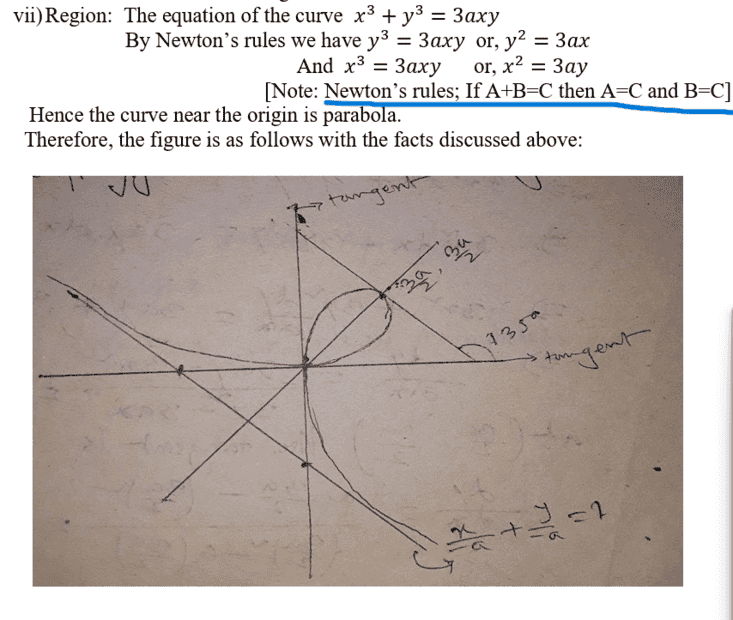
What is it meant by Newton's Rules in point (vii)?
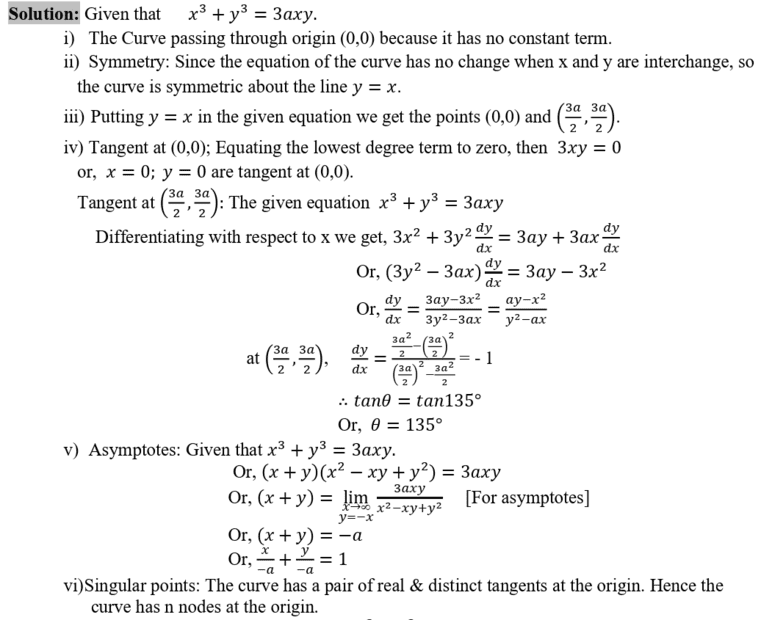
Screenshot 2024-02-21 141024.png
Screenshot 2024-02-21 141049.png
 
Mathematics news on Phys.org
Have you looked up "newton's rules" in the index of the text where you found the problem? Certainly google has turned up nothing relevant, which suggests that it is not a currently or widely used term.

Fronthe context, I guess it has something to do with multiple branches at the origin.
 
Last edited:
I have never heard of this term and couldn't Google it either. I meditated on the technique and I suspect the point is if you're near the origin and x is not equal to y, one of them is smaller, and you can throw out the highest order term in that variable to see locally what the graph looks like. This A+B=C statement is hiding a lot of work if that's what is going on.
 
  • Like
Likes   Reactions: WWGD and PeroK
There's an asymptotic principle that if ##A(x) + B(x) = C(x)## and both sides tend to infinity, then one of the terms ##A(x)## or ##B(x)## should become negligible towards the limit. So, either ##A(x)## or ##B(x)## is asymptotic to ##C(x)##, but probably not both. That is, of course, only a practical rule of thumb.
 
  • Informative
  • Like
Likes   Reactions: Gavran and jack action
WWGD said:
Maybe you can paste in a copy of the problem statement and not just the conclusion?
I think the problem statement is draw a graph of ##x^3+y^3=3axy## but I agree it would have been nice