What is meant when $\sigma$ is said to be discriminatory?

  • Level: Graduate 
  • Thread starter Thread starter jamesb1
  • Start date Start date
  • Tags Tags
    Measure theory
Join the discussion
Registration is free. Start your own thread to ask a follow-up.
5 replies · 2K views
jamesb1
Messages
22
Reaction score
0
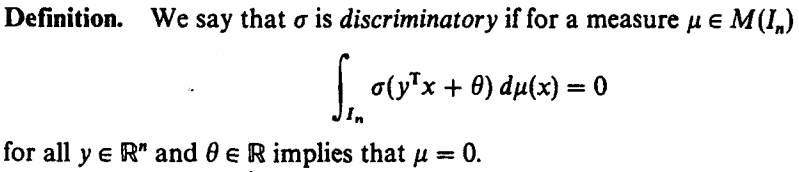
I am reviewing this http://deeplearning.cs.cmu.edu/pdfs/Cybenko.pdf on the approximating power of neural networks and I came across a definition that I could not quite understand. The definition reads:
0OFMv.png


where $I_n$ is the n-dimensional unit hypercube and $M(I_n)$ is the space of finite, signed, regular Borel measures on In.

The only thing that I could get from this definition which again does not seem plausible enough is: since whenever the integral is 0 it must imply that the measure μ is 0, then σ is non-zero. I am not sure if this right though.

I literally could not find any other literature or similar definitions on this and I've looked in a number of textbooks such as Kreyzig, Rudin and Stein & Shakarchi.

Any insight/help?
 
Last edited by a moderator:
Physics news on Phys.org
Well, if you tell us up front what you understand and the main definitions/results you are working with, we may be better able to help you.
 
jamesb1 said:
where $I_n$ is the n-dimensional unit hypercube and $M(I_n)$ is the space of finite, signed, regular Borel measures on I_n.

The only thing that I could get from this definition which again does not seem plausible enough is: since whenever the integral is 0 it must imply that the measure μ is 0, then σ is non-zero. I am not sure if this right though.

WWGD said:
Well, if you tell us up front what you understand and the main definitions/results you are working with, we may be better able to help you.

The other definitions in the paper I linked are not really necessary as this definition does not take any special insight from them. I gave the information needed specifically for I_n and M(I_n) because they're mentioned but other than that, it can pretty much be taken as a standalone definition in my opinion. I just cannot understand what the correlation is between the integral being zero and the measure being zero. What does that tell us about the function sigma and how is it the case? I said what I think but I do not think it is correct.

*** EDIT ***
What MAY be of use is the fact sigma in this definition is possibly being taken as sigmoidal ONLY, but then again if that is the case then my understanding does not make sense since a sigmoid function f(t) can tend to zero as t -> -∞
 
Last edited:
All I know is the definition I read, in which I understood that ##\sigma ## is intended to approximate a characteristic function of a set S, i.e., to be 1 on S and 0 otherwise.