What is the Average Speed of an Object Traveling 12 Meters in 9 Seconds?

Click For Summary

Homework Help Overview

The discussion revolves around calculating the average speed of an object that is said to travel 12 meters in 9 seconds. Participants are exploring the implications of the given data and the assumptions underlying the average speed calculation.

Discussion Character

  • Conceptual clarification, Assumption checking, Problem interpretation

Approaches and Questions Raised

  • Some participants question the validity of the distance and time values provided, noting that the object may not have actually traveled 12 meters in the specified time frame. They discuss the importance of understanding the change in distance and time rather than just the total values given.

Discussion Status

There is an ongoing examination of the problem's setup, with participants offering insights into how the average speed should be calculated based on changes in distance and time. Multiple interpretations of the data are being explored, and some participants express concern about the clarity and construction of the question itself.

Contextual Notes

Participants note that students are not expected to understand velocity and should only manipulate the speed equation. There is also mention of ambiguity in the data points provided, which affects the interpretation of the average speed calculation.

erandall
Messages
5
Reaction score
0
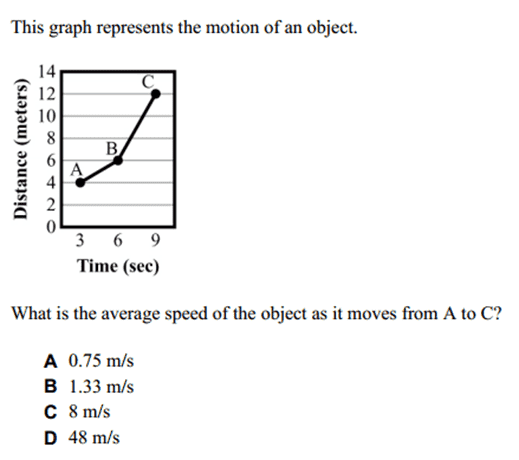
1. I'm a middle school science teacher without a science or math background. My goal here is to avoid teaching an explanation that kids will have to unlearn later in their academic career. I'm designing a lesson to teach students how to answer this question:
upload_2015-2-15_15-4-51.png
2. Limitation: students are NOT expected to understand velocity, they only need to manipulate the Speed= distance/time equation.

3. As far as I can tell from the answer choices, the answer should be 1.33 m/s, which is the ending speed. Logically, this makes sense to me: if the object was able to travel 12 meters in 9 seconds, then that final data point is essentially averaging the time that it takes to travel the total distance, despite any changes in rate that may occur throughout the line.

However, I seem to remember--and googling seems to confirm-- that this isn't actually the way mathematically to find the average slope of a function. So why does this work? Or am I actually incorrect about the answer?


If possible, could you please explain in terms that would make sense to a student who hasn't had a math or science education beyond the 6th grade. The more simple and concrete, the better!

Thanks for your help.
 
Physics news on Phys.org
The chart is ambiguous.
The only recorded data points are from 3s onwards. And at that point, it was already 4m distant from some reference point. You cannot say that is has moved 12m.

You can say that is has moved (12-4=) 8m in (9-3=) 6s, which is, in fact 1.33m/s, but not for the reason you state.
 
The object doesn't travel 12 meters in 9 seconds (this just coincidentally gives the right answer).

As it travels from A to C it only travels 12-4=8 meters (because it starts out at 4 meters already). And it doesn't take 9 seconds because it's at point A at t=3 seconds, so it only takes 9-3=6 seconds. Thus the average speed is 8/6 m/s.

The important thing to realize is that the correct form of "average speed = distance / time" should actually be "average speed = (change in distance) / (change in time)"
(Well, this isn't strictly true. For example, if you're running in a circle, the average speed is clearly not zero, but the change in distance will sometimes be zero so this formula will be wrong. But I'm sure if you don't expect them to understand velocity, then you will keep everything 1 dimensional, in other words, movement is restricted to straight lines.)

The starting time (3 seconds) and the starting distance (4 meters) are completely arbitrary. We could have said the starting time was 15 years, and the starting distance was 100 miles, but this has no effect on the average speed.
 
DaveC426913 said:
The chart is ambiguous.
The only recorded data points are from 3s onwards. And at that point, it was already 4m distant from some reference point. You cannot say that is has moved 12m.

You can say that is has moved (12-4=) 8m in (9-3=) 6s, which is, in fact 1.33m/s, but not for the reason you state.
Quite, and this makes it a poorly constructed question for multiple choice. The student has a high chance of picking the right answer for the wrong reason.
 

Similar threads

Replies
1
Views
2K
  • · Replies 11 ·
Replies
11
Views
5K
  • · Replies 5 ·
Replies
5
Views
3K
  • · Replies 4 ·
Replies
4
Views
2K
Replies
3
Views
2K
Replies
4
Views
3K
Replies
8
Views
2K
Replies
11
Views
12K
  • · Replies 31 ·
2
Replies
31
Views
4K
Replies
5
Views
2K