SUMMARY
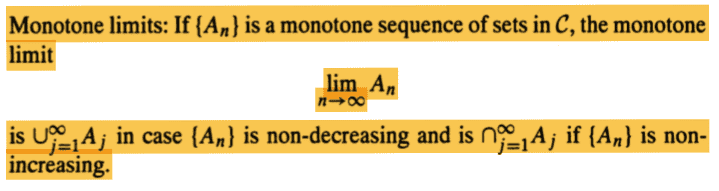
The concept of monotone limits refers to two distinct definitions based on the behavior of sequences of subsets. A non-decreasing sequence of subsets, denoted as ##A_1 \subseteq A_2 \subseteq \ldots##, has a monotone increasing limit defined as ##\lim_{n\to \infty} A_n = \bigcup_{n=1}^\infty A_n##. Conversely, a non-increasing sequence, denoted as ##A_1 \supseteq A_2 \supseteq \ldots##, has a monotone decreasing limit defined as ##\lim_{n\to \infty} A_n = \bigcap_{n=1}^\infty A_n##. The terminology used in literature can be misleading, as both limits are often referred to collectively as "monotone limits," which can cause confusion.
PREREQUISITES
- Understanding of monotonic convergence theorem
- Familiarity with set theory and subset notation
- Basic knowledge of limits in mathematical analysis
- Exposure to probability theory concepts
NEXT STEPS
- Study the monotonic convergence theorem in detail
- Explore set theory, focusing on unions and intersections of sets
- Review literature on probability theory, specifically "A Probability Path" for graduate students
- Investigate the implications of terminology in mathematical definitions
USEFUL FOR
Mathematicians, graduate students in probability theory, educators teaching set theory, and anyone interested in the precise definitions of limits in mathematical contexts.