What is the critical speed of the hollow shaft and how can it be increased?

  • Thread starter Thread starter sallama
  • Start date Start date
  • Tags Tags
    Shaft Speed
Click For Summary

Discussion Overview

The discussion revolves around the critical speed of a hollow shaft and strategies for increasing it. Participants explore theoretical calculations, practical modifications, and the implications of design choices on the shaft's performance, particularly in the context of a specific application involving deburring and grinding hard materials.

Discussion Character

  • Exploratory
  • Technical explanation
  • Debate/contested
  • Mathematical reasoning

Main Points Raised

  • One participant calculates the critical speed of the hollow shaft to be approximately 10,000 RPM but observes resonance at around 2,500 RPM.
  • Another participant suggests that the first vibration mode of the central shaft is about 50 Hz, which may correspond to the observed resonance.
  • There are inquiries about methods to increase the critical speed to 90-95 Hz without producing new components, including adding mass to the inner side of the hollow shaft.
  • Participants discuss the potential effects of changing the material of the inner shaft and whether it would significantly impact the critical speed.
  • Some propose making the inner shaft lighter or altering its shape to improve its stiffness and reduce the critical speed.
  • There are conflicting calculations regarding the fundamental frequency of the shafts, with one participant obtaining a frequency of ~176 Hz while others calculate around 49 Hz.
  • Discussion includes the possibility of having two sets of frequencies for the inner non-rotating shaft and the outer rotating hollow shaft, with some noting the coupling effects through the bearings.

Areas of Agreement / Disagreement

Participants express differing views on the effectiveness of various modifications to increase critical speed. There is no consensus on the best approach, and calculations of critical frequencies vary among participants, indicating unresolved aspects of the discussion.

Contextual Notes

Participants mention limitations in their calculations, including assumptions about shaft support and material properties. The discussion reflects a range of theoretical models and practical considerations without definitive conclusions.

Who May Find This Useful

Engineers and designers working with rotating machinery, particularly those focused on vibration analysis and structural dynamics, may find the insights and calculations relevant to their work.

sallama
Messages
5
Reaction score
0
I want to figure out critical speed of hollow shaft. When I calculate from equation, critical speed of this shaft is approximately 10000 RPM. But when I start to increase speed of shaft, at ~2500 RPM I see that the critical speed occurred. What can I do to increase this critical speed to double, (to add mass under hollow shaft?). And what is the problem that I can not calculate real critical values. Assy Configuration, Fixed Shaft, Grooves, Length??

System can be seen at attachment. On the center axis of the shaft, a non turn shaft placed. On this shaft there are two 6308 Ball bearings to allow turn the hollow shaft. On the hollow shaft there are grooves.

Hollow Shaft info:
Material: Steel (I don't know exactly which type, but producer said that ST37/ASTM A283)
Do= 160mm
Di=129mm
Length (Center From Bearing)=1350mm
Total Length=1500mm
Distribution Force (approximate) =1500N
Fixed Shaft D=45mm
Bearing Type: Ball Bearing 6308Motor: 15 KW
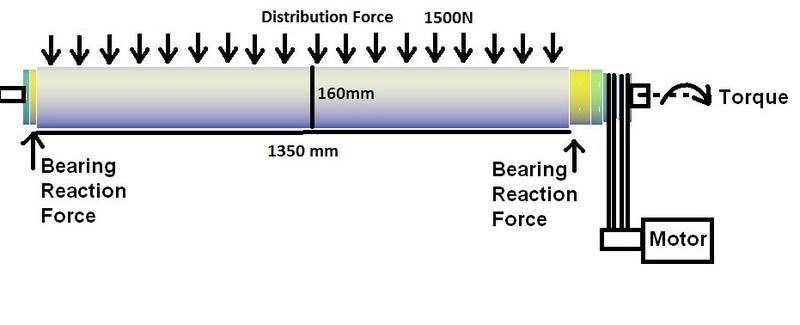
Hollow_Shaft-FBD.jpg
 

Attachments

  • Hollow_Shaft-Model.jpg
    Hollow_Shaft-Model.jpg
    9.7 KB · Views: 923
  • Hollow_Shaft-2.jpg
    Hollow_Shaft-2.jpg
    50.2 KB · Views: 949
Engineering news on Phys.org
From a hand calc, I get the first vibration mode of the central shaft = about 50 Hz = 3000 RPM.

I guess that is where your resonance at 2500 RPM is coming from.
 
Thanks AlephZero,

What is your advice to increase this critical speed to 90-95 Hz without new production. Because i want to run the hollow shaft with half of the critical speed, and this will be 2500x2=5000 RPM. But above 4000 RPM will be enough. Where and which sizes can l add mass to the inner side of the hollow shaft. The inner diameter of hollow shaft is 129mm, so that my adding cylinder' outer diameter will be 129mm. And what should be the length and inner diameter of these cylinders?

I use software and hand formula to get critical speed. Which formula did you use with which datas?

Thank a lot for your interest and favour.
Serkan
 
I assumed the center shaft was a beam pinned at the bearing positions. That is not quite right because presumably it is also supported at the ends and the mass of the outer shaft will have a small effect. That would make the actual frequency lower than my 50 Hz which and that is what you are seeing.

Changing the hollow shaft won't make much difference. You need to change the frequency of the center shaft. If its only purpose is to support the bearings at the ends, you could probably make a different design with no center shaft at all. It's not very clear from your drawings if it has some other purpose as well.

Maybe you could also fix the problem by making the center shaft more flexible to reduce the 2500RPM frequency. Accelerate through it and run the machine above it.
 
Yes, you are right.
Center shaft doesn't rotate.Center Shaft only for fixing and bearings mounted on it. This was done because I have limited hollow shaft material/tube (Length & Diameter is limited per my design so that I should use inner shaft for unbalance and fix). I can not change design that any new hollow/outer shaft. But I have a chance to make different inner/center shaft if this doesn't take too much time. Or any adding some mass between outer & inner shaft without any unbalance.

I must not run above its critical speed because of machine/fatigue/bearing life. This is special machine to deburring&grinding hard material. So, I should increase critical speed.

Will "Change inner shaft with high strength steel" be a solution for increase critical speed? or any other opinions.
Thanks for your reply...
Serkan
Hollow_Shaft-FBD_Rev.jpg
 

Attachments

  • Hollow_Shaft-3.jpg
    Hollow_Shaft-3.jpg
    36.1 KB · Views: 710
  • Hollow_Shaft-1.jpg
    Hollow_Shaft-1.jpg
    45.7 KB · Views: 729
Changing the material of the inner shaft won't make much difference. For the same shape of object, the material property that controls the vibration frequency is the ratio of E/\rho, and that is very similar for any structural metal.

You need to make the inner shaft stiffer, and/or lighter. For a beam the frequencies are proportional to \sqrt{EI/m} where m is the mass per unit length. For a circular beam I is proportional to d^4 and m is proportional to d^2 so the frequency is proportional to the diameter.

You could make the center shaft lighter by fabricating it in three parts, with most of the length as another hollow tube. Or you could machine the solid shaft into a cross-shape to reduce the mass but keep the bending stiffness large.
 
From your answers, I should apply some solutions...

-inner shaft will be lighter with decreasing diameter between bearings. Or machine shaft to cross shape between bearings? will this be effect worst fatigue life in the future??
-Is there a good choice to apply heat treatment to get harder steel?
-If inner shaft produce in three parts, I think I will have trouble with rigidity when assy of these part will be done.

I have only one choice to apply one of the solution, because I don't have any time and any extra material. Which solution must I select?

Thank yo very much AlephZero...
For your fast response...
Serkan
 
And is there any solution for rotating hollow shaft. Not for the non rotate center shaft
 
sallama said:
I have only one choice to apply one of the solution, because I don't have any time and any extra material. Which solution must I select?
Nobody here can answer that question from the limited amount of information we have here.

I've told you what I think the problem is, and if that really is the problem some ideas about how to fix it. If it was my job to sort this out, I would want to spend a lot more time working on it than I'm going to do here, for free.
 
  • #10
AlephZero said:
From a hand calc, I get the first vibration mode of the central shaft = about 50 Hz = 3000 RPM.

I guess that is where your resonance at 2500 RPM is coming from.

How did you calculate it? I get frequency of ~176Hz.
As far as i know-for steel shafts f=2.01*10^6*(d/L^2)
 
  • #12
I took it from Elements and units of machines -page 45.
http://www.scribd.com/doc/63290149/14/Elements-and-Units-of-Machines

The formulas look similar. what m,E,I did you use?
 
  • #13
What units is your formula in? The constant must be units dependent.

FWIW if the lengths are in mm, I get 2.01*10^6* 45 / 1350^2 = 49.6 Hz

I used d = 0.045m L = 1.35m E = 200 GPa density = 7800 Kg/m^3

I = 2.01* 10^-7 m^4
m = 12.4 kg/m

9.87 / (2 pi * 1.35^2) sqrt(200 x 10^9 x 2.01 * 10^-7 / 12.4)
= 0.862 x sqrt(3242) = 49.1 Hz
 
  • #14
I got it, you used d=45mm for the shaft diameter. I used the hollow shaft diameter.
So such a system have 2 frequencies - one of the inner non rotating shaft and one for the hollow rotating shaft?
 
  • #15
GT1 said:
I got it, you used d=45mm for the shaft diameter. I used the hollow shaft diameter.
So such a system have 2 frequencies - one of the inner non rotating shaft and one for the hollow rotating shaft?

Actually it has two sets of frequencies (sometimes called families of frequencies), one for the outer shaft and one for the inner.

They two sets will be slightly coupled together by the bearings of course, but it's hard to take that into account with a simple hand calculation.

You may have found another problem here though. You get 176 Hz = 10,560 RPM for a solid outer shaft, but the OP calculated the first whirl mode for the hollow shaft at "about 10,000 RPM". Those two numbers look suspiciously close to each other!
 
  • #16
Yes, for the hollow shaft it should be:
f=2.01*10^6*(160/1350^2)*(160/129)=219Hz
 

Similar threads

  • · Replies 5 ·
Replies
5
Views
5K
  • · Replies 7 ·
Replies
7
Views
3K
  • · Replies 4 ·
Replies
4
Views
3K
  • · Replies 23 ·
Replies
23
Views
37K