What is the energy equation in Schrodinger's Spherical equation?

Click For Summary

Homework Help Overview

The discussion revolves around the energy equation in the context of Schrödinger's spherical equation, particularly related to the ground state of a hydrogen atom. Participants are exploring the mathematical derivations and interpretations of the wave function and energy expressions.

Discussion Character

  • Exploratory, Mathematical reasoning, Assumption checking

Approaches and Questions Raised

  • The original poster attempts to derive the energy equation by calculating derivatives of the wave function and comparing results with known energy values. Some participants question the completeness and correctness of the derived equations, particularly regarding the form of the equations and the treatment of terms in the Schrödinger equation.

Discussion Status

The discussion is ongoing, with participants providing feedback on the mathematical expressions presented. There is a focus on ensuring that equations are properly formatted and that assumptions about the variables are critically examined. Some guidance has been offered regarding the structure of equations and the need for clarity in mathematical representation.

Contextual Notes

Participants are addressing potential errors in the manipulation of powers and the need for equations to hold true for all values of the variable involved, not just specific cases. The discussion reflects a collaborative effort to refine understanding and clarify mathematical expressions.

Danielk010
Messages
35
Reaction score
4
Homework Statement
Show by direct substitution that the wave function corresponding to n = 1, l = 0, m l = 0 is a
solution of Eq. 7.10 corresponding to the ground-state energy of hydrogen.
Relevant Equations
Schrodinger's Spherical equation: ## \frac {-\hbar^2} {2m} (\frac {d^2 \psi} {dr^2} + \frac {2} {r} * \frac {d\psi} {dr} + \frac {1} {r^2\sin(\theta)} * \frac {d} {d\theta} * \sin(\theta) *\frac {d\psi} {d\theta} + \frac {1} {r^2\sin(\theta)^2} * \frac {d^2\psi} {d\phi^2}) + U(r) * \psi (r, \theta, \phi) = E * \psi (r, \theta, \phi) ##
Radial equation: ##\frac {2*e^{\frac {-r} {a_0}}} {a_0^{\frac {3} {2}}} ##
Theta equation: ## \frac {1} {\sqrt 2} ##
Phi equation: ## \frac {1} {\sqrt {2\pi}} ##
Wave function = Radial equation * Theta equation * Phi equation
Wave function: ##\frac {e^{\frac {-r} {a_0}}} {\sqrt \pi * a_0^{\frac {3} {2}}} ##
My final energy result: ## \frac {2\pi\varepsilon_0 (-\hbar^2 * r + 2a_0^2\hbar^2) - ma_0^4e^2} {4\pi\varepsilon_0 r a_0^4 m} ##
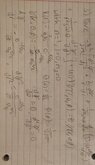
I attempted the problem by first finding the radial, theta, and phi equation for the ground state of a hydrogen atom. I multiplied the three equations to get the wave equation. From there, I took each derivative in the Schrödinger Spherical equation and found that ## \frac {\partial^2 \psi} {\partial \phi^2} = 0 ## and ## \frac {\partial \psi} {\partial \theta} = 0 ##. From there I found that ## \frac {\partial \psi} {\partial r} = \frac {-e^{\frac {-r} {a_0}}} {\sqrt \pi * a_0^{\frac {5} {2}}} ## and ## \frac {\partial \psi^2} {\partial r^2} = \frac {e^{\frac {-r} {a_0}}} {\sqrt \pi * a_0^{\frac {7} {2}}} ##. I then just plugged in the different equations including, ## U(r) = \frac {-e^2} {4\pi\varepsilon_0 r} ## into the equation to get my final result for energy. Compared to ## E_1 = \frac {-me^4} {32\pi^2\varepsilon_0^2\hbar^2} ## I am not sure if I did the math wrong to not get that energy equation or is there a different energy equation I should use. Thank you for any help provided.
 
Physics news on Phys.org
Danielk010 said:
Radial equation: ##\frac {2*e^{\frac {-r} {a_0}}} {a_0^{\frac {3} {2}}} ##
Theta equation: ## \frac {1} {\sqrt 2} ##
Phi equation: ## \frac {1} {\sqrt {2\pi}} ##

These are not equations.

Danielk010 said:
From there, I took each derivative in the Schrödinger Spherical equation and found that ## \frac {\partial^2 \psi} {\partial \phi^2} = 0 ## and ## \frac {\partial \psi} {\partial \theta} = 0 ##. From there I found that ## \frac {\partial \psi} {\partial r} = \frac {-e^{\frac {-r} {a_0}}} {\sqrt \pi * a_0^{\frac {5} {2}}} ## and ## \frac {\partial \psi^2} {\partial r^2} = \frac {e^{\frac {-r} {a_0}}} {\sqrt \pi * a_0^{\frac {7} {2}}} ##. I then just plugged in the different equations including, ## U(r) = \frac {-e^2} {4\pi\varepsilon_0 r} ## into the equation to get my final result for energy. Compared to ## E_1 = \frac {-me^4} {32\pi^2\varepsilon_0^2\hbar^2} ## I am not sure if I did the math wrong to not get that energy equation or is there a different energy equation I should use. Thank you for any help provided.
For the radial part you took the second derivative with respect to ##r## but it seems that you left out the ##\frac{2}{r}\frac{\partial \psi}{\partial r}## term.
 
kuruman said:
These are not equations.


For the radial part you took the second derivative with respect to ##r## but it seems that you left out the ##\frac{2}{r}\frac{\partial \psi}{\partial r}## term.
I multiplied the ##\frac{2}{r}## after getting the derivative. Also what do you mean they are not equations?
 
Danielk010 said:
Also what do you mean they are not equations?
Equations usually have an "equals" sign that looks like ##=##.
All I see is a colon that looks like ##:##

After you take your derivatives and you get what you call your "final energy result", that's only half of an equation. Write an equation that separates two sides with an ##=## sign and has mathematical expressions on each side, not words on one and a mathematical expression on the other. If your "final energy result" is on the left-hand side, what should be on the right-hand side?
 
kuruman said:
Equations usually have an "equals" sign that looks like ##=##.
All I see is a colon that looks like ##:##

After you take your derivatives and you get what you call your "final energy result", that's only half of an equation. Write an equation that separates two sides with an ##=## sign and has mathematical expressions on each side, not words on one and a mathematical expression on the other. If your "final energy result" is on the left-hand side, what should be on the right-hand side?
Oh my bad. For my final energy result it would E = *that equation*
 
Danielk010 said:
Oh my bad. For my final energy result it would E = *that equation*
You still have not written down an equation. Remember, mathematical expressions on both sides.
 
kuruman said:
You still have not written down an equation. Remember, mathematical expressions on both sides.
Sorry. E = ## \frac {2\pi\varepsilon_0 (-\hbar^2 * r + 2a_0^2\hbar^2) - ma_0^4e^2} {4\pi\varepsilon_0 r a_0^4 m} ##
 
Where did you get that E is equal to all those derivatives that you took?
 
kuruman said:
Where did you get that E is equal to all those derivatives that you took?
I used the schordinger equation. I wrote the math down. Would it be better if I shared a picture of the math?
 
  • #10
Danielk010 said:
I used the schordinger equation. I wrote the math down. Would it be better if I shared a picture of the math?
The right hand side of the equation is ##E~\psi(r)##. Show me the equation that has your "final energy result" plus the potential energy on the left side and ##E~\psi(r)## on the right side. Yes, share a picture of the math but make sure it's legible.
 
  • #11
kuruman said:
The right hand side of the equation is ##E~\psi(r)##. Show me the equation that has your "final energy result" plus the potential energy on the left side and ##E~\psi(r)## on the right side. Yes, share a picture of the math but make sure it's legible.
20240415_190938.jpg


The ##\psi(r)## was canceled out.
 

Attachments

  • 20240415_190919(1).jpg
    20240415_190919(1).jpg
    30.8 KB · Views: 86
  • #12
I deleted my immediate reply in case you saw it because I misread the ##r## in the denominator. I will post an more appropriate reply soon.
 
  • #13
thank you so much for the help.
 
  • Like
Likes   Reactions: kuruman
  • #14
Here is the more appropriate reply. First of all the powers of ##a_0## in the denominator are incorrect. If you divide ##a_0^{7/2}## by ##a_0^{3/2}##, you don't get ##a_0^4## which is ##a_0^{8/2}##. Same problem with ##a_0^{5/2}##. Fix it.

In the corrected simplified equation (see below), replace ##U(r) with what it is equal to but do not add the fractions. Instead factor out the ##\frac{1}{r}## in the two terms that contain it and rewrite the equation.

Screen Shot 2024-04-15 at 6.39.37 PM.png

Do you see where to go next? Ask if you don't.
 
  • #15
kuruman said:
Here is the more appropriate reply. First of all the powers of ##a_0## in the denominator are incorrect. If you divide ##a_0^{7/2}## by ##a_0^{3/2}##, you don't get ##a_0^4## which is ##a_0^{8/2}##. Same problem with ##a_0^{5/2}##. Fix it.

In the corrected simplified equation (see below), replace ##U(r) with what it is equal to but do not add the fractions. Instead factor out the ##\frac{1}{r}## in the two terms that contain it and rewrite the equation.

View attachment 343474
Do you see where to go next? Ask if you don't.
20240415_201200.jpg

So would this be correct?
 
  • #16
I said
kuruman said:
In the corrected simplified equation (see below), replace ##U(r) with what it is equal to but do not add the fractions[/color]. Instead factor out the ##\frac{1}{r}## in the two terms that contain it and rewrite the equation.[/size]
Do it.
 
  • #17
kuruman said:
I said

Do it.
Sorry. Would this be correct?
20240415_202808.jpg
 
  • #18
I works except that its sideways. Look at the equation. On the right you have the ground state state energy which is a constant. On the left you have a constant ##C_1## times of ##\frac{1}{r}## plus another constant ##C_2##. How can that be reconciled? Hint: This equation must hold for any ##r##.

Also, it looks like you are unsure about dividing powers. If the base is the same, you subtract the exponent in the denominator from the exponent in the numerator
$$\frac{a_0^{\frac{5}{2}}}{a_0^{\frac{3}{2}}}=a_0^{\frac{5}{2}-\frac{3}{2}}=a_0^{\frac{2}{2}}=a_0.$$Fix it before you proceed.
 
  • #19
kuruman said:
I works except that its sideways. Look at the equation. On the right you have the ground state state energy which is a constant. On the left you have a constant ##C_1## times of ##\frac{1}{r}## plus another constant ##C_2##. How can that be reconciled? Hint: This equation must hold for any ##r##.

Also, it looks like you are unsure about dividing powers. If the base is the same, you subtract the exponent in the denominator from the exponent in the numerator
$$\frac{a_0^{\frac{5}{2}}}{a_0^{\frac{3}{2}}}=a_0^{\frac{5}{2}-\frac{3}{2}}=a_0^{\frac{2}{2}}=a_0.$$Fix it before you proceed.
Thank you. Would equating r to be 1 work?
 
  • #20
Danielk010 said:
Thank you. Would equating r to be 1 work?
Nope. Like I said, it should hold for any ##r##, not just for the specific value of ##r=1##. Besides, what does "1" mean? One meter. one inch, one light year, one what? You need to ponder this a bit that is why I am not giving you the answer. Just think. What must be true for E on the other side to be constant?
 
  • #21
kuruman said:
Nope. Like I said, it should hold for any ##r##, not just for the specific value of ##r=1##. Besides, what does "1" mean? One meter. one inch, one light year, one what? You need to ponder this a bit that is why I am not giving you the answer. Just think. What must be true for E on the other side to be constant?
Should you just plug in Bohr's radius?
 
Last edited:
  • #22
That would not work. Look, you have an equation that looks like
##E=\dfrac{1}{r}C_1+C_2## where ##C_1## and ##C_2## are constants.
You want ##E## to be a constant. What must be true so that you can write
##E=const.##?
In other words, how can you get rid of the ##\frac{1}{r}## term?
Remember the equation is
$$\frac{1}{r}\left(\frac{\hbar^2}{ma_0}-\frac{e^2}{4\pi\epsilon_0}\right)-\frac{\hbar^2}{2ma_0^2}=E.$$
 
Last edited:
  • #23
kuruman said:
That would not work. Look, you have an equation that looks like
##E=\dfrac{1}{r}C_1+C_2## where ##C_1## and ##C_2## are constants.
You want ##E## to be a constant. What must be true so that you can write
##E=const.##?
In other words, how can you get rid of the ##\frac{1}{r}## term?
Solve for r, and then plug it in? ## r = \frac {C_1} {E-C_2} ##
 
  • #24
No. Set ##C_1=0.## When you do that, which of the quantities in ##C_1## have fixed values?
 
  • #25
kuruman said:
No. Set ##C_1=0.## When you do that, which of the quantities in ##C_1## have fixed values?
all of the values except m
 
  • #26
Why except ##m##? Isn't the mass of the electron fixed at ##9.11\times 10^{-31}~## kg?
What about the Bohr radius ##a_0##? What is an expression for it, not a numerical value. Look it up if you don't remember.
 
  • #27
Oh my bad. All of the values in Bohr's radius are constants if I am not mistaken. ##a_0 = \frac {4\pi\varepsilon_0\hbar^2} {m_e*e}##. 4, \pi, \hbar and the permittivity are all constants. An electron's rest mass is constant (##0.511 Mev##), and the elementary charge of an electron is also a constant.
 
  • #28
What happens when you substitute the expression that you quoted for ##a_0## in $$\frac{1}{r}\left(\frac{\hbar^2}{ma_0}-\frac{e^2}{4\pi\epsilon_0}\right)-\frac{\hbar^2}{2ma_0^2}=E~~?$$
 
  • #29
kuruman said:
What happens when you substitute the expression that you quoted for ##a_0## in $$\frac{1}{r}\left(\frac{\hbar^2}{ma_0}-\frac{e^2}{4\pi\epsilon_0}\right)-\frac{\hbar^2}{2ma_0^2}=E~~?$$
oohhh. I got it. thank you for the help
 
  • #30
The expression for the Bohr radius is obtained by setting the coefficient of the ##\dfrac{1}{r}## term equal to zero. This ensures that the energy of the ground state is constant for any value of variable ##r##.
 
  • Like
Likes   Reactions: Danielk010

Similar threads

Replies
5
Views
2K
Replies
6
Views
5K
  • · Replies 5 ·
Replies
5
Views
2K
  • · Replies 2 ·
Replies
2
Views
3K
  • · Replies 30 ·
2
Replies
30
Views
3K
  • · Replies 6 ·
Replies
6
Views
2K
  • · Replies 1 ·
Replies
1
Views
2K
  • · Replies 2 ·
Replies
2
Views
2K
Replies
7
Views
2K
Replies
2
Views
2K