What is the fair way to distribute costs and why?

  • Context: High School 
  • Thread starter Thread starter davidwinth
  • Start date Start date
Click For Summary
SUMMARY

The discussion centers on the fair distribution of sidewalk repair costs among eight homeowners on a dead-end street. Two methods are proposed: one suggests splitting costs based on the number of homeowners using each segment, while the other allocates costs based on the frequency of use by each homeowner. The first method results in a more equitable distribution for all homeowners, while the second method, proposed by a friend, leads to disproportionate payments for those at the end of the block. Ultimately, the consensus leans towards equal cost-sharing as the most agreeable solution.

PREREQUISITES
  • Understanding of basic arithmetic and fractions
  • Familiarity with cost-sharing principles
  • Knowledge of neighborhood dynamics and community agreements
  • Basic comprehension of logical reasoning and fairness in resource allocation
NEXT STEPS
  • Research cost-sharing models in community projects
  • Explore mathematical fairness concepts in resource allocation
  • Learn about negotiation techniques in community disputes
  • Investigate case studies on equitable cost distribution in shared resources
USEFUL FOR

Homeowners, community organizers, and anyone involved in neighborhood agreements regarding shared resources will benefit from this discussion.

davidwinth
Messages
103
Reaction score
8
A friend and I have a disagreement, and I am hoping someone here can help settle the matter.

The conditions:
8 homes along a dead-end street need to repair the sidewalk, and so they all agree that they will split the bill based on use. No homeowner walks past their own house towards the dead end, ever, but each homeowner goes for a walk towards the cross-street and back home once a day. The total bill is based on a straight per foot cost. There is no flat part to the fee, like $5000 + $20.00 per foot or something like that.

I reason as follows:
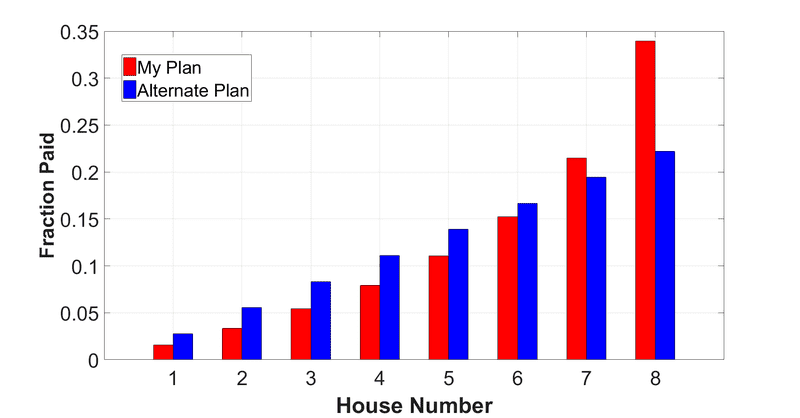
All homeowners use the first 1/8 of the sidewalk, so they should all split the bill for that 1/8 of the sidewalk, which is 1/8 of the total bill. Thus every house pays 1/64 of the total bill for their use of that section of the sidewalk. The second 1/8 section is only used by 7 of the homeowners, and so the bill for that section of the sidewalk should be equally shared by all but the first homeowner on the block. Thus every homeowner but the first should pay 1/(8*7) of the total bill for their use of that section. This continues until all segments of the sidewalk are paid for equally by those who use it.
The fraction of the total cost paid by each home is:

H1: 1/(8*8) = 1/64
H2: 1/(8*8) + 1/(8*7) = 15/448
H3: 1/(8*8) + 1/(8*7) + 1/(8*6) = 73/1344
H4: 1/(8*8) + 1/(8*7) + 1/(8*6)+ 1/(8*5) = 533/6720
etc.

My friend says this:
Assign each 1/8 section of the road a unit U. Then the first homeowner uses 1*U units, the second homeowner uses 2*U units, the third homeowner uses 3*U units, etc. Thus we have U + 2*U + 3*U + ... +8*U = 36*U and so the fraction of the total cost paid by each home is:

H1: 1/36
H2: 2/36
H3: 3/36
H4: 4/36
etc.

The difference is shown graphically in the image. He says I would have the two homeowners at the end of the block overpaying, and I say he is having the first 6 homeowners paying for sidewalk they don't use.

So the question is, which is most fair and why?

Thanks!
7twMHHA.png
 

Attachments

  • 7twMHHA.png
    7twMHHA.png
    10.1 KB · Views: 503
Last edited:
Mathematics news on Phys.org
I would take the bill and divide it up equally otherwise you’ll get complaints either because the computation is convoluted or because one homeowner is paying more than others.

Make them understand that as neighbors we share equal usage of the walk. Consider if you have kids they will use the sidewalk equally and wherever it is.
 
  • Like
Likes   Reactions: mfb
You can make up many schemes but ultimately I think "everyone pays the same" is the only thing where you have a chance to make people agree on (unless the last house needs a much longer connection than everyone else or something similar).
You can sell it as "everyone pays for the connection in front of their house".
 
  • Like
Likes   Reactions: jedishrfu
Thanks for the input, but we are speaking only of the scenarios that fit the conditions. "Everyone pays an equal amount" would never work with this crowd, and it is most certainly not the fairest way given the conditions.

Does anyone know of a name for the two different ways of partitioning described above?
 
jedishrfu said:
I would take the bill and divide it up equally otherwise you’ll get complaints either because the computation is convoluted or because one homeowner is paying more than others.

Make them understand that as neighbors we share equal usage of the walk. Consider if you have kids they will use the sidewalk equally and wherever it is.
My sense is that this is more of a thought exercise than an actual problem, and the OP is wondering which of the two solutions is the more reasonable one. If it's a real-world problem, then probably equal shares for all is the best course.

It seems to me that the friend's solution is the better one. It at least has the advantage of being more understandable.
If we let U = 1/8 of a block, then
8th person (at far end) uses 8U
7th person uses 7U
6th person uses 6U
.
.
.
1st person uses 1U
Total: 36U
So the Nth person is responsible for (NU)/(36U) = N/36 of the cost
8th person: 8/36 of cost
7th person: 7/36
6th person 6/36
etc.
 
Interesting. I guess there's no accounting for the way problems seem to different people. My friend's solution is in comprehensible to me. Where did the 36 come from? There are neither 36 homes, not 36 sidewalk segments. I don't see why the shares are

My solution seems rather straightforward. It follows a simple rule:

The cost of each segment is equally shared only by those households that use it.

What could be simpler than that? It makes sense to me that since all 8 use the first segment, all 8 split the cost of that segment. Since only 7 use the second segment, the cost of that segment is paid for equally by only those seven, etc.
 
36 is (half) the number of sidewalk segment crossings done per day (one family does 1, one family does 2, ...). It is the total street usage.
davidwinth said:
My solution seems rather straightforward.
Both do.
  • The cost of each segment is equally shared only by those households that use it.
  • The cost of of the street is shared proportional to the amount of street used per household.
"Pay twice as much if you use twice as much of the street" is another way to phrase the second option, and sounds perfectly reasonable as well.
 
mfb said:
Both do.
  • The cost of each segment is equally shared only by those households that use it.
  • The cost of of the street is shared proportional to the amount of street used per household.

I see! If my friend had been able to articulate his reason/rule like that, it wouldn't have seemed so arbitrary to me. Now I struggle to see why the amounts paid end up being different when they seem like equally fair ways to divide the cost! My intuition expects one more fair and one less fair method, and I can't seem to choose between them. I guess one thing I can see different between them is that the first homeowner, for example, shouldn't care about the total number of segments used per day because that includes segments of the road he/she doesn't use. That homeowner should only care about how many people use the segments he/she uses, and so for the other homeowners.

In any case, you have given me insight into the difference between our methods, and now they both seem reason-able. :-) Thanks!
 
  • Like
Likes   Reactions: mfb

Similar threads

  • · Replies 7 ·
Replies
7
Views
2K
  • · Replies 7 ·
Replies
7
Views
1K
  • · Replies 1 ·
Replies
1
Views
4K
  • · Replies 1 ·
Replies
1
Views
3K
  • · Replies 5 ·
Replies
5
Views
2K
  • · Replies 2 ·
Replies
2
Views
4K
  • · Replies 4 ·
Replies
4
Views
2K
Replies
23
Views
2K
  • · Replies 1 ·
Replies
1
Views
1K
  • · Replies 5 ·
Replies
5
Views
2K