What is the Measure of Angle GHD in a Complex Pentagon Configuration?

  • Context: High School 
  • Thread starter Thread starter anemone
  • Start date Start date
Click For Summary
SUMMARY

The measure of angle GHD in the given complex pentagon configuration can be determined using geometric principles. In the regular pentagon ABCDE, with point F on AB and angle CDF measuring 55 degrees, the intersection of lines FC and BE at point G leads to the selection of point H on the extension of CE. The relationship between angles DHE and FDG is crucial for calculating angle GHD, which is derived through geometric reasoning.

PREREQUISITES
  • Understanding of regular pentagons and their properties
  • Knowledge of angle relationships in geometric configurations
  • Familiarity with geometric constructions and intersections
  • Ability to apply theorems related to angles and triangles
NEXT STEPS
  • Study the properties of regular polygons, particularly pentagons
  • Learn about angle chasing techniques in geometry
  • Explore geometric constructions involving intersecting lines
  • Investigate the use of geometric proofs to solve complex angle problems
USEFUL FOR

Mathematics students, geometry enthusiasts, and educators looking to deepen their understanding of angle relationships in complex geometric configurations.

anemone
Gold Member
MHB
POTW Director
Messages
3,851
Reaction score
115
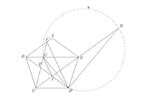
Let $ABCDE$ be a regular pentagon, and let $F$ be a point on $AB$ with $\angle CDF=55^{\circ}$. Suppose $FC$ and $BE$ meet at $G$, and select $H$ on the extension of $CE$ past $E$ such that $\angle DHE=\angle FDG$. FInd the measure of $\angle GHD$ in degrees.

--------------------
Remember to read the http://www.mathhelpboards.com/showthread.php?772-Problem-of-the-Week-%28POTW%29-Procedure-and-Guidelines to find out how to http://www.mathhelpboards.com/forms.php?do=form&fid=2!
 
Physics news on Phys.org
Re: Problem of the week #107 -April 14th, 2014

No one submitted a solution to this problem. Here is a solution that uses purely geometrical means:
View attachment 2360

Let $J$ be the intersection of diagonals $BD$ and $CE$, and note that $ABEJ$ is a rhombus. First, we claim that $JG$ and $DF$ are parallel.

Let $CF$ and $BD$ meet at $T$. Observe that $\angle TCJ=\angle TFB$ and $\angle BTG=\angle CTJ$ and $\angle GBT=\angle FBG=\angle JCD=\angle JDC=36^{\circ}$

Applying the law of Sines gives $\dfrac{TG}{GF}=\dfrac{TJ}{JD}$, proving the claim.

Then $\angle JGD=\angle FDG=\angle EHD=\angle JHD$ and so $J,\,D,\,G,\,H$ are concyclic. Now we may deduce $\angle GHD=180^{\circ}-\angle GJD=\angle JDF=\angle CDF-36^{\circ}=19^{\circ}$
 

Attachments

  • POTW Pentagon.JPG
    POTW Pentagon.JPG
    15.8 KB · Views: 102

Similar threads

  • · Replies 1 ·
Replies
1
Views
2K
  • · Replies 1 ·
Replies
1
Views
2K
  • · Replies 1 ·
Replies
1
Views
2K
  • · Replies 1 ·
Replies
1
Views
2K
  • · Replies 1 ·
Replies
1
Views
1K
Replies
1
Views
2K
Replies
1
Views
1K
Replies
1
Views
2K
  • · Replies 2 ·
Replies
2
Views
2K
Replies
1
Views
2K