What is the minimum force needed to move a block with friction present?

Join the discussion
Ask a follow-up here, or get your own question answered by working scientists, mathematicians and engineers — people, not an autocomplete.
Real named experts · corrections over time · the nuance an AI answer skips
92 replies · 10K views
rudransh verma
Gold Member
Messages
1,067
Reaction score
96
Homework Statement
A body of mass m results on horizontal floor with which it has coefficient of static friction ##\mu##. It is desired to move the block with minimum possible force. Find the applied force F.
Relevant Equations
##F_n=ma##
##F_s=\mu F_N##
We know the minimum force to move the body in presence of friction will be ##F>\mu F_N##
But it’s not right.
 
Physics news on Phys.org
rudransh verma said:
We know the minimum force to move the body in presence of friction will be ##F>\mu F_N##
But it’s not right.
Why not? (What does ##F_N## equal?)
 
Doc Al said:
Why not? (What does ##F_N## equal?)
Delta2 said:
I am intrigued, what is the answer key @rudransh verma . Why you say its not correct? According to my opinion the minimum force is ##\mu mg##.
Yes ##\mu mg##. But the answer in my book says ##F=\frac{\mu mg}{\sqrt{1+\mu^2}}##
 
rudransh verma said:
Yes ##\mu mg##. But the answer in my book says ##F=\frac{\mu mg}{\sqrt{1+\mu^2}}##
Something is fishy here, can you post some sort of figure that perhaps exists in the book for this problem?
 
rudransh verma said:
But the answer in my book says ##F=\frac{\mu mg}{\sqrt{1+\mu^2}}##
Did you provide the complete problem statement?
 
  • Like
Likes   Reactions: rudransh verma
Delta2 said:
Something is fishy here, can you post some sort of figure that perhaps exists in the book for this problem?
 

Attachments

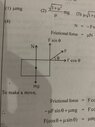
  • image.jpg
    image.jpg
    25.2 KB · Views: 222
Seriously? You only now thought it relevant to tell us that the applied force F is at an angle?
 
  • Like
  • Love
Likes   Reactions: Steve4Physics, Delta2, berkeman and 1 other person
Doc Al said:
Seriously? You only now thought it relevant to tell us that the applied force F is at an angle?
No. This is the complete question. There is no mentioning of any angle as you can see.I don’t know why they are applying force at an angle.
 
rudransh verma said:
No. This is the complete question. There is no mentioning of any angle as you can see.I don’t know why they are applying force at an angle.
So you are saying that the diagram you just posted has nothing to do with this problem?
 
  • Like
Likes   Reactions: Vanadium 50
Doc Al said:
So you are saying that the diagram you just posted has nothing to do with this problem?
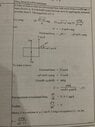
I am saying they have solved the problem assuming force at an angle. That diagram is not the part of question but of the answer.
 
rudransh verma said:
I am saying they have solved the problem assuming force at an angle. That diagram is not the part of question but of the answer.
That's a bit hard to believe.

(1) Post the complete problem statement
(2) Post the complete solution provided.
 
  • Like
  • Love
Likes   Reactions: Vanadium 50, Mark44 and russ_watters
Ah, I see the issue now. You were not told anything about the direction of the applied force, so you are free to apply it in any direction to solve for the minimum force needed. Assuming that the applied force must be horizontal was a mistake.
 
  • Like
Likes   Reactions: vcsharp2003
Doc Al said:
1) Post the complete problem statement

Doc Al said:
Post the complete solution provided.
 

Attachments

  • image.jpg
    image.jpg
    31.3 KB · Views: 223
See my last post. Do you see how being allowed to apply the force at an angle can affect the answer?
 
rudransh verma said:
I don’t know why they are applying force at an angle.
Because that lowers the normal force and therefore the horizontal force required to move the block. Since the problem did not say anything about the direction, in order to find the minimal force, you need to find an expression for the required force as a function of the angle and then minimise with respect to the angle.
 
  • Like
Likes   Reactions: Vanadium 50 and Delta2
OK , well I am not sure if that "the force applied must be at an angle " should be part of the problem statement or the student would have to think it. I was not smart enough to think it, and I am deeply sorry for myself o:).
 
  • Haha
  • Like
Likes   Reactions: vcsharp2003 and sysprog
Delta2 said:
OK , well I am not sure if that "the force applied must be at an angle " should be part of the problem statement or the student would have to think it. I was not smart enough to think it, and I am deeply sorry for myself o:).
Everybody makes bloopers or misread problems sometimes. Obviously, stating explicitly that the force could be at an angle would make it more obvious, but technically it is also fair game with the problem just stating to find the minimal force.
 
  • Like
Likes   Reactions: Delta2, vcsharp2003, Doc Al and 1 other person
Orodruin said:
Obviously, stating explicitly that the force could be at an angle would make it more obvious, but technically it is also fair game with the problem just stating to find the minimal force.
The problem asks specifically for the magnitude of the force. That's a very broad hint here.
 
  • Like
Likes   Reactions: vcsharp2003 and vela
Delta2 said:
OK , well I am not sure if that "the force applied must be at an angle " should be part of the problem statement or the student would have to think it. I was not smart enough to think it, and I am deeply sorry for myself o:).
It can help to put yourself into the problem. If you had to tug a heavy mass across a floor, how would you do it?
 
  • Like
Likes   Reactions: Nugatory
haruspex said:
It can help to put yourself into the problem. If you had to tug a heavy mass across a floor, how would you do it?
I don't know how you think but according to my thinking and intuition I would push it with horizontal force.
 
  • Like
Likes   Reactions: Tom.G and russ_watters
Delta2 said:
I don't know how you think but according to my thinking and intuition I would push it with horizontal force.
So you just learned something practically useful! 😉

In addition, pulling at an angle will also mean helping to overcome issues of bad grip on the ground on your part as you also increase your own normal force.
 
  • Like
Likes   Reactions: russ_watters and jbriggs444
Delta2 said:
I don't know how you think but according to my thinking and intuition I would push it with horizontal force.
Maybe you need to do more manual labour!

Two physicists were watching workmen on a building site. "See how he pulls the wheelbarrow behind himself instead of pushing it in front. He has obviously worked out that because he is pulling up at a slight angle it reduces the rolling resistance", observed one.
The other physicist asked the workman why he did it. "I've pushed wheelbarrows for thirty years," he replied, "and I'm fed up with the sight of 'em."
 
Last edited:
  • Like
  • Haha
Likes   Reactions: phinds, Nugatory, russ_watters and 6 others
Orodruin said:
Because that lowers the normal force and therefore the horizontal force required to move the block.
To apply minimum force the force of friction has to be less and will become less when we decrease the normal force and that would mean a tilted block.
But the eqns are ##F_N+F\sin \theta =mg##
##F\cos \theta=\mu F_N## which I don’t think is consistent with the tilted block.
 
rudransh verma said:
and that would mean a tilted block.
No, it would not necessarily tilt the block. Why do you think so? There is a separate set of equations (based on torque balance) that would tell you whether the block tilts or not.

rudransh verma said:
which I don’t think is consistent with the tilted block.
Why not? They are valid as long as the coefficient of friction remains the same.
 
Orodruin said:
No, it would not necessarily tilt the block. Why do you think so?
If it will not leave the ground at least from one side how the friction will decrease ?
 
Orodruin said:
By decreasing the normal force. Maximal friction is proportional to normal force.
Are you saying applying a force at an angle can decrease the friction without actually lifting it. That there is some ##0<F_N<mg##