What is the name of this equation?

  • Thread starter Thread starter Goethe10
  • Start date Start date
Click For Summary

Discussion Overview

The discussion revolves around identifying an equation presented by a user, specifically focusing on its name and how to solve it. The conversation includes elements of calculus, particularly differentiation, and seeks clarification on terminology used in the context of the equation.

Discussion Character

  • Exploratory
  • Technical explanation
  • Conceptual clarification

Main Points Raised

  • A user asks for the name of the equation they presented, indicating they are from a non-English speaking country and need resources for solving it.
  • One participant describes the equation as an "ordinary equation" and suggests that there is nothing special about it, implying that it does not require extensive lookup.
  • Another participant explains that the equation can be differentiated, providing the derivative as 6x².
  • There is a request for clarification on the meaning of "dy," with an explanation that "dy" and "dx" are differentials in the context of calculus.

Areas of Agreement / Disagreement

Participants generally agree that the equation is straightforward and can be differentiated, but there is no consensus on a specific name for the equation itself. The discussion remains somewhat unresolved regarding the terminology and the user's initial query.

Contextual Notes

The discussion does not clarify the specific context or applications of the equation, nor does it resolve the user's request for a full name of the equation.

Goethe10
Messages
11
Reaction score
0
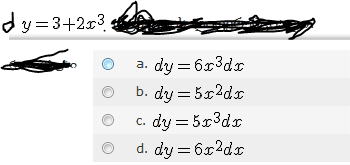
Hello everybody, What is this equation called? I'm from non-English speaking country and I need to look up materials about how to solve it, Thank you.
1ake7HP.png
 
Physics news on Phys.org
Welcome to PF!

Hello Goethe10! Welcome to PF! :smile:
Goethe10 said:
y = 3 + 2x3

(why have you written a "d" there? :confused:)

This is an ordinary equation,

and the four possible answers are dervatives of it,

except that instead of writing dy/dx = f(x), they've written them dy = f(x)dx :wink:
 
tiny-tim said:
Hello Goethe10! Welcome to PF! :smile:


(why have you written a "d" there? :confused:)

This is an ordinary equation,

and the four possible answers are dervatives of it,

except that instead of writing dy/dx = f(x), they've written them dy = f(x)dx :wink:

Haha, sorry.
It was just smudge done by paint tool, not an actual D, sorry about confusion :P
What do you mean "ordinary equation" Can you please give me the full name? Thanks.
 
Goethe10 said:
What do you mean "ordinary equation" Can you please give me the full name? Thanks.

i mean it's just an equation, there's nothing special about, there's nothing to look up! :smile:

(just differentiate it!)
 
Ah, I see! :D Thank you
So
3+2x^3 would be
6x^2
Can you please tell me what does "dy" means?
 
Goethe10 said:
So
3+2x^3 would be
6x^2

correct! :smile:
Can you please tell me what does "dy" means?

if you'd written the equations in full, you would have written:

y = 3+2x3

So dy/dx = 6x2

The "dy" and "dx" in "dy = 6x2dx" are called differentials (or infinitesimal differentials).

You can always rewrite any dy/dx equation so that the dy and dx are on opposite sides …

look that up in almost any book on calculus :wink:
 
Thank you! :)
 

Similar threads

  • · Replies 2 ·
Replies
2
Views
2K
  • · Replies 7 ·
Replies
7
Views
3K
  • · Replies 1 ·
Replies
1
Views
1K
  • · Replies 23 ·
Replies
23
Views
4K
  • · Replies 4 ·
Replies
4
Views
4K
  • · Replies 1 ·
Replies
1
Views
1K
Replies
3
Views
3K
  • · Replies 6 ·
Replies
6
Views
2K
  • · Replies 3 ·
Replies
3
Views
3K
  • · Replies 21 ·
Replies
21
Views
3K