How to Solve the Laplace Equation on a Trapezoid?

Click For Summary

Discussion Overview

The discussion revolves around finding an analytical solution to the Laplace equation defined on a trapezoidal domain. Participants explore various methods and considerations for solving the equation, including boundary conditions and continuity requirements.

Discussion Character

  • Exploratory
  • Technical explanation
  • Debate/contested
  • Mathematical reasoning

Main Points Raised

  • One participant expresses familiarity with solving the Laplace equation on squares and rectangles but seeks an analytical method for trapezoids.
  • Another participant suggests solving the equation in triangular and square subdomains using different coordinate systems and then patching the solutions together at a specified point.
  • A different viewpoint questions the uniqueness of the solution derived from the proposed method, presenting a specific form of the solution based on boundary conditions and continuity.
  • Further contributions emphasize the need to consider the derivatives of the solutions at the boundary, highlighting a potential inconsistency in the continuity requirements at a specified boundary.
  • Another participant argues against the requirement of continuity for both the function and its derivative at the boundary, suggesting that only a linear combination can be continuous.
  • A numerical solution is mentioned, indicating that it yields different results compared to the analytical approaches discussed.
  • A participant raises a question about the existence of an analytical solution when switching between Neumann and Dirichlet boundary conditions along the trapezoid's sides.

Areas of Agreement / Disagreement

Participants express differing opinions on the methods for solving the Laplace equation, the uniqueness of solutions, and the requirements for continuity at boundaries. There is no consensus on the best approach or the implications of switching boundary conditions.

Contextual Notes

Participants discuss various assumptions regarding boundary conditions and the mathematical properties of the solutions, but these assumptions are not fully resolved within the discussion.

MatPhy
Messages
4
Reaction score
0
Hello everybody!

I know how to solve Laplace equation on a square or a rectangle.

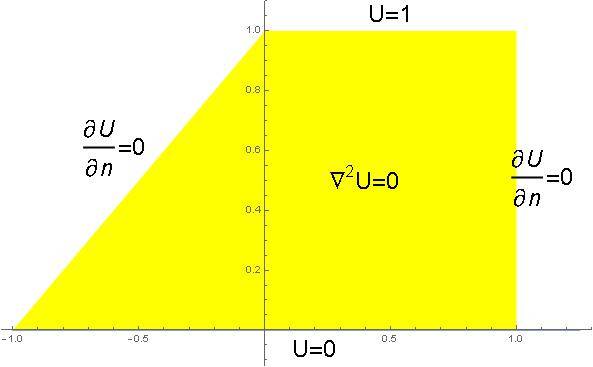
Is there any easy way to find an analytical solution of Laplace equation on a trapezoid (see picture).

Thank you.
aJPz5z.jpg
 
Physics news on Phys.org
Solve it in the triangle using polar coordinates with origin at (-1,0), and in the square in cartesian coordinates. Patch the two together by requiring continuity on (0,0) to (0,1).
 
  • Like
Likes   Reactions: MatPhy
Pasmith, thank you for the answer. But maybe it is possible to solve this in this way:

IfPV6L.jpg
 
I don't think that allows you to determine f uniquely.

I did find the solution <br /> u(x,y) = \begin{cases} y, &amp; 0 \leq x \leq 1, 0 \leq y \leq 1, \\ (x + 1)y, &amp; -1 \leq x &lt; 0, 0 \leq y \leq 1 + x \end{cases} by considering solutions of the form u(x,y) = yf(x), motivated by the condition on y = 0. That gave me u(x,y) = Axy+ By. Allowing for different values of A and B on either side of x = 0 gives four unknowns, and using these it proved possible to satisfy the remaining boundary conditions and the condition of continuity at x = 0.
 
  • Like
Likes   Reactions: MatPhy
Pasmith, thank you for the answer.

But in my opinion we should also consider this relation:

{\partial u_1(x,y) \over \partial x} = {\partial u_2(y) \over \partial x} at x=0 \quad \text{,}

where
u_1(x,y) = (x+1)y on subdomain -1 \leq x &lt; 0, 0 \leq y \leq 1 + x \quad \text{and}
u_2(y) = y on subdomain 0 \leq x \leq 1, 0 \leq y \leq 1 \quad \text{.}

But {\partial u_2(y) \over \partial x} = 0

and

{\partial u_1(x,y) \over \partial x} = y \neq 0 \quad \text{.}
 
You can't require continuity of both u and \partial u/\partial x at x = 0; all you can do is require continuity of a linear combination of u and \partial u/\partial x.
 
  • Like
Likes   Reactions: MatPhy
Well numerical solution gave different result. Solution for U(x,y) at 0 \leq y \leq 1 \quad \text{and} \quad x=0 is

TOg4b7.png
 
Does an analytical solution exists for the same problem but when switching between Neumann and Dirichlet boundary conditions? That is if we set no flux (Neumann) boundary conditions along the bases of the trapezoid, and the same Dirichlet boundary conditions as prescribed above, along the two other sides of the trapezoid?

Thank you!
 

Similar threads

  • · Replies 2 ·
Replies
2
Views
2K
  • · Replies 1 ·
Replies
1
Views
924
Replies
3
Views
3K
  • · Replies 5 ·
Replies
5
Views
3K
  • · Replies 6 ·
Replies
6
Views
3K
  • · Replies 10 ·
Replies
10
Views
4K
  • · Replies 33 ·
2
Replies
33
Views
5K
  • · Replies 22 ·
Replies
22
Views
4K
  • · Replies 6 ·
Replies
6
Views
3K
  • · Replies 1 ·
Replies
1
Views
2K