DieselDave
- 1
- 0
Hi, can't believe I haven't discovered this forum until now - I would post in an introductions section, however I couldn't find one!
This question is loosely based around mechanical engineering, however may be applied to automotive, so apologies for posting in the wrong section.
I have had a set of hardened head studs made for my vehicle (for upgraded power/boost etc), the stock ones are grade 10.9, and the never ones should *in theory* be above 12.9 grade, by the by, they are stronger due to them being hardened.
My understanding is that in this situation, the newer hardened studs should stretch the same amount as the old studs under the same amount of loads, however due to their hardness and bearing hookes law in mind, they should purely be able to stretch further without yielding?, am I correct in my assumption?. Therefore would be able to be torqued to a higher torque angle than the stock bolts, applying a greater force on its respective load.
Stock torque angle is 220°, and with the newer bolts then a greater torque angle should be able to be acheived, without damage and yield of the bolts (assuming same conditions, bolt pitch, friction etc)
Or am I totally barking up the wrong tree here, and due to them being heat treated and hardened, this would reduce the malleability, therefore increasing the load on the bolts before yield point, although lower the malleability and ability for them to stretch as much before the yield point? so a higher clamping force will be achieved with less of a torque angle?
Any help on this subject would be greatly appreciated, here's and a photo of the new products.
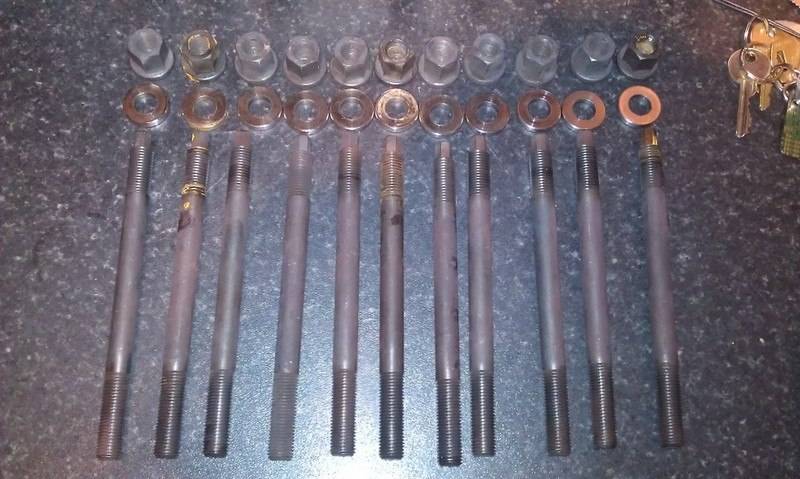
Many thanks, dave
This question is loosely based around mechanical engineering, however may be applied to automotive, so apologies for posting in the wrong section.
I have had a set of hardened head studs made for my vehicle (for upgraded power/boost etc), the stock ones are grade 10.9, and the never ones should *in theory* be above 12.9 grade, by the by, they are stronger due to them being hardened.
My understanding is that in this situation, the newer hardened studs should stretch the same amount as the old studs under the same amount of loads, however due to their hardness and bearing hookes law in mind, they should purely be able to stretch further without yielding?, am I correct in my assumption?. Therefore would be able to be torqued to a higher torque angle than the stock bolts, applying a greater force on its respective load.
Stock torque angle is 220°, and with the newer bolts then a greater torque angle should be able to be acheived, without damage and yield of the bolts (assuming same conditions, bolt pitch, friction etc)
Or am I totally barking up the wrong tree here, and due to them being heat treated and hardened, this would reduce the malleability, therefore increasing the load on the bolts before yield point, although lower the malleability and ability for them to stretch as much before the yield point? so a higher clamping force will be achieved with less of a torque angle?
Any help on this subject would be greatly appreciated, here's and a photo of the new products.
Many thanks, dave