What Is the Probability That a Chord on a Unit Circle Is At Least 1 Unit Long?

  • Context: High School 
  • Thread starter Thread starter anemone
  • Start date Start date
Click For Summary
SUMMARY

The probability that a chord on a unit circle is at least 1 unit long can be determined through geometric analysis. Participants in the discussion, including MarkFL, magneto, laura123, and Ifdahl, provided correct solutions to the problem. An honorable mention was given to chisigma for misinterpreting the question, calculating the probability that the chord is no greater than one unit in length instead. The solutions highlighted various approaches to solving the problem, emphasizing the importance of understanding geometric properties of circles.

PREREQUISITES
  • Understanding of unit circles and their properties
  • Basic knowledge of probability theory
  • Familiarity with geometric concepts related to chords
  • Ability to interpret mathematical problems accurately
NEXT STEPS
  • Study geometric probability in relation to circles
  • Explore the concept of chord lengths in different geometric contexts
  • Learn about the law of cosines and its applications in chord length calculations
  • Investigate common misconceptions in probability problems
USEFUL FOR

Students and educators in secondary and high school mathematics, particularly those interested in geometry and probability theory. This discussion is also beneficial for anyone looking to enhance their problem-solving skills in mathematical contexts.

anemone
Gold Member
MHB
POTW Director
Messages
3,851
Reaction score
115
Two points are picked at random on the unit circle $x^2+y^2=1$. Determine the probability that the chord joining the two points has length at least 1.

--------------------
Remember to read the http://www.mathhelpboards.com/showthread.php?772-Problem-of-the-Week-%28POTW%29-Procedure-and-Guidelines to find out how to http://www.mathhelpboards.com/forms.php?do=form&fid=2!
 
Physics news on Phys.org
Hello MHB Community,

anemone couldn't be with us this week, but she conscientiously made provisions for me to post this week's POTW for Secondary School/High School Students in her stead.

So, with no further ado...

Congratulations to the following members for their correct solutions::)

  1. MarkFL
  2. magneto
  3. laura123
  4. Ifdahl
Honorable mention goes also to chisigma as he simply misread the problem and computed the probability that the given chord is no greater than one unit in length.

Solution from magneto:

Consider a circle $O$ with radius $r = 1$. Let a point $A$ on the circumference be given.
Then there are two distinct points on the circumference $B$ and $B'$ where $AB = 1 = AB'$.
Note that $\triangle AOB$ and $\triangle AOB'$ are both equilateral, so $m \measuredangle BAB' = 120^\circ$,
and the major arc $BB'$ is $240^\circ$. If any point $C$ lies on the major arc $BB'$, the length of chord $AC \geq 1$.
So, the probability is $\frac{240}{360} = \frac 23$.

Solution from Ifdahl:

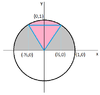
Two points picked at random on the unit circle spans an arc of length $\alpha$, where $0 \le \alpha \le \pi$. Thus picking two points at random corresponds to choosing a certain $\alpha$ - just like cutting out a piece of a circular birthday cake :). The pdf for a random choice of $\alpha$ is uniform continuous, because every possible $\alpha$-value has the same weight*. If the chord, that connects the points has length $c = 1$, we have the limit: $\alpha = \frac{\pi}{3}$. (Cf. attached figure).
Thus
$P(\alpha \le \frac{\pi}{3}) = P(c \le 1) = \frac{\frac{\pi}{3}-0}{\pi – 0}=\frac{1}{3}$

- and therefore the probability of choosing two points at random with a corresponding chord of length greater than $1$ is:

$ P(\alpha > \frac{\pi}{3}) = P(c > 1) = 1 - \frac{1}{3}= \frac{2}{3}$.

(*).This is not the case for the distribution of the cord length, $c$.

View attachment 3092
 

Attachments

  • POTW #126 HS.png
    POTW #126 HS.png
    3 KB · Views: 111

Similar threads

  • · Replies 1 ·
Replies
1
Views
2K
  • · Replies 1 ·
Replies
1
Views
2K
  • · Replies 1 ·
Replies
1
Views
1K
  • · Replies 1 ·
Replies
1
Views
2K
Replies
1
Views
2K
  • · Replies 1 ·
Replies
1
Views
1K
  • · Replies 1 ·
Replies
1
Views
2K
  • · Replies 1 ·
Replies
1
Views
2K
  • · Replies 1 ·
Replies
1
Views
2K
  • · Replies 1 ·
Replies
1
Views
1K