What is the relationship between dℓ and dR in the sign convention for voltage?

Click For Summary
SUMMARY

The discussion clarifies the relationship between the line integral and voltage in the context of electric fields, specifically addressing the apparent contradiction in examples 24-2 and 24-3. The integral is taken anti-parallel to the field lines, resulting in a positive voltage despite the negative integrand. The key takeaway is that the sign of voltage serves primarily as a directional tool, while the magnitude remains the focus. The relationship between the differential path length, dℓ, and the differential resistance, dR, is also highlighted, emphasizing the importance of understanding these variables in electric field calculations.

PREREQUISITES
  • Understanding of electric field concepts and line integrals
  • Familiarity with voltage and potential difference in electrostatics
  • Knowledge of calculus, particularly integration techniques
  • Basic grasp of vector mathematics, especially dot products
NEXT STEPS
  • Study the derivation of voltage from electric fields using line integrals
  • Explore the implications of the sign convention in electrostatics
  • Investigate the relationship between path length dℓ and resistance dR in circuit analysis
  • Learn about the application of the dot product in physics, particularly in electric field calculations
USEFUL FOR

Students of physics, electrical engineers, and anyone studying electromagnetism who seeks to deepen their understanding of voltage and electric fields.
Calpalned
Messages
297
Reaction score
6
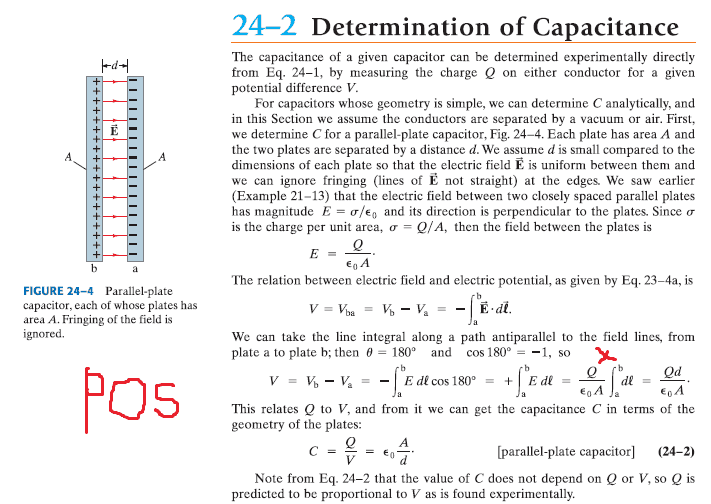
In the derivation for equation 24-2 in the picture below., the line integral was chosen along a path anti-parallel to the field lines. As a result, cos(180) = -1, which made the integral for the voltage positive.
Screenshot (66).png


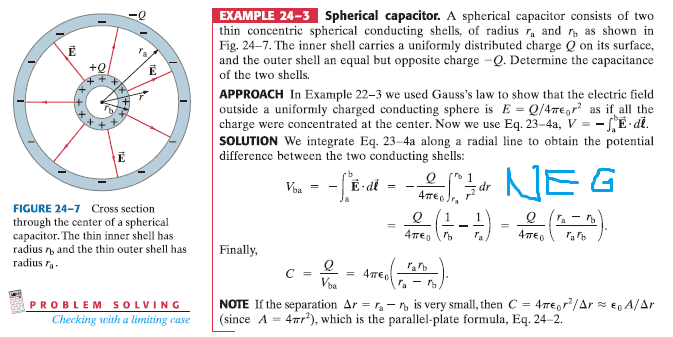
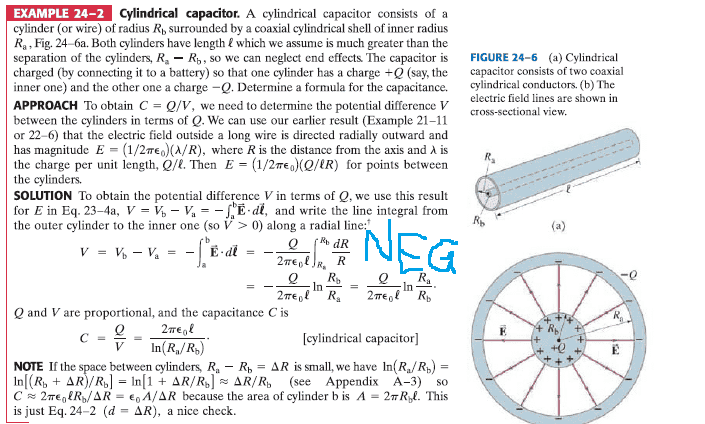
However, in examples 24-2 and 24-3, the line integral is also taken as anti-parallel to the field lines, but the voltage integral remains negative. This seems contradictory.
Screenshot (67).png


Screenshot (68).png
 
Physics news on Phys.org
Try doing the line integral yourself to check.
Where is the contradiction? The resulting voltage comes out positive.
 
The sign of voltage is more like a tool to decide direction of field. It's the magnitude we are more concerned with. So in either case just find the magnitude and the field is from +ve to -ve. Or you can take it as potential decreases on direction of field.
(I just said this to make stuff easy. The line integral will give you the right result always. Do as Simon said.)
 
In Example 24-2, the integrand is ##\vec{E}\cdot d\vec{l} = \|\vec{E}\| \|d\vec{l}\| \cos 180^\circ = -\|\vec{E}\| \|d\vec{l}\|##. The negative sign cancels with the negative sign in front of the integral, so you have
$$V = \int_a^b \|\vec{E}\| \|d\vec{l}\| > 0.$$ Note that ##a## and ##R_a## don't mean exactly the same thing; this is why the limits on the integral change as the integral is written in terms of ##d\vec{l}## and then in terms of ##dR##. Now considering the fact that ##R_a > R_b##, how is ##\| d\vec{l} \|## related to ##dR##?
 

Similar threads

  • · Replies 3 ·
Replies
3
Views
2K
  • · Replies 10 ·
Replies
10
Views
2K
  • · Replies 8 ·
Replies
8
Views
2K
  • · Replies 4 ·
Replies
4
Views
2K
  • · Replies 5 ·
Replies
5
Views
18K
  • · Replies 6 ·
Replies
6
Views
4K
  • · Replies 1 ·
Replies
1
Views
2K
Replies
2
Views
3K
  • · Replies 3 ·
Replies
3
Views
3K
  • · Replies 2 ·
Replies
2
Views
8K