What is the required force to lift oneself using movable pulleys?

  • Thread starter Thread starter xX1SHOt
  • Start date Start date
  • Tags Tags
    Force Pulleys
Click For Summary
SUMMARY

The discussion centers on calculating the force required for a man to lift himself using movable pulleys, with a total weight of 780 N. The participant initially attempted to solve the problem using the equation mg = T(1) + T(2) and concluded that T(1) should equal 390 N. However, after further consideration, they recognized that to lift steadily, the tension T must equal the total weight, resulting in T = 780 N. The absence of acceleration data was noted as a significant factor in determining the correct force.

PREREQUISITES
  • Understanding of Newton's laws of motion
  • Familiarity with pulley systems and tension forces
  • Basic algebra for solving equations
  • Knowledge of weight and mass relationships
NEXT STEPS
  • Study the mechanics of movable pulley systems
  • Learn about tension in ropes and its applications in physics
  • Explore the impact of acceleration on force calculations
  • Review examples of similar physics problems involving forces and pulleys
USEFUL FOR

Students studying physics, particularly those focusing on mechanics, as well as educators seeking to explain concepts related to forces and pulley systems.

xX1SHOt
Messages
18
Reaction score
0
1. Homework Statement

In the figure below, the man and the platform together weigh 780 N. The pulley can be modeled as frictionless. Determine how hard the man has to pull on the rope to lift himself steadily upward above the ground.
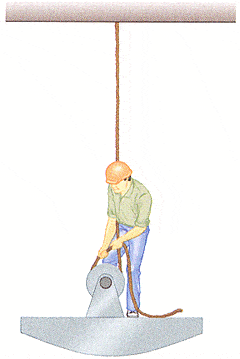
p4-33.gif


____________N


2. Homework Equations

I didn't use any until it said i was wrong but here is what it would be:

mg = T(1) + T(2)
T(1) = T(2)


3. The Attempt at a Solution

mg = 780 N = 2*T(1)

780 N / 2 = T(1)

390 N = T(1)

I first entered 390 and it was wrong, then I tried 391 to steadily move it upward. Both were wrong. Any help?
 

Attachments

  • p4-33.gif
    p4-33.gif
    11.7 KB · Views: 761
  • p4-33.gif
    p4-33.gif
    11.7 KB · Views: 514
  • p4-33.gif
    p4-33.gif
    11.7 KB · Views: 508
  • p4-33.gif
    p4-33.gif
    11.7 KB · Views: 495
Physics news on Phys.org
cant anyone help
 
I believe the answer is simply T = 780 N.

T - mg = m(0)
T = mg = 780 N

They didn't give you any value for the acceleration which if they did would've changed a lot.
 
nevermind i figured it out, thanks
 

Similar threads

  • · Replies 22 ·
Replies
22
Views
1K
Replies
24
Views
4K
  • · Replies 6 ·
Replies
6
Views
2K
Replies
6
Views
4K
  • · Replies 19 ·
Replies
19
Views
5K
  • · Replies 8 ·
Replies
8
Views
3K
Replies
10
Views
1K
  • · Replies 2 ·
Replies
2
Views
2K
Replies
10
Views
1K
  • · Replies 20 ·
Replies
20
Views
4K