What is the transpose of a matrix $i[A,B]$?

  • Thread starter Thread starter Slimy0233
  • Start date Start date
Click For Summary
SUMMARY

The discussion centers on the mathematical operation of taking the transpose of a matrix represented as the product of the imaginary unit and a commutator, specifically denoted as i[A, B]. Participants clarify that if A and B are skew-Hermitian matrices, then i[A, B] is Hermitian. The conversation emphasizes the importance of understanding the properties of Hermitian and skew-Hermitian matrices in this context. Additionally, it highlights the necessity of assuming that matrices A and B are non-zero for the operations discussed to be valid.

PREREQUISITES
  • Understanding of Hermitian and skew-Hermitian matrices
  • Familiarity with matrix transposition
  • Knowledge of commutators in quantum mechanics
  • Basic properties of imaginary numbers in mathematical operations
NEXT STEPS
  • Study the properties of Hermitian matrices in linear algebra
  • Learn about the mathematical implications of skew-Hermitian matrices
  • Explore the concept of commutators in quantum mechanics
  • Investigate the role of the imaginary unit in matrix operations
USEFUL FOR

Students and professionals in mathematics and quantum mechanics, particularly those dealing with linear algebra and matrix theory, will benefit from this discussion.

Slimy0233
Messages
167
Reaction score
48
Homework Statement
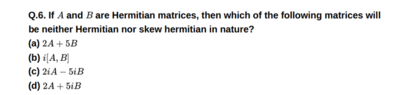
Q.6. If A and B are Hermitian matrices, then which of the following matrices will
be neither Hermitian nor skew hermitian in nature?
Relevant Equations
For a Hermitian Matrix A,
1. $A^{\dagger} = A$
2. $iA$ is a skew-Hermitian Matrix
1693057590678.png

I don't know how to simplify option b)

I mean, I don't know how to take the transpose of a matrix which exists as a product of $\iota$, how can I solve this further?

I need help only with option c. I have attempted this previously and have gotten what seems to be the right answer, but I don't know how I did that now
DocScanner 26-Aug-2023 19-12.jpg
 

Attachments

  • 1693057606307.png
    1693057606307.png
    10.8 KB · Views: 110
Physics news on Phys.org
In general your solutions have a step missing. It's not a major problem, but you leave a bit of work for the reader.

You also need to assume that ##A, B \ne 0##.
 
PeroK said:
In general your solutions have a step missing. It's not a major problem, but you leave a bit of work for the reader.

You also need to assume that ##A, B \ne 0##.
except for opt B and opt D you don't need extra steps as you can use property
The sum of two Hermitian Matrices is also a Hermitian matrix. But, I still get how to solve c though. I want to take the transpose of i[A,B], how can I do this?
 
Slimy0233 said:
I want to take the transpose of i[A,B], how can I do this?
I thought you ready did in your OP.
 
PeroK said:
I thought you ready did in your OP.
I didn't unfortunately, I did try and do it now which is attached, but I am pretty sure there's an easier way as I am not supposed to do this in the exams.
DocScanner 26-Aug-2023 22-28.jpg
 
That's okay. Perhaps it could be simpler, but all the steps are correct.
 
For example, you could first show that ##[A,B]## is skew-Hermitian, hence ##i[A, B]## is Hermitian.
 
  • Like
  • Love
Likes vanhees71 and Slimy0233
PeroK said:
For example, you could first show that ##[A,B]## is skew-Hermitian, hence ##i[A, B]## is Hermitian.
Thank you! of c! I forgot the fact that [A, B] can also be treated like a matrix (even though it doesn't look like a conventional matrix)
This is what I was looking for
 
PeroK said:
For example, you could first show that ##[A,B]## is skew-Hermitian, hence ##i[A, B]## is Hermitian.
if A is skew-Hermitian then ##(iA)^{\dagger} = iA## making ##iA## skew-Hermitian$$(iA)^\dagger = i^*A^\dagger = -iA^\dagger = -i (-A) = iA$$
edit: I corrected something stupid I said
 
  • #10
You meant if ##A## is skew-Hermitean than ##\mathrm{i} A## is Hermitean, and that's in fact what you correctly have proven.
 
  • #11
If i may ask what the i stands for in
i[a,b]? I guess [a,b] is the conmutator?
 
  • #12
WWGD said:
If i may ask what the i stands for in
i[a,b]? I guess [a,b] is the conmutator?
I'd be willing to bet it's the imaginary unit...
 
  • #13
Mark44 said:
I'd be willing to bet it's the imaginary unit...
So you're multiplying the conmutator by the imaginary unit?
 
  • #14
WWGD said:
So you're multiplying the conmutator by the imaginary unit?
Commutators are a topic I've never studied, but from the work shown, i is multiplying the result of the commutator action.
 
  • #15
Mark44 said:
Commutators are a topic I've never studied, but from the work shown, i is multiplying the result of the commutator action.
I _am_ multiplying. ;).
 
  • #16
WWGD said:
I _am_ multiplying. ;).
You may be, but so is ##i##. :oldbiggrin:
 
  • Like
Likes PhDeezNutz and WWGD
  • #17
Mark44 said:
Commutators are a topic I've never studied, but from the work shown, i is multiplying the result of the commutator action.
It's standard stuff, as far as QM is concerned.
 
  • #18
PeroK said:
It's standard stuff, as far as QM is concerned.
Which is above my level at this point.
 

Similar threads

  • · Replies 3 ·
Replies
3
Views
2K
  • · Replies 2 ·
Replies
2
Views
1K
  • · Replies 0 ·
Replies
0
Views
1K
  • · Replies 2 ·
Replies
2
Views
2K
  • · Replies 3 ·
Replies
3
Views
2K
  • · Replies 11 ·
Replies
11
Views
2K
  • · Replies 4 ·
Replies
4
Views
3K
  • · Replies 10 ·
Replies
10
Views
2K
  • · Replies 12 ·
Replies
12
Views
2K