Multipole Expansion: Show that the quadrupole moment is symmetric and that the trace vanished

Join the discussion
Ask a follow-up here, or get your own question answered by working scientists, mathematicians and engineers — people, not an autocomplete.
Real named experts · corrections over time · the nuance an AI answer skips
10 replies · 3K views
Lambda96
Messages
233
Reaction score
77
Homework Statement
Show that the quadrupole moment is symmetric and that the trace vanished
Relevant Equations
none
Hi

i have problems, to solve task a)
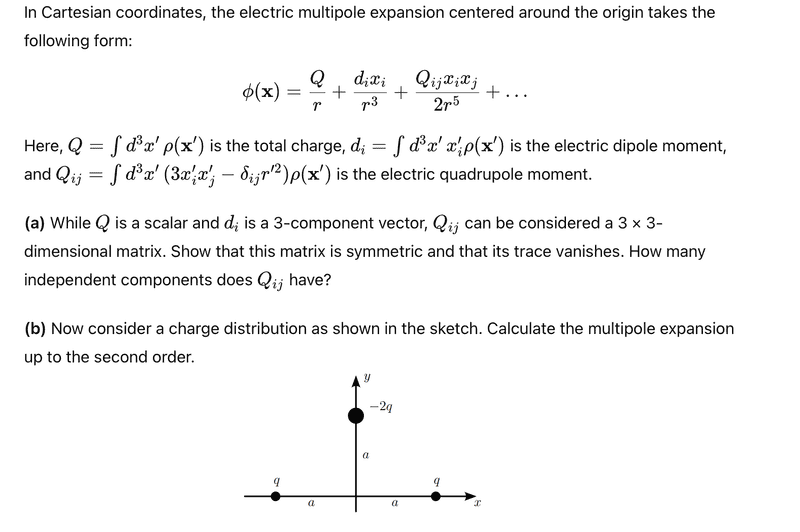
Bildschirmfoto 2024-11-02 um 19.10.31.png

Since I have to calculate the trace of the matrix ##Q##, I started as follows:

$$\text{trace} (Q)=\sum\limits_{i=1}^{3}\int_{}^{}d^3x'(3x_i^{'2}-r^{'2}) \rho(x')$$

I then calculated further until I got the following form:

$$\text{trace} (Q)=\int_{}^{}d^3x' \cdot 2x'^{2} \rho(x')$$

Now I'm stuck because I don't know how to show that the expression is 0
 
Physics news on Phys.org
Lambda96 said:
$$\text{trace} (Q)=\sum\limits_{i=1}^{3}\int_{}^{}d^3x'(3x_i^{'2}-r^{'2}) \rho(x')$$

I then calculated further until I got the following form:

$$\text{trace} (Q)=\int_{}^{}d^3x' \cdot 2x'^{2} \rho(x')$$
In getting to the second equation above, you made a mistake when evaluating ## \sum\limits_{i=1}^{3}r^{'2}##.
 
Reply
  • Like
Likes   Reactions: Lambda96
TSny said:
In getting to the second equation above, you made a mistake when evaluating ## \sum\limits_{i=1}^{3}r^{'2}##.
I think the mistake is in dropping the subscript and writing ##x'^2## in OP's expression for the trace. What does that even mean?
(I deleted my post because it went in an unnecessary direction.)
 
Reply
  • Like
Likes   Reactions: Lambda96
kuruman said:
I think the mistake is in dropping the subscript and writing ##x'^2## in OP's expression for the trace. What does that even mean?
I interpreted the OP's ##x'^2## to mean the same as ##r'^2##.

I tried to guess how the OP got the incorrect factor of ##2x'^2##. The sum over ##i## of ##3{x'_i}^2## gives ##3r'^2##. Then I guessed that the OP just subtracted the ##r'^2## in the expression to get ##2r'^2## which they wrote as ##2x'^2##. But, I shouldn't have done all this guessing! Bad form on my part. :blushing:

Hopefully, the OP will clarify what they did.
 
Reply
  • Like
Likes   Reactions: kuruman
Hint: ##(3x^2 - r^2 ) + (3y^2 - r^2) + (3z^2 - r^2) ## equals what?
 
Reply
  • Like
Likes   Reactions: TSny and Lambda96
Thank you TSny, kuruman and PhDeezNutz for your help 👍👍👍

You are right TSny :smile: I proceeded as follows:

I interpreted ##r'^2## as follows:

$$r'^2=\sum\limits_{i=1}^{3}{x'}_i \cdot {x'}_i=\sum\limits_{i=1}^{3}{x'^2}_i={x'^2}_1+{x'^2}_2+{x'^2}_3$$

Then I calculated the following

$$\sum\limits_{i=1}^{3} \int_{}^{}d^3x'(3{x'^2}_i-{x'^2}_i) p(x’)$$
$$\sum\limits_{i=1}^{3} \int_{}^{}d^3x'\cdot 2{x'^2}_i p(x')$$
$$\int_{}^{}d^3x'\cdot 2({x'^2}_1+{x'^2}_2+{x'^2}_3) p(x')$$
$$\int_{}^{}d^3x'\cdot 2{x’^2} p(x')$$

In the end I should have written ##{r’}^2## instead of ##{x'}^2##.
 
Reply
  • Like
Likes   Reactions: TSny
I strongly suggest you write out the terms in the sum explicitly. There’s only 3.

The first term is

##3{x’}_1^2 - r^2## where ##r^2 = {x’}_1^2 + {x’}_2^2 + {x’}_3^2##

Write out the next two terms and sum all 3 terms together. What do you realize?

@Lambda96 post is fixed now.

I think I see what you are doing and while it is valid I don't think it's the best approach. Simplify at the end when you have written out all terms and summed them instead of trying to prove each term is zero ( I think that's what you're trying to do). Think about it this way; if the trace is ##0## regardless of charge distribution then the (entire) integrand (after you have summed) has to be categorically ##0##.

Long and short of it: bring the sum inside the integral.

Don't prove the integral is zero by integrating each term.

Prove the integral is zero by proving the integrand is zero.
 
Last edited:
Reply
  • Like
Likes   Reactions: Lambda96
Thank you PhDeezNutz for your help 👍

Do you mean the following?

$$=\sum\limits_{i=1}^{3} \int_{}^{}d^3x'(3{x'^2}_i-{r'}^2) p(x’)$$
$$=\sum\limits_{i=1}^{3} \int_{}^{}d^3x'(3{x'^2}_i-{x'^2}_1-{x'^2}_2-{x'^2}_3) p(x’)$$
$$=\int_{}^{}d^3x'(\sum\limits_{i=1}^{3} 3{x'^2}_i-{x'^2}_1-{x'^2}_2-{x'^2}_3) p(x’)$$
$$=\int_{}^{}d^3x'(3{x'^2}_1-{x'^2}_1-{x'^2}_2-{x'^2}_3+3{x'^2}_2-{x'^2}_1-{x'^2}_2-{x'^2}_3+3{x'^2}_3-{x'^2}_1-{x'^2}_2-{x'^2}_3) p(x’)$$
$$=\int_{}^{}d^3x'(3{x'^2}_1+3{x'^2}_2+3{x'^2}_3-3{x'^2}_1-3{x'^2}_2-3{x'^2}_3) p(x’)$$
$$=\int_{}^{}d^3x'0 p(x’)$$
$$=0$$
 
Reply
  • Like
Likes   Reactions: PhDeezNutz
More simply you change the order of summation and integration and then work on the summation to write $$\begin{align} & \sum\limits_{i=1}^{3} (3{x'^2}_i-{r'}^2)=\sum\limits_{i=1}^{3} (3{x'^2}_i)-\sum\limits_{i=1}^{3} ({r'}^2)\nonumber \\
& =3\sum\limits_{i=1}^{3} ({x'^2}_i)-({r'}^2)\sum\limits_{i=1}^{3}1=3({r'}^2)-({r'}^2)\times 3=0. \nonumber
\end{align}$$
 
Reply
  • Like
Likes   Reactions: Lambda96 and PhDeezNutz
That’s exactly what I meant. Good Job.
 
Reply
  • Like
Likes   Reactions: Lambda96 and kuruman
Thank you kuruman and PhDeezNutz for your help 👍👍
 
Reply
  • Like
Likes   Reactions: PhDeezNutz