Undergrad What method should I use to get the roots of this equation?

Click For Summary
SUMMARY

The discussion focuses on solving the differential equation (D^8 - 2D^4 + D)y = 0, where "D" represents the differential operator. The user initially identified two roots, x1 = 0 and x2 = 1, but sought assistance in finding the remaining roots. Various methods were suggested, including the Ferrari method for solving the biquadratic equation D^3 = t, and applying Descartes' rule of signs to determine the nature of the roots. Ultimately, the characteristic equation can be factored to find all roots, including complex conjugates.

PREREQUISITES
  • Understanding of differential equations and their solutions
  • Familiarity with the characteristic equation and root-finding techniques
  • Knowledge of Descartes' rule of signs
  • Experience with MATLAB for numerical solutions
NEXT STEPS
  • Learn the Ferrari method for solving biquadratic equations
  • Study the application of Descartes' rule of signs in root analysis
  • Explore methods for solving higher-order differential equations
  • Practice using MATLAB for solving differential equations and finding roots
USEFUL FOR

Students and educators in mathematics, particularly those studying differential equations, as well as anyone looking to enhance their problem-solving skills in calculus and numerical methods.

GoodEngineering
Messages
5
Reaction score
1
Mentor note: Thread moved to Diff. Equations subforum
Hello, few days ago I had a calculus test in which I had to find the general solution for the next differential equation: (D^8 - 2D^4 + D)y = 0.

"D" stands for the differential "Dy/Dx". However I could only find 2 of the roots on the ecuation, x1 = 0 and x2 = 1.

By the time I took the test I only knew 3 methods, the P/Q Descartes Method, factorization & the legendary and well known quadratic formula.
Then when I got home I entered the differential equation on MATLAB & got the next roots
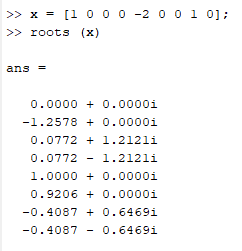
241881
So can anyone tell me how to get the remaining roots or what method I have to use?
 
Last edited by a moderator:
Physics news on Phys.org
GoodEngineering said:
I only knew 3 methods
To solve differential equations ?

Did it occur to you to try solutions of the form ##y = e^{\lambda x}##, one of the more basic methods for solving differential equations ?

##y(x) = 0 ## and ##y(x) = 1## are indeed solutions, in fact any constant will do. ##x_1=0## is meaningless as a solution of the differential equation.
 
##D(D^7-2D^3+1)=0 \implies D=0 or
D^7-2D^3+1=0##
To solve second put ##D^3=t## so that ## t^4-2t+1=0##. Use the Ferrari method to solve this biquadratic equation(Google for the steps). Now what you got is ##D^3##, so, solve it for D by taking complex cube root of the roots you got.
 
Can't follow. ##D^3 =t \Rightarrow D^7 = t^4 ?##

I would divide by ##D-1##, the solution already found.
 
GoodEngineering said:
Hello, few days ago I had a calculus test in which I had to find the general solution for the next differential equation: (D^8 - 2D^4 + D)y = 0.

"D" stands for the differential "Dy/Dx". However I could only find 2 of the roots on the ecuation, x1 = 0 and x2 = 1.

By the time I took the test I only knew 3 methods, the P/Q Descartes Method, factorization & the legendary and well known quadratic formula.
Then when I got home I entered the differential equation on MATLAB & got the next roots

View attachment 241881So can anyone tell me how to get the remaining roots or what method I have to use?

I doubt that any reasonable method of getting actual solutions is possible on an exam or test. However, you could apply Descartes' rule of signs to determine the number of positive and negative real roots of ##D^7 - 2D^3 + 1##: one negative and two positive real roots ##-r_1, r_2, r_3##. Then there must be four complex roots, coming in conmplex-conjugate pairs: ##s_1 \pm i w_1, s_2 \pm i w_2.## That would allow you to write
$$y' = a_1 e^{-r_1 t} + a_2 e^{r_2 t} + a_3 e^{r_3 t}
+ b_1 \cos(w_1 t) e^{s_1 t} \\
\hspace{4em}
+ b_2 \sin(w_1 t) e^{s_1 t} + c_1 \cos(w_2 t) e^{s_2 t} + c_2 \sin(w_2 t) e^{s_2 t},$$
where the ##a_i, b_i , c_i, r_i>0, s_i, w_i > 0## are real constants. Then ##y = k + \int y' \, dt,## where ##k## is another constant.
 
Last edited:
  • Like
Likes Abhishek11235
GoodEngineering said:
Hello, few days ago I had a calculus test in which I had to find the general solution for the next differential equation: (D^8 - 2D^4 + D)y = 0.
Could it be that you are mistaken in what you remember? Asking a student to solve ##y^{(8)} - 2y^{(4)} + y' = 0## on a timed exam is unreasonable, IMO, but asking him or her to solve ##y^{(8)} - 2y^{(4)} + y = 0## is reasonable.

The first equation above has a characteristic equation of ##r^8 - 2r^4 - r = 0##, which can be factored into ##r(r^7 - 2r^3 + 1) = 0##. @Abhishek11235's suggestion in post #3 is no help, as has been pointed out.

The second equation has a characteristic equation of ##r^8 - 2r^4 + 1 = 0##, which can easily be factored into ##(r^4 - 1)^2 = 0## and further to ##(r^2 - 1)^2(r^2 + 1)^2 = 0##, with repeated roots of ##r = \pm 1, r = \pm i##.
 
  • Like
Likes BvU
BvU said:
To solve differential equations ?

Did it occur to you to try solutions of the form ##y = e^{\lambda x}##, one of the more basic methods for solving differential equations ?

##y(x) = 0 ## and ##y(x) = 1## are indeed solutions, in fact any constant will do. ##x_1=0## is meaningless as a solution of the differential equation.
Yes, actually that was the final part on the test, to get the Yc = c1 + c2ex + the remaining products, but as you may know, I need the roots in order to get the whole solution
 

Similar threads

  • · Replies 3 ·
Replies
3
Views
1K
  • · Replies 2 ·
Replies
2
Views
3K
  • · Replies 2 ·
Replies
2
Views
4K
  • · Replies 1 ·
Replies
1
Views
2K
  • · Replies 5 ·
Replies
5
Views
3K
  • · Replies 19 ·
Replies
19
Views
3K
Replies
16
Views
2K
  • · Replies 2 ·
Replies
2
Views
2K
  • · Replies 7 ·
Replies
7
Views
2K
  • · Replies 9 ·
Replies
9
Views
7K