What Type of Cam Does a Four Arc Design Describe?

  • Thread starter Thread starter mechengstudent
  • Start date Start date
  • Tags Tags
    Cam Type
Click For Summary
SUMMARY

The discussion centers on identifying the type of motion for a four arc cam designed for use in SolidWorks. The cam consists of a base circle, a nose arc, and two flank arcs, with each arc tangent to the next. The user seeks clarification on the terminology used in SolidWorks for the cam segments, specifically regarding the rise, dwell, and return intervals. The cam is likely a dwell cam, commonly found in four-cycle gasoline engines, and accurate identification of cam types requires precise measurements and curve fitting rather than visual inspection.

PREREQUISITES
  • Understanding of cam profiles and their applications in mechanical design.
  • Familiarity with SolidWorks cam design tools and terminology.
  • Knowledge of cam motion types, including dwell, constant acceleration, and harmonic motion.
  • Ability to interpret cam diagrams and perform measurements accurately.
NEXT STEPS
  • Research SolidWorks cam design terminology and how to apply it to four arc cams.
  • Learn about cam motion types, focusing on dwell and harmonic motions.
  • Explore resources on cam profile design and analysis techniques, including curve fitting.
  • Study the relationship between cam geometry and engine performance in four-cycle engines.
USEFUL FOR

Mechanical engineers, CAD designers, and students studying mechanical design who are interested in cam profiles and their applications in engine design and simulation.

mechengstudent
Messages
18
Reaction score
0
I am trying to determine what type of cam this is from the various cam diagrams but they don't really help as they all seem very similar. I have a simple four arc cam, so a base circle/arc, a nose circle/arc and an arc on one side tangent to the nose and base arcs, and another of slightly different radius on the other side/flank.

vOiaEtx.png


I am trying to design this in Solidworks but they have a drop down list containing a whole heap of different cams like so:
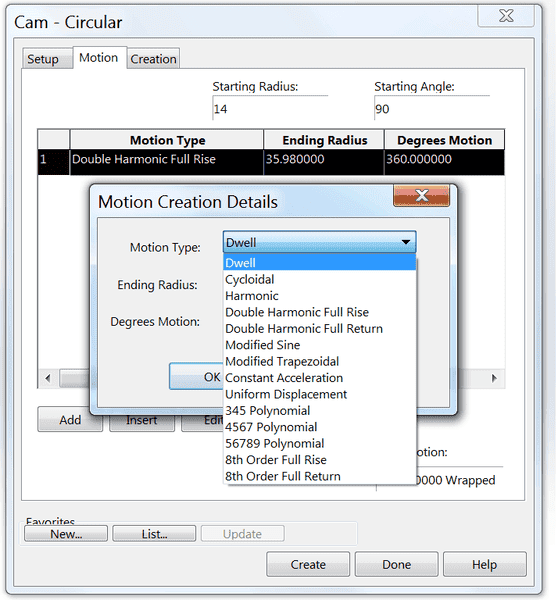
AxFecLE.png


Can someone tell me what type of cam/motion of the cam this is?
 
Engineering news on Phys.org
I believe it is called a dwell cam, with 4 intervals - rise interval, dwell interval, return interval, dwell interval. You would likely see one in a four cycle gasoline engine.
 
  • Like
Likes   Reactions: RogueOne
You will never be able to tell one type of cam from another by simply looking at it. The differences are very slight, the sort of differences that measured in one hundred thousandths of an inch.

You could draw a (visually) close approximation to that cam as a 4 arc cam, but that would never be truly accurate.

Do you know the source of that picture? Modified sine and modified trapezoid are popular cam profiles for industrial machinery, but polynomial cams are almost mandatory in competition IC engines.
 
If I had to choose each segment from the dropdown box, what would I select for the rise, the nose and the return?
 
I think you might want to print this figure out so that you can scale the drawing. The measure the nose radius and the included angle. Also measure the base radius and estimate where the rise begins. From that you can estimate the angular duration of both the rise and the return.

Once you have these "measured values" scaled from the figure, you should plan to iterate your choices until you are satisfied with the appearance of the result. There is no guarantee of an exact fit; you don't know exactly what you are fitting.
 
This is a cam I designed from given data. I know all the measurements but I just don't know how to make it using the Solidworks cam design tool as I don't know what the names are for each section. That's all I need, what each arc section is called as per the names in the dropdown box
 
I know a lot about cams, but nothing about Solidworks, so I suppose I cannot help you.
Do you wish to learn about cams, or about Solidworks?
 
I just want to know what type of motion the cam segments are. The first, base circle is clearly a dwell motion. What is the next called? Is it a constant acceleration, harmonic, double harmonic etc.? And what is the nose? It isn't a dwell or harmonic.
 
I thought I said above, you will never be able to identify the cam type from a picture. If you plot the data from which the picture is developed, and then do some curve fitting, you should be able to tell.
 
  • #10
Draw the follower and guide system as well and then plot the motion over 360 deg rotation .

I'm not sure whether you are analysing a given cam profile or trying to design a new one ?
 
  • #11
As I also said above, I DESIGNED THIS CAM. I have all the measurements, it is a four arc cam, with each arc tangent to the next. That picture is a screenshot of the one I made on the computer. I made it from the information I was given, the rise angle, return angle, nose radius, base radius and lift. What I don't know is what each of those arc segments are called. If it is a four arc cam, with each arc tangent to the next, there should be enough information to determine what type of motion each segment is called. That is all I would like to know.
 
  • #12
Nidum said:
Draw the follower and guide system as well and then plot the motion over 360 deg rotation .

I'm not sure whether you are analysing a given cam profile or trying to design a new one ?

I have designed this one. But I don't know the terms for what type of motion each segment is. I would like to know it so I can recreate it in the program I took a screenshot of above. In the program they don't use the information I was given, like rise angle, return angle, nose size etc. They use terminology like harmonic, constant acceleration etc. to describe the segments.
 
  • #15
Nidum said:
https://www.slideshare.net/rajat_jubilee/chapter-8-29473471

Best read it all but material of immediate interest to you starts p16 .

Yes it is very similar to our lecture slides. Unfortunately I can't tell from my cam what the type of motion each segment is unless I simulate it. And I can't simulate it without knowing what type of motion each segment is. That is why I am asking someone with a bit more knowledge about cams than me what my four arc cam would be. Each arc is a radius of a normal circle and they run tangent to each other.
 
  • #16
I have many resources and textbooks I can look at but nobody seems able to tell me what type of motions my four arc cam would be
 

Similar threads

  • · Replies 18 ·
Replies
18
Views
2K
  • · Replies 9 ·
Replies
9
Views
3K
  • · Replies 6 ·
Replies
6
Views
2K
  • · Replies 1 ·
Replies
1
Views
2K
  • · Replies 1 ·
Replies
1
Views
2K
  • · Replies 48 ·
2
Replies
48
Views
23K
  • · Replies 5 ·
Replies
5
Views
3K
  • · Replies 19 ·
Replies
19
Views
849
  • · Replies 8 ·
Replies
8
Views
7K
  • · Replies 3 ·
Replies
3
Views
7K