baiyang11
- 8
- 0
Convex function and convex set(#1 edited)
Please answer #4, where I put my questions more specific. Thank you very much!
The question is about convex function and convex set. Considering a constrained nonlinear programming (NLP) problem
\[min \quad f({\bf x}) \quad {\bf x}\in \mathbb{R}^{n} \]
\[s.t. \quad g_{i}({\bf x})\leq 0 \quad i=1,2,...,N \]
\[\quad\quad h_{j}({\bf x})=0 \quad j=1,2,...,M \]
Where \(g_{i}({\bf x})\) and \(h_{j}({\bf x})\) is twice continuously differentiable. The feasible region \( S=\{{\bf x}|g_{i}({\bf x}),h_{j}({\bf x}),\forall i,j\}\). It is known that if \(g_{i}({\bf x})\) is convex and \(h_{j}({\bf x})\) is affinely linear for \({\bf x}\in \mathbb{R}^{n}\), \(S\) is a convex set. However, in my problem, \(g_{i}({\bf x})\) and \(h_{j}({\bf x})\) is indefinite for \({\bf x}\in \mathbb{R}^{n}\). So I would like to ask if there is any theory may answer the following two questions:
(1)For any twice continuously differentiable but indefinite function \(g_{i}({\bf x})\), on what condition, \(g_{i}({\bf x})\) is convex in a neighborhood of a point \({\bf x_{0}}\in\mathbb{R}^{n}\) ? (A guess is that Hessian of \(g_{i}\) at \({\bf x_{0}}\) is positive semidefinite. Is that the case?)
View attachment 989
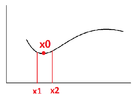
Just like the image above. The function is indefinite for all \(x\), but is locally convex in the neighborhood of \(x_{0}\), which is \((x_{1},x_{2})\).
(2)On what condition, a neighborhood in \(S\) of a feasible point \({\bf x_{0}}\in S\) is a convex set? (I suppose a sufficient condition is that every \(g_{i}({\bf x})\) and \(h_{j}({\bf x})\) is convex in a neighborhood of \({\bf x_{0}}\). But is that necessary?)
View attachment 990
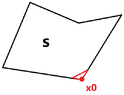
Just like the image above. The set \(S\) is not convex, but is locally convex in the neighborhood of \({\bf x_{0}}\) (the red triangle set).
Please answer #4, where I put my questions more specific. Thank you very much!
The question is about convex function and convex set. Considering a constrained nonlinear programming (NLP) problem
\[min \quad f({\bf x}) \quad {\bf x}\in \mathbb{R}^{n} \]
\[s.t. \quad g_{i}({\bf x})\leq 0 \quad i=1,2,...,N \]
\[\quad\quad h_{j}({\bf x})=0 \quad j=1,2,...,M \]
Where \(g_{i}({\bf x})\) and \(h_{j}({\bf x})\) is twice continuously differentiable. The feasible region \( S=\{{\bf x}|g_{i}({\bf x}),h_{j}({\bf x}),\forall i,j\}\). It is known that if \(g_{i}({\bf x})\) is convex and \(h_{j}({\bf x})\) is affinely linear for \({\bf x}\in \mathbb{R}^{n}\), \(S\) is a convex set. However, in my problem, \(g_{i}({\bf x})\) and \(h_{j}({\bf x})\) is indefinite for \({\bf x}\in \mathbb{R}^{n}\). So I would like to ask if there is any theory may answer the following two questions:
(1)For any twice continuously differentiable but indefinite function \(g_{i}({\bf x})\), on what condition, \(g_{i}({\bf x})\) is convex in a neighborhood of a point \({\bf x_{0}}\in\mathbb{R}^{n}\) ? (A guess is that Hessian of \(g_{i}\) at \({\bf x_{0}}\) is positive semidefinite. Is that the case?)
View attachment 989
Just like the image above. The function is indefinite for all \(x\), but is locally convex in the neighborhood of \(x_{0}\), which is \((x_{1},x_{2})\).
(2)On what condition, a neighborhood in \(S\) of a feasible point \({\bf x_{0}}\in S\) is a convex set? (I suppose a sufficient condition is that every \(g_{i}({\bf x})\) and \(h_{j}({\bf x})\) is convex in a neighborhood of \({\bf x_{0}}\). But is that necessary?)
View attachment 990
Just like the image above. The set \(S\) is not convex, but is locally convex in the neighborhood of \({\bf x_{0}}\) (the red triangle set).
Attachments
Last edited: